Raja Veena, Gu Ying, Lee Hsi-Ming, Deng Jie, Prestwich Glenn, Ryan Maria
Department of Oral Biology and Pathology, Stony Brook School of Dental Medicine, Stony Brook, NY, USA.
Department of General Dentistry, Stony Brook School of Dental Medicine, Stony Brook, NY, USA.
J Exp Pharmacol. 2022 Mar 30;14:117-129. doi: 10.2147/JEP.S353757. eCollection 2022.
To determine the effect of a semi-synthetic-glycosaminoglycan Ether (SAGE) as a universal therapeutic benefit to reduce periodontal inflammation and alveolar bone loss in naturally occurring-beagle-dog model of periodontal disease as a surrogate for human non-risk associated natural periodontitis.
Six adult female dogs with generalized periodontitis were distributed into two groups: control and SAGE treatment (n=3/group). After a 1-hour full-mouth scaling and root planning (SRP) at baseline, control or SAGE treatment (50mg/mL) bioadhesive gel formulation was locally applied for 12 weeks. Various clinical periodontal measurements (probing depth, CAL) were measured at different time periods (baseline, 4, 8 and 12 weeks), and gingival crevicular fluid (GCF), blood samples and gingival tissue biopsies (12 week) were analyzed for inflammatory mediators, collagenases and cell-signaling molecules. Standardized radiographs were taken at baseline and 12week period.
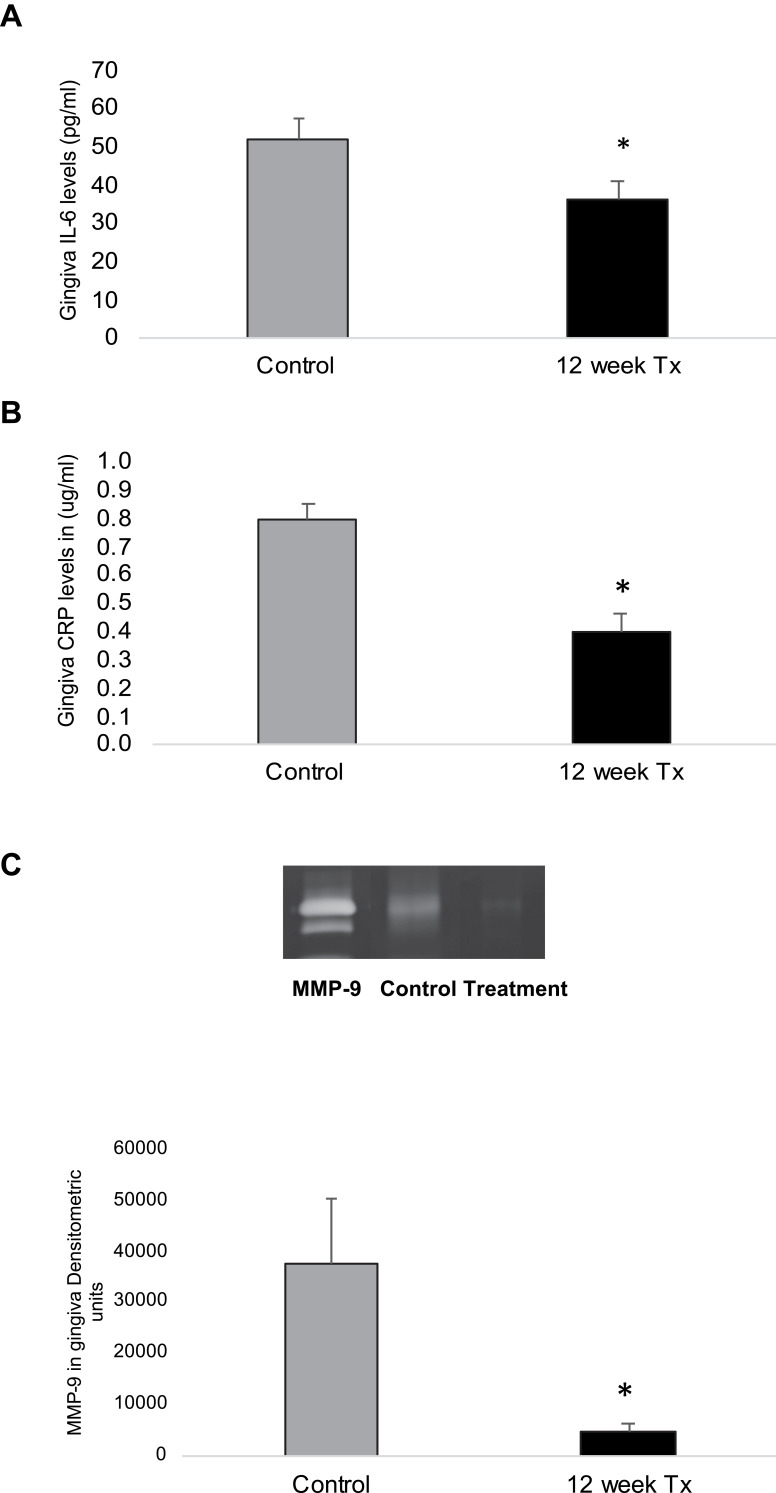
SAGE treatment significantly reduced gingival inflammation (GCF flow), pocket depth (PD), and clinical attachment loss (CAL) compared to control. SAGE also considerably reduced alveolar bone loss and reduced MMP-9, IL-6, CRP levels in gingival tissue, GCF and plasma. Cell-signaling molecules in the inflammatory cascade system TLR-2, TLR-4, p38 MAPK, ERK1/2 and NF-kB responded to SAGE in a pattern consistent with reductions at the active phase of the inflammatory process and collagenolysis.
In the beagle dog model of periodontitis, local SAGE administration significantly attenuated clinical measures of periodontitis, pro-inflammatory cytokines, MMPs, and signal transduction molecules. All our studies, using in vitro and in vivo models, support the therapeutic potential of SAGE as an innovative adjunct to SRP in the treatment of chronic periodontal disease.
在自然发生的比格犬牙周病模型中,确定一种半合成糖胺聚糖醚(SAGE)作为一种通用治疗手段,对减轻牙周炎症和牙槽骨丧失的效果,该模型可作为人类非风险相关自然牙周炎的替代模型。
将6只患有广泛性牙周炎的成年雌性犬分为两组:对照组和SAGE治疗组(每组n = 3)。在基线时进行1小时的全口洁治和根面平整(SRP)后,局部应用对照或SAGE治疗(50mg/mL)生物粘附凝胶制剂,持续12周。在不同时间段(基线、4周、8周和12周)测量各种临床牙周指标(探诊深度、临床附着丧失),并分析龈沟液(GCF)、血液样本和牙龈组织活检样本(12周时)中的炎症介质、胶原酶和细胞信号分子。在基线和12周时拍摄标准化X线片。
与对照组相比,SAGE治疗显著减轻了牙龈炎症(GCF流量)、牙周袋深度(PD)和临床附着丧失(CAL)。SAGE还显著减少了牙槽骨丧失,并降低了牙龈组织、GCF和血浆中MMP-9、IL-6、CRP的水平。炎症级联系统中的细胞信号分子TLR-2、TLR-4、p38 MAPK、ERK1/2和NF-κB对SAGE的反应模式与炎症过程和胶原溶解活跃期的减轻一致。
在比格犬牙周炎模型中,局部应用SAGE显著减轻了牙周炎的临床指标、促炎细胞因子、MMPs和信号转导分子。我们所有使用体外和体内模型的研究都支持SAGE作为SRP治疗慢性牙周病的创新辅助手段的治疗潜力。