Department of Public Health and Primary Care Campus-Den Haag, Leiden University Medical Center, Leiden, The Netherlands.
Department of Biomedical Data Sciences, Leiden University Medical Center, Leiden, The Netherlands.
PLoS One. 2022 Apr 7;17(4):e0266473. doi: 10.1371/journal.pone.0266473. eCollection 2022.
Approximately 2% of patients in primary care practice and up to 25% of hospital patients are registered as being allergic to an antibiotic. However, up to 90% of these registrations are incorrect, leading to unnecessary prescription of 2nd choice antibiotics with the attendant loss of efficacy, increased toxicity and antibiotic resistance. To improve registration, a better understanding is needed of how incorrect labels are attributed.
To investigate the quality of antibiotic allergy registration in primary care and identify determinants to improve registration of antibiotic allergies.
Registration of antibiotic allergies in primary care practices were analysed for 1) completeness and 2) correctness. To identify determinants for improvement, semi-structured interviews with healthcare providers from four healthcare domains were conducted.
A total of 300 antibiotic allergy registrations were analysed for completeness and correctness. Thirty-four healthcare providers were interviewed.
A registration was defined as complete when it included a description of all symptoms, time to onset of symptoms and the duration of symptoms. It was defined as correct when the conclusion was concordant with the Salden criteria. Determinants of correct antibiotic allergy registrations were divided into facilitators or obstructers.
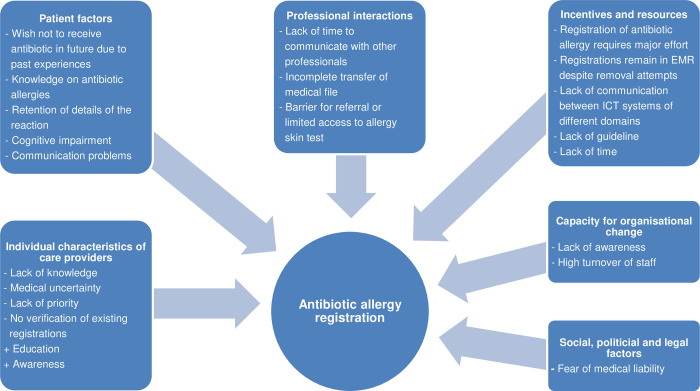
Rates of completeness and correctness of registrations were 0% and 29.3%, respectively. The main perceived barriers for correct antibiotic allergy registration were insufficient knowledge, lack of priority, limitations of registration features in electronic medical records (EMR), fear of medical liability and patients interpreting side-effects as allergies.
The quality of antibiotic allergy registrations can be improved. Potential interventions include raising awareness of the consequences of incomplete and the importance of correct registrations, by continued education, and above all simplifying registration in an EMR by adequate ICT support.
在初级保健实践中,约有 2%的患者和多达 25%的住院患者被登记为对一种抗生素过敏。然而,多达 90%的这些登记是不正确的,导致不必要地开第二种选择的抗生素,从而降低疗效、增加毒性和抗生素耐药性。为了改善登记,需要更好地了解不正确标签是如何归因的。
调查初级保健中抗生素过敏登记的质量,并确定改善抗生素过敏登记的决定因素。
分析了初级保健实践中抗生素过敏登记的 1)完整性和 2)正确性。为了确定改善的决定因素,对来自四个医疗保健领域的医疗保健提供者进行了半结构化访谈。
共分析了 300 例抗生素过敏登记的完整性和正确性。对 34 名医疗保健提供者进行了访谈。
当登记包括所有症状的描述、症状开始时间和症状持续时间时,定义为完整。当结论与 Salden 标准一致时,定义为正确。正确的抗生素过敏登记的决定因素分为促进因素或阻碍因素。
登记的完整性和正确性的发生率分别为 0%和 29.3%。正确登记抗生素过敏的主要障碍是知识不足、缺乏优先级、电子病历(EMR)中登记功能的限制、对医疗责任的恐惧和患者将副作用解释为过敏。
抗生素过敏登记的质量可以得到改善。潜在的干预措施包括通过继续教育提高对不完整和正确登记的后果的认识,最重要的是通过适当的 ICT 支持简化 EMR 中的登记。