Blake A D, Strader C D
Biochem J. 1986 May 15;236(1):227-34. doi: 10.1042/bj2360227.
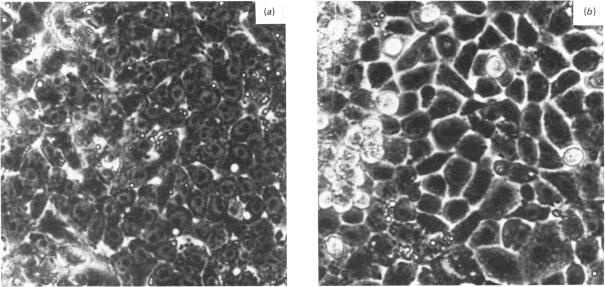
The effects of tumour-promoting phorbol esters on the receptor-mediated endocytosis of insulin were investigated in the human hepatoma cell line HepG2. Treatment of these cells with the biologically active phorbol 12-O-tetradecanoylphorbol 13-acetate (TPA), but not with the non-tumour-promoting analogue 4 alpha-phorbol 12,13-didecanoate, resulted in dramatic morphological changes, which were accompanied by a 1.5-2.5-fold increase in specific 125I-insulin association with the cells at 37 degrees C. This increase in insulin binding was not observed when the binding reaction was performed at 4 degrees C. The potentiation of 125I-insulin association with TPA-treated cells at 37 degrees C could be completely accounted for by an increase in the intracellular pool of internalized insulin; there was no concomitant increase in cell-surface insulin binding. Dissociation studies showed that the enhanced internalization of insulin by cells after treatment with TPA resulted from a decrease in the rate of intracellular processing of the insulin after receptor-mediated endocytosis. The phorbol-ester-induced enhancement of internalized insulin in HepG2 cells was additive with the potentiation of endocytosed insulin induced by both the lysosomotropic reagent chloroquine and the ionophore monensin; this indicates that TPA affects the intracellular processing of the insulin receptor at a point other than those disrupted by either of these two reagents. The potentiation of insulin receptor internalization by tumour-promoting phorbol esters could be completely mimicked by treatment with phospholipase C, but not with phospholipase A, and partially mimicked by treatment with the synthetic diacylglycerol 1-oleoyl-2-acetylglycerol. By these criteria, the effects of phorbol esters on the insulin receptor in HepG2 cells appear to be mediated through protein kinase C. These results support the concept that the activation of protein kinase C by treatment with phorbol esters causes a perturbation of the insulin-receptor-mediated endocytotic pathway in HepG2 cells, reflected in a long-term decreased rate of dissociation of internalized insulin by the phorbol-ester-treated cells.
在人肝癌细胞系HepG2中研究了促肿瘤佛波酯对胰岛素受体介导的内吞作用的影响。用具有生物活性的佛波醇12 - O -十四烷酰佛波醇13 - 乙酸酯(TPA)处理这些细胞,而非用无促肿瘤作用的类似物4α -佛波醇12,13 - 十二烷酸酯处理,会导致显著的形态学变化,同时在37℃时与细胞特异性结合的125I -胰岛素增加了1.5 - 2.5倍。当结合反应在4℃进行时,未观察到胰岛素结合的这种增加。在37℃时,TPA处理的细胞与125I -胰岛素结合的增强完全可归因于内化胰岛素细胞内池的增加;细胞表面胰岛素结合没有相应增加。解离研究表明,TPA处理后细胞对胰岛素内化的增强是由于受体介导的内吞作用后胰岛素细胞内加工速率降低所致。佛波酯诱导的HepG2细胞内化胰岛素的增强与溶酶体促渗剂氯喹和离子载体莫能菌素诱导的内吞胰岛素的增强具有相加性;这表明TPA在不同于这两种试剂所破坏的位点影响胰岛素受体的细胞内加工。促肿瘤佛波酯对胰岛素受体内化的增强作用可通过用磷脂酶C处理完全模拟,但不能用磷脂酶A模拟,且可被合成二酰基甘油1 -油酰基 - 2 -乙酰甘油部分模拟。根据这些标准,佛波酯对HepG2细胞胰岛素受体的作用似乎是通过蛋白激酶C介导的。这些结果支持这样的概念,即通过佛波酯处理激活蛋白激酶C会导致HepG2细胞中胰岛素受体介导的内吞途径受到干扰,表现为佛波酯处理的细胞内化胰岛素解离速率长期降低。