Department of Pathology, Konkuk University Medical Center, Konkuk University School of Medicine, Seoul, Republic of Korea.
Yonsei University Wonju College of Medicine, Wonju, Republic of Korea.
Sci Rep. 2022 Apr 7;12(1):5889. doi: 10.1038/s41598-022-09840-3.
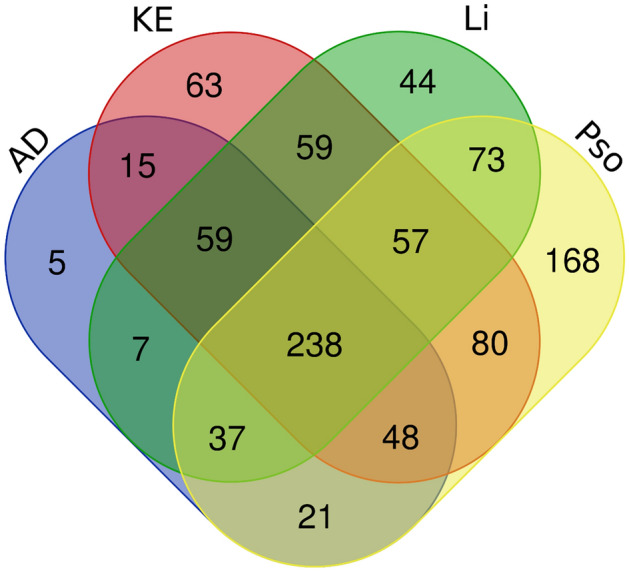
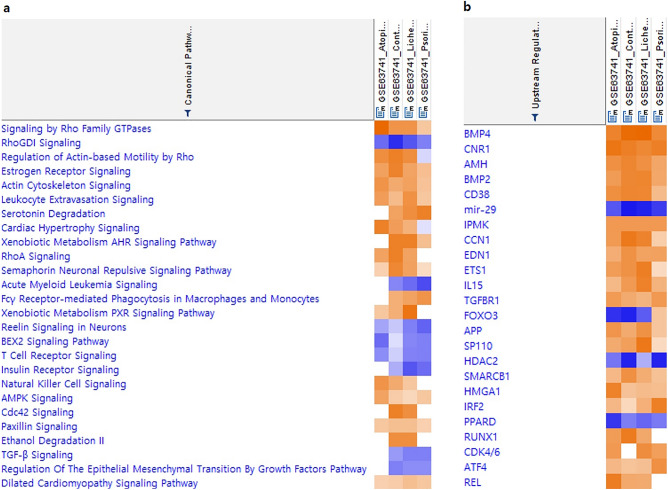
Selection of appropriate biomarker to identify inflammatory skin diseases is complicated by the involvement of thousands of differentially expressed genes (DEGs) across multiple cell types and organs. This study aimed to identify combinatorial biomarkers in inflammatory skin diseases. From one gene expression microarray profiling dataset, we performed bioinformatic analyses on dataset from lesional skin biopsies of patients with inflammatory skin diseases (atopic dermatitis [AD], contact eczema [KE], lichen planus [Li], psoriasis vulgaris [Pso]) and healthy controls to identify the involved pathways, predict upstream regulators, and potential measurable extracellular biomarkers. Overall, 434, 629, 581, and 738 DEGs were mapped in AD, KE, Li, and Pso, respectively; 238 identified DEGs were shared among four different inflammatory skin diseases. Bioinformatic analysis on four inflammatory skin diseases showed significant activation of pathways with known pathogenic relevance. Common upstream regulators, with upregulated predicted activity, identified were CNR1 and BMP4. We found the following common serum biomarkers: ACR, APOE, ASIP, CRISP1, DKK1, IL12B, IL9, MANF, MDK, NRTN, PCSK5, and VEGFC. Considerable differences of gene expression changes, involved pathways, upstream regulators, and biomarkers were found in different inflammatory skin diseases. Integrated bioinformatic analysis identified 12 potential common biomarkers of inflammatory skin diseases requiring further evaluation.
选择合适的生物标志物来识别炎症性皮肤病是复杂的,因为涉及到数千个在多种细胞类型和器官中差异表达的基因(DEGs)。本研究旨在鉴定炎症性皮肤病的组合生物标志物。从一个基因表达微阵列分析数据集,我们对炎症性皮肤病(特应性皮炎[AD]、接触性皮炎[KE]、扁平苔藓[Li]、寻常型银屑病[Pso])患者的病变皮肤活检的数据集进行了生物信息学分析,以识别涉及的途径、预测上游调节剂和潜在可测量的细胞外生物标志物。总体而言,AD、KE、Li 和 Pso 分别有 434、629、581 和 738 个 DEGs 被映射;在四种不同的炎症性皮肤病中有 238 个确定的 DEGs 是共有的。对四种炎症性皮肤病的生物信息学分析显示,具有已知发病相关性的途径被显著激活。确定上调的共同上游调节剂为 CNR1 和 BMP4。我们发现以下常见的血清生物标志物:ACR、APOE、ASIP、CRISP1、DKK1、IL12B、IL9、MANF、MDK、NRTN、PCSK5 和 VEGFC。不同的炎症性皮肤病之间存在显著的基因表达变化、涉及的途径、上游调节剂和生物标志物的差异。综合生物信息学分析确定了 12 个炎症性皮肤病的潜在共同生物标志物,需要进一步评估。