Department of Psychology, University of Bern, Bern, Switzerland.
Faculty of Psychology, UniDistance Suisse, Brig, Switzerland.
Psychophysiology. 2022 Oct;59(10):e14069. doi: 10.1111/psyp.14069. Epub 2022 Apr 8.
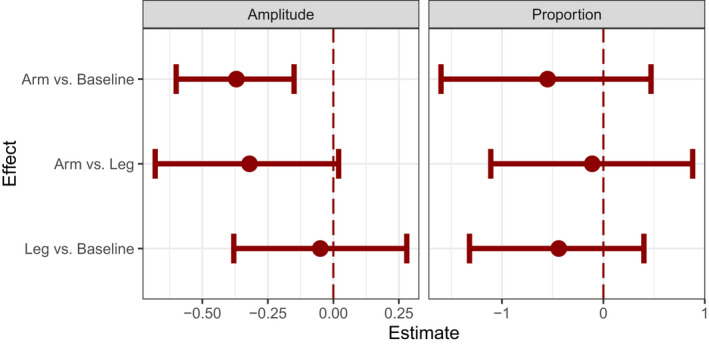
Mental imagery is a powerful capability that engages similar neurophysiological processes that underlie real sensory and motor experiences. Previous studies show that motor cortical excitability can increase during mental imagery of actions. In this study, we focused on possible inhibitory effects of mental imagery on motor functions. We assessed whether imagined arm paralysis modulates motor cortical excitability in healthy participants, as measured by motor evoked potentials (MEPs) of the hand induced by near-threshold transcranial magnetic stimulation (TMS) over the primary motor cortex hand area. We found lower MEP amplitudes during imagined arm paralysis when compared to imagined leg paralysis or baseline stimulation without paralysis imagery. These results show that purely imagined bodily constraints can selectively inhibit basic motor corticospinal functions. The results are discussed in the context of motoric embodiment/disembodiment.
心理意象是一种强大的能力,它涉及到与真实感觉和运动体验相关的类似神经生理过程。先前的研究表明,在进行动作的心理意象时,运动皮质兴奋性会增加。在这项研究中,我们专注于心理意象对运动功能的可能抑制作用。我们评估了健康参与者在想象手臂瘫痪时,通过经颅磁刺激(TMS)在手运动皮质区域施加近阈值刺激引起的手部运动诱发电位(MEP),是否会调节运动皮质兴奋性。与想象腿部瘫痪或没有瘫痪想象的基线刺激相比,我们发现想象手臂瘫痪时 MEP 振幅较低。这些结果表明,纯粹的想象身体限制可以选择性地抑制基本的运动皮质脊髓功能。该结果在运动体现/去体现的背景下进行了讨论。