Wilmer Eye Institute, Johns Hopkins University School of Medicine, Baltimore, Maryland.
Johns Hopkins Disability Health Research Center, Baltimore, Maryland.
JAMA Netw Open. 2022 Apr 1;5(4):e226555. doi: 10.1001/jamanetworkopen.2022.6555.
People with disabilities experience disparities in health care access and outcomes, and inaccessible health care facilities are major barriers to health care access. Methods to collect accessibility request information are needed to improve health care outcomes for patients with disabilities.
To evaluate an electronic health record (EHR)-based questionnaire designed to identify accessibility requests for patients with disabilities at an eye clinic.
DESIGN, SETTING, AND PARTICIPANTS: This cross-sectional pilot study implemented an EHR questionnaire and prospectively collected data on accessibility requests at a university-based eye clinic. The study included 55 722 patients making appointments at the Johns Hopkins Wilmer Eye Institute from April 1, 2019, to March 31, 2020.
The Wilmer Eye Institute staff were trained to assess accessibility requests of patients making appointments in-person or via telephone using a standardized script and entering patient responses into the EHR. Data were later extracted for analysis and used to determine the proportion of patients making eye appointments who reported a disability accessibility request (physical, sensory, or intellectual) during their clinic visit.
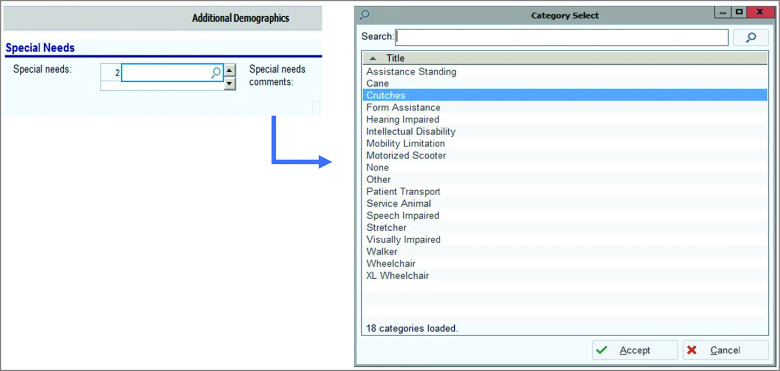
Accessibility request data were collected from 250 932 patient encounters. Patients had a mean (SD) age of 61.9 (20.6) years; most were women (146 846 [58.5%]) and were White individuals (162 720 [64.9%]). Of these, 23 510 (9.4%) encounters were associated with an accessibility request. The most reported accessibility request was mobility related (18 857 [7.5%]) (needing a cane, crutches, motorized scooter, walker, wheelchair, stretcher, assistance standing, or transport services), followed by sensory-related (2988 [1.2%]) (visual, hearing, or speech impairment), intellectual (353 [0.1%]), and other (1312 [0.5%]) (assistance with filling forms or service animal) requests. Patients with an accessibility request compared with those without, were older (72.6 vs 60.8 years), less likely to be White individuals (59.7% vs 65.4%), and more likely to be women (62.6% vs 58.1%), receiving Medicare (69.6% vs 41.5%), and have vision impairment (41.3% vs 13.6%) (P < .001 for all).
In this cross-sectional study, a substantial proportion of patients making eye appointments reported having accessibility requests as captured using a new EHR-based questionnaire. Such standardization of data collection for disability-related accessibility requests in EHR is scalable, could be expanded to other clinical settings, and has the potential to improve accessibility of health care interactions for patients with disabilities.
残疾人在获得医疗保健方面存在差异,而无法获得医疗保健设施是获得医疗保健的主要障碍。需要收集可及性请求信息的方法来改善残疾患者的医疗保健结果。
评估一种基于电子健康记录 (EHR) 的问卷,旨在确定眼科诊所中残疾患者的可及性请求。
设计、地点和参与者:这是一项在大学眼科诊所实施的基于 EHR 的问卷调查的横断面试点研究,前瞻性地收集了可及性请求数据。该研究纳入了 2019 年 4 月 1 日至 2020 年 3 月 31 日期间在约翰霍普金斯威尔默眼科研究所预约的 55722 名患者。
威尔默眼科研究所的工作人员接受了培训,以使用标准化脚本评估亲自或通过电话预约的患者的可及性请求,并将患者的回答输入 EHR。后来提取数据进行分析,以确定报告在就诊期间有残疾可及性请求(身体、感官或智力)的预约眼科患者的比例。
从 250932 次患者就诊中收集了可及性请求数据。患者的平均(标准差)年龄为 61.9(20.6)岁;大多数是女性(146846 [58.5%])和白人(162720 [64.9%])。其中,23510 次就诊与可及性请求有关。报告最多的可及性请求与行动能力有关(18857 [7.5%])(需要拐杖、拐杖、机动滑板车、助行器、轮椅、担架、协助站立或运输服务),其次是感官相关(2988 [1.2%])(视力、听力或言语障碍),智力(353 [0.1%])和其他(1312 [0.5%])(协助填写表格或服务性动物)请求。与没有可及性请求的患者相比,有可及性请求的患者年龄更大(72.6 岁比 60.8 岁),白人的比例更低(59.7%比 65.4%),女性的比例更高(62.6%比 58.1%),更多的人获得医疗保险(69.6%比 41.5%),并且有视力障碍(41.3%比 13.6%)(所有 P<0.001)。
在这项横断面研究中,相当一部分预约眼科就诊的患者报告了使用新的基于 EHR 的问卷获得了可及性请求。这种对 EHR 中与残疾相关的可及性请求数据的标准化收集是可扩展的,可以扩展到其他临床环境,并有可能改善残疾患者的医疗保健互动的可及性。