Centre for Infectious Disease Control (CIb), National Institute for Public Health and the Environment (RIVM), P.O. Box 1, 3720 BA, Bilthoven, The Netherlands.
Department of Medical Microbiology, Amsterdam University Medical Centers, Amsterdam, The Netherlands.
Antimicrob Resist Infect Control. 2022 Apr 9;11(1):57. doi: 10.1186/s13756-022-01097-9.
The Netherlands is currently considered a low endemic country for carbapenem-resistant Enterobacterales (CRE) and carbapenemase-producing Enterobacterales (CPE), experiencing only sporadic hospital outbreaks. This study aims to describe susceptibility to carbapenems and the epidemiology of carbapenemase production in Enterobacterales in the Netherlands in 2017-2019.
Three complementary nationwide surveillance systems are in place to monitor carbapenem susceptibility in the Netherlands. Routine antimicrobial susceptibility test results from medical microbiology laboratories were used to study phenotypic susceptibility of Escherichia coli and Klebsiella pneumoniae. Pathogen surveillance (of all Enterobacterales species) and mandatory notifications were used to describe the characteristics of CPE positive isolates and affected persons.
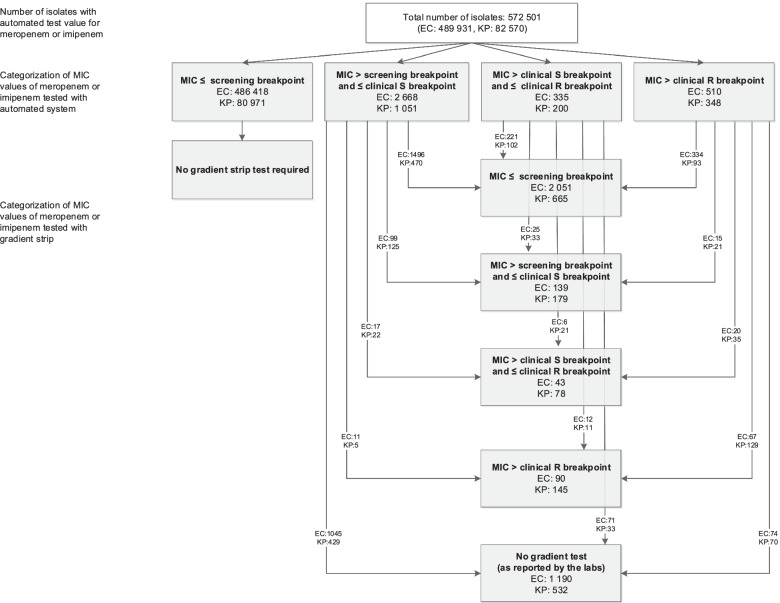
The prevalence of isolates with gradient strip test-confirmed elevated meropenem (> 0.25 mg/L) or imipenem (> 1 mg/L) minimum inhibitory concentration (MIC) in the Netherlands was very low in 2017-2019, with percentages of 0.06% in E. coli and 0.49% in K. pneumoniae, and carbapenem resistances of 0.02% and 0.18%, respectively. A total of 895 unique species/carbapenemase-encoding allele combinations of CPE from 764 persons were submitted between 2017 and 2019, with the annual number of submissions increasing slightly each year. Epidemiological data was available for 660 persons. Screening because of presumed colonisation risk was the reason for sampling in 70.0% (462/660) of persons. Hospitalization abroad was the most common risk factor, being identified in 45.9% of persons.
Carbapenem resistance of E. coli and K. pneumoniae remains low in the Netherlands. The annual number of CPE isolates slightly increased during the period 2017-2019. Recent hospitalization abroad is the main risk factor for acquisition of CPE.
荷兰目前被认为是碳青霉烯类耐药肠杆菌科(CRE)和产碳青霉烯酶肠杆菌科(CPE)的低流行国家,仅偶尔发生医院暴发。本研究旨在描述 2017-2019 年荷兰肠杆菌科对碳青霉烯类药物的敏感性和产碳青霉烯酶的流行病学。
有三个互补的全国性监测系统用于监测荷兰的碳青霉烯类药物敏感性。使用来自医学微生物学实验室的常规抗菌药物敏感性试验结果来研究大肠杆菌和肺炎克雷伯菌的表型敏感性。病原体监测(所有肠杆菌科物种)和强制性报告用于描述 CPE 阳性分离株和感染者的特征。
2017-2019 年,荷兰梯度条试验证实美罗培南(>0.25mg/L)或亚胺培南(>1mg/L)最低抑菌浓度(MIC)升高的分离株的流行率非常低,大肠杆菌和肺炎克雷伯菌的百分比分别为 0.06%和 0.49%,碳青霉烯类耐药率分别为 0.02%和 0.18%。2017 年至 2019 年间,共提交了 764 人 895 种独特的 CPE 种/碳青霉烯酶编码等位基因组合,每年提交的数量略有增加。660 人可获得流行病学数据。由于推定的定植风险进行筛查是 660 人中 70.0%(462/660)采样的原因。国外住院是最常见的危险因素,在 45.9%的人中发现。
荷兰大肠杆菌和肺炎克雷伯菌的碳青霉烯类耐药率仍然较低。2017-2019 年期间,CPE 分离株的年数量略有增加。近期国外住院是获得 CPE 的主要危险因素。