Chatterjee Seshadri Sekhar, Bhattacharyya Ranjan, Chakraborty Amrita, Lahiri Arista, Dasgupta Abhijit
Department of Psychiatry, Diamond Harbour Government Medical College and Hospital, Diamond Harbour, India.
Department of Psychiatry, Murshidabad Medical College and Hospital, Berhampore, India.
Front Psychiatry. 2022 Mar 24;13:791001. doi: 10.3389/fpsyt.2022.791001. eCollection 2022.
Sexual dysfunction (SD) and its effect on our life is an important but less studied topic especially during post-COVID era. This study examines the extent of SD and other mental health predictors and their effect on quality of life.
A cross-sectional survey of sexually active adults was conducted in an Indian metro-city. Along with sociodemographic data, sexual dysfunction, depression, anxiety, stress, and quality of life were assessed by Arizona Sexual Experience Scale (ASEX), Depression Anxiety and Stress Scale (DASS), and WHOQOL-BREF, respectively. Structural equations modeling was used to understand their relationship.
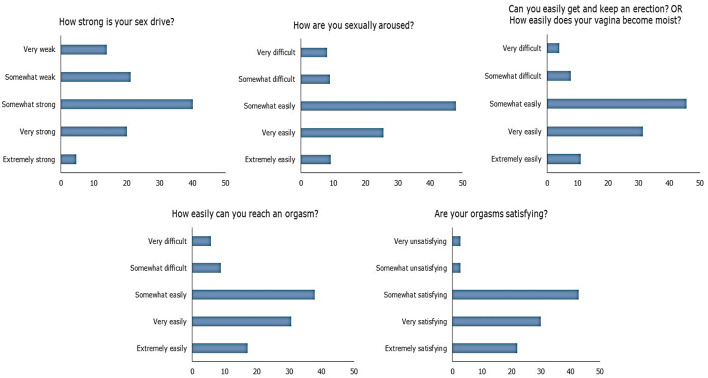
Out of the total 1,376 respondents, 80.52% were male, 65.98% were married, and 48.54% were graduates. The mean age of the participants was 34.42 (±9.34) years. Of the participants, 27.18% had sexual dysfunction. Majority of the respondents did not have depression (59.30%), anxiety (52.33%), or stress (44.48%). Mild and moderate levels were the commonest findings among those who had depression, anxiety, or stress. Among the respondents, 27.18% had sexual dysfunction as per the ASEX instrument. Increase in age and female gender were associated with sexual dysfunction overall and also all its components. Presence of depression adversely affected ease of achieving orgasm and satisfaction from orgasm and was associated with sexual dysfunction overall. The respondents had a mean score of 73.57 (±13.50) as per the WHO-QOL. Depression and stress emerged as statistically significant factors for poor quality of life, while sexual dysfunction was not associated statistically.
More than one-fourth of the study population reported sexual dysfunction during the first wave of the pandemic in India. The study findings highlight the role of poor mental health issues in this regard. In fact, issues like depression and stress were associated with poor quality of life as well. The current findings unequivocally warrant specific interventions to improve mental health of the respondents.
性功能障碍(SD)及其对我们生活的影响是一个重要但研究较少的课题,尤其是在新冠疫情后的时代。本研究调查了性功能障碍的程度以及其他心理健康预测因素及其对生活质量的影响。
在印度一座大城市对性活跃成年人进行了横断面调查。除社会人口统计学数据外,分别通过亚利桑那性体验量表(ASEX)、抑郁焦虑压力量表(DASS)和世界卫生组织生活质量简表(WHOQOL - BREF)评估性功能障碍、抑郁、焦虑、压力和生活质量。采用结构方程模型来理解它们之间的关系。
在总共1376名受访者中,80.52%为男性,65.98%已婚,48.54%为毕业生。参与者的平均年龄为34.42(±9.34)岁。其中,27.18%有性功能障碍。大多数受访者没有抑郁(59.30%)、焦虑(52.33%)或压力(44.48%)。在有抑郁、焦虑或压力的人群中,轻度和中度水平最为常见。根据ASEX工具,受访者中有27.18%有性功能障碍。年龄增长和女性性别总体上与性功能障碍及其所有组成部分都有关联。抑郁的存在对达到性高潮的难易程度和性高潮满意度有不利影响,并且总体上与性功能障碍有关。根据世界卫生组织生活质量量表,受访者的平均得分为73.57(±13.50)。抑郁和压力是生活质量差的统计学显著因素,而性功能障碍在统计学上没有关联。
在印度疫情第一波期间,超过四分之一的研究人群报告有性功能障碍。研究结果突出了心理健康问题在这方面的作用。事实上,抑郁和压力等问题也与生活质量差有关。当前的研究结果明确需要采取具体干预措施来改善受访者的心理健康。