Sholklapper Tamir N, Creswell Michael L, Payne Alexandra T, Markel Michael, Pepin Abigail, Carrasquilla Michael, Zwart Alan, Danner Malika, Ayoob Marilyn, Yung Thomas, Collins Brian, Kumar Deepak, Aghdam Nima, Suy Simeng, Hankins Ryan A, Kowalczyk Keith, Collins Sean P
Georgetown University School of Medicine, Washington, DC, United States.
Department of Radiation Medicine, Georgetown University Hospital, Washington, DC, United States.
Front Oncol. 2022 Mar 25;12:852844. doi: 10.3389/fonc.2022.852844. eCollection 2022.
In patients with localized prostate cancer, 5-fraction, stereotactic body radiation therapy (SBRT) has been found to offer comparable oncologic outcomes and potential for improved treatment compliance compared to conventional, 40-plus fraction radiation therapy (RT). Recent studies of oncologic patient experiences have highlighted both the impact of therapy-associated financial toxicity (FT) on treatment adherence and health-related quality of life (HRQOL).
A cross-sectional assessment of FT after SBRT was performed using the 12-item COST questionnaire. The total questionnaire score (range 0-44) was used to evaluate the FT grade (0-3), with a higher COST value representing lower grade. The patient zip code was used to approximate the distance from the index hospital. Univariate and multivariate analyses of the average COST score (0-4) are performed.
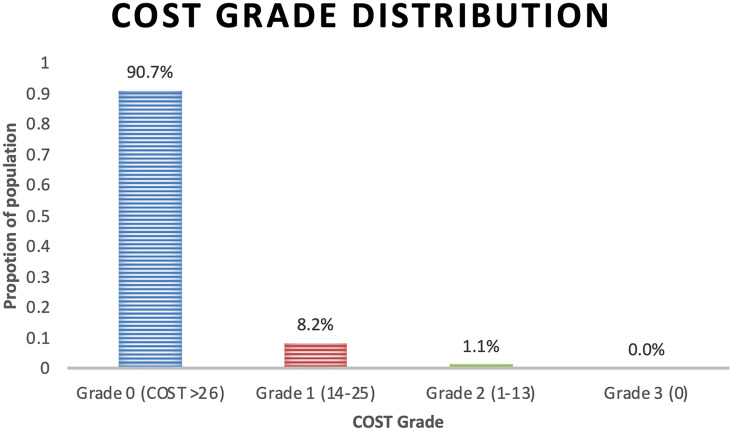
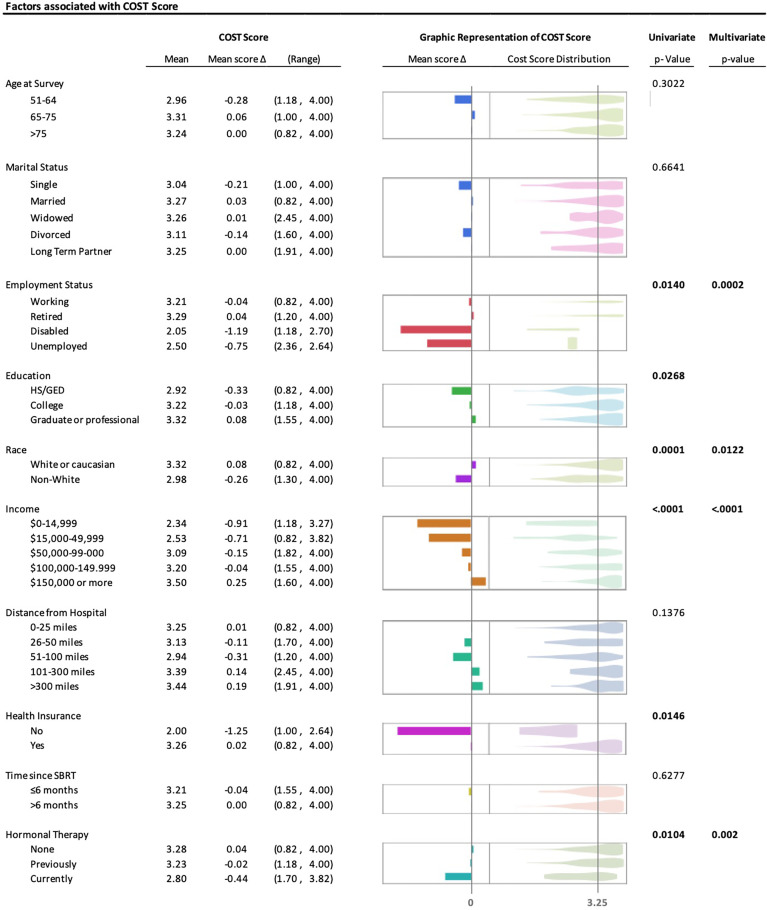
The response rate was 57.5% (332 of 575 consented patients) with 90.7%, 8.2%, and 1.1% experiencing grade 0, 1, and 2 FT, respectively, with no grade 3. Unemployment or disability, non-white race, low income, and concurrent hormonal therapy were associated with a statistically significant worse FT (lower COST value) on univariate and multivariate analyses (p < 0.05). Education level and insurance status significant were evaluated on univariate analysis only. There was a non-statistically significant difference in age, marital status, time since treatment, and distance from the index hospital.
SBRT was associated with low FT. However, statistically significant socioeconomic disparities in FT remain despite ultra-hypofractionated treatment.
在局限性前列腺癌患者中,与传统的40多次分割放疗(RT)相比,已发现5次分割的立体定向体部放疗(SBRT)具有相当的肿瘤学疗效,且有可能提高治疗依从性。近期对肿瘤患者经历的研究强调了治疗相关经济毒性(FT)对治疗依从性和健康相关生活质量(HRQOL)的影响。
使用12项COST问卷对SBRT后的FT进行横断面评估。问卷总分(范围0 - 44)用于评估FT分级(0 - 3),COST值越高表示分级越低。患者邮政编码用于估算与索引医院的距离。对平均COST评分(0 - 4)进行单因素和多因素分析。
应答率为57.5%(575名同意参与的患者中有332名),分别有90.7%、8.2%和1.1%的患者经历0级、1级和2级FT,无3级。单因素和多因素分析显示,失业或残疾、非白人种族、低收入以及同时进行激素治疗与统计学上显著更差的FT(较低的COST值)相关(p < 0.05)。仅在单因素分析中评估了教育水平和保险状况的显著性。在年龄、婚姻状况、治疗后时间以及与索引医院的距离方面,存在无统计学意义的差异。
SBRT与低FT相关。然而,尽管采用了超分割治疗,FT在社会经济方面仍存在统计学显著差异。