Department of Crop and Soil Sciences, Faculty of Agriculture, Kwame Nkrumah University of Science and Technology, PMB, Kumasi, Ghana.
Faculty of Biological and Environmental Sciences, University of Helsinki, FIN-00014 Helsinki, Finland.
FEMS Microbiol Ecol. 2022 May 6;98(5). doi: 10.1093/femsec/fiac043.
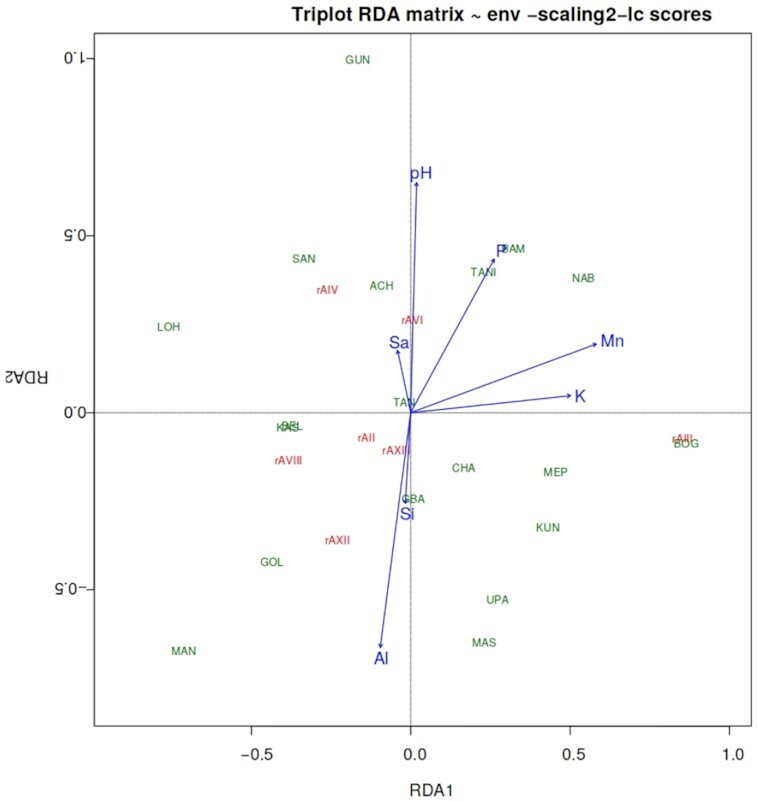
A total of 102 bacterial strains isolated from nodules of three Bambara groundnut and one soybean cultivars grown in nineteen soil samples collected from northern Ghana were characterized using multilocus gene sequence analysis. Based on a concatenated sequence analysis (glnII-rpoB-recA-gyrB-atpD-dnaK), 54 representative strains were distributed in 12 distinct lineages, many of which were placed mainly in the Bradyrhizobium japonicum and Bradyrhizobium elkanii supergroups. Twenty-four of the 54 representative strains belonged to seven putative novel species, while 30 were conspecific with four recognized Bradyrhizobium species. The nodA phylogeny placed all the representative strains in the cosmopolitan nodA clade III. The strains were further separated in seven nodA subclusters with reference strains mainly of African origin. The nifH phylogeny was somewhat congruent with the nodA phylogeny, but both symbiotic genes were mostly incongruent with the core housekeeping gene phylogeny indicating that the strains acquired their symbiotic genes horizontally from distantly related Bradyrhizobium species. Using redundancy analysis, the distribution of genospecies was found to be influenced by the edaphic factors of the respective sampling sites. In general, these results mainly underscore the high genetic diversity of Bambara groundnut-nodulating bradyrhizobia in Ghanaian soils and suggest a possible vast resource of adapted inoculant strains.
从加纳北部 19 个土壤样本中种植的三种斑豆和一种大豆品种的根瘤中分离出的 102 株细菌菌株,采用多位点基因序列分析进行了特征描述。基于串联序列分析(glnII-rpoB-recA-gyrB-atpD-dnaK),54 株代表性菌株分布在 12 个不同的谱系中,其中许多主要位于日本根瘤菌和伊坎氏根瘤菌超级群中。54 株代表性菌株中有 24 株属于 7 个可能的新种,而 30 株与 4 个公认的根瘤菌种相同。nodA 系统发育树将所有代表性菌株置于世界性的 nodA 进化枝 III 中。这些菌株进一步分为 7 个 nodA 亚群,参考菌株主要来自非洲。nifH 系统发育树与 nodA 系统发育树有些一致,但这两个共生基因与核心管家基因系统发育树大多不一致,表明这些菌株从远缘的根瘤菌种中水平获得了共生基因。冗余分析发现,基因型的分布受各采样点土壤因子的影响。总的来说,这些结果主要强调了加纳土壤中斑豆根瘤菌的遗传多样性很高,并表明可能有大量适应接种剂菌株的资源。