Gómez-Flores-Ramos Liliana, Barraza-Arellano Angélica Leticia, Mohar Alejandro, Trujillo-Martínez Miguel, Grimaldo Lizbeth, Ortiz-Lopez Rocío, Treviño Víctor
CONACYT/Center for Population Health Research, National Institute of Public Health, Universidad No. 655, Cuernavaca 62100, Morelos, Mexico.
School of Medicine, Tecnologico de Monterrey, Morones Prieto Av 3000, Los Doctores, Monterrey 64710, Nuevo Leon, Mexico.
Cancers (Basel). 2022 Mar 24;14(7):1647. doi: 10.3390/cancers14071647.
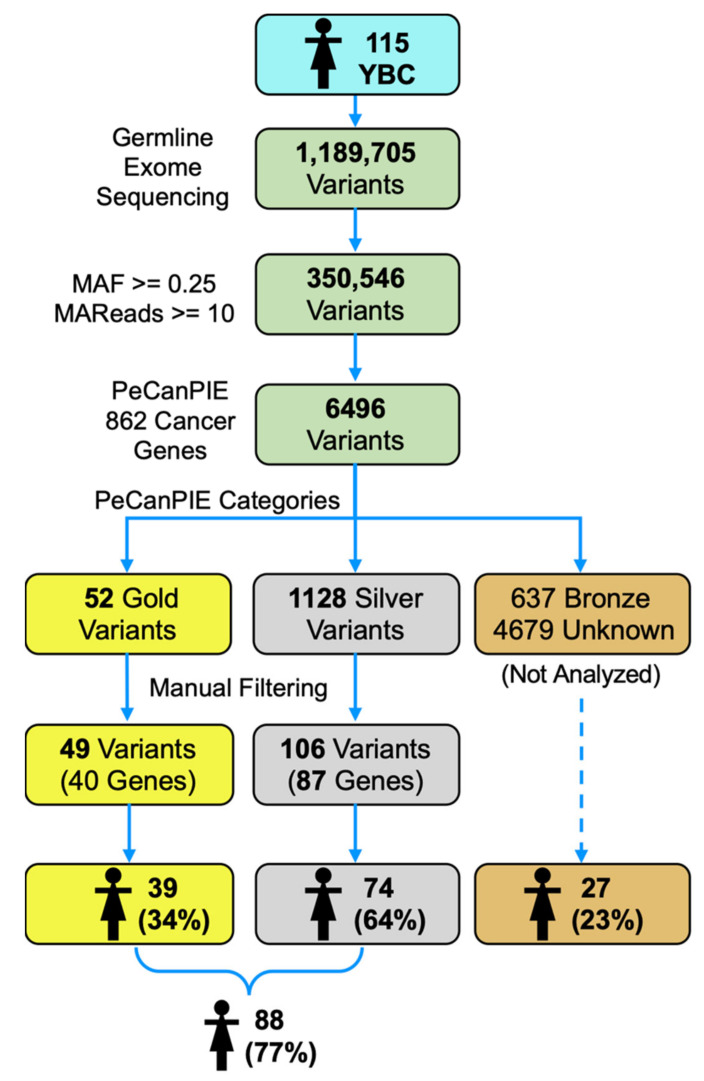
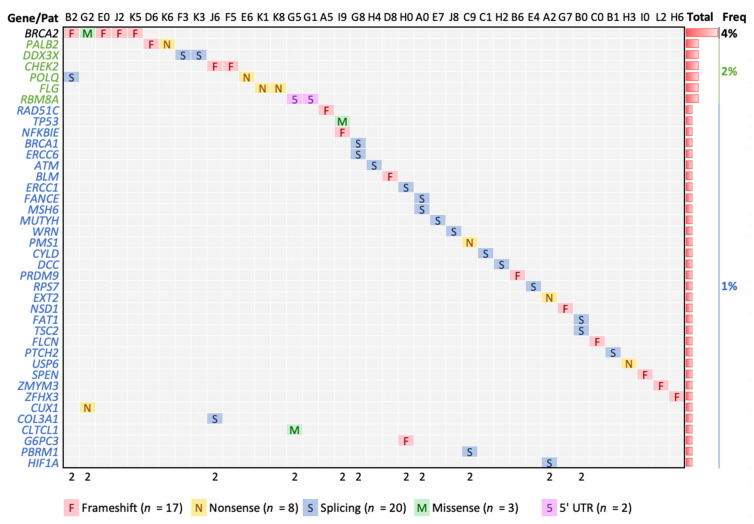
Breast cancer (BC) is one of the most frequent cancer types in women worldwide. About 7% is diagnosed in young women (YBC) less than 40 years old. In Mexico, however, YBC reaches 15% suggesting a higher genetic susceptibility. There have been some reports of germline variants in YBC across the world. However, there is only one report from a Mexican population, which is not restricted by age and limited to a panel of 143 genes resulting in 15% of patients carrying putatively pathogenic variants. Nevertheless, expanding the analysis to whole exome involves using more complex tools to determine which genes and variants could be pathogenic. We used germline whole exome sequencing combined with the PeCanPie tool to analyze exome variants in 115 YBC patients. Our results showed that we were able to identify 49 high likely pathogenic variants involving 40 genes on 34% of patients. We noted many genes already reported in BC and YBC worldwide, such as , , , , , and , but also others not commonly reported in YBC in Latin America, such as , , , , and . We show further supporting and controversial evidence for some of these genes. We conclude that exome sequencing combined with robust annotation tools and further analysis, can identify more genes and more patients affected by germline mutations in cancer.
乳腺癌(BC)是全球女性中最常见的癌症类型之一。约7%的病例在40岁以下的年轻女性(YBC)中被诊断出来。然而,在墨西哥,YBC的比例达到15%,这表明其遗传易感性更高。世界各地已有一些关于YBC中种系变异的报道。然而,来自墨西哥人群的报告只有一份,该报告不受年龄限制,且仅限于一组143个基因,结果显示15%的患者携带可能致病的变异。然而,将分析扩展到全外显子组需要使用更复杂的工具来确定哪些基因和变异可能是致病的。我们使用种系全外显子组测序结合PeCanPie工具,对115例YBC患者的外显子组变异进行了分析。我们的结果表明,我们能够在34%的患者中鉴定出涉及40个基因的49个高度可能致病的变异。我们注意到许多在全球BC和YBC中已报道的基因,如 、 、 、 、 和 ,但也有一些在拉丁美洲YBC中不常报道的基因,如 、 、 、 和 。我们为其中一些基因提供了进一步的支持性和争议性证据。我们得出结论,外显子组测序结合强大的注释工具和进一步分析,可以识别出更多受癌症种系突变影响的基因和患者。