Ammendola Serena, Rizzo Paola Chiara, Longhi Michele, Zivelonghi Emanuele, Pedron Serena, Pinna Giampietro, Sala Francesco, Nicolato Antonio, Scarpa Aldo, Barresi Valeria
Department of Diagnostics and Public Health, Section of Anatomic Pathology, University of Verona, 37134 Verona, Italy.
Unit of Stereotactic Neurosurgery, Department of Neurosciences, Hospital Trust of Verona, 37134 Verona, Italy.
Cancers (Basel). 2022 Mar 28;14(7):1718. doi: 10.3390/cancers14071718.
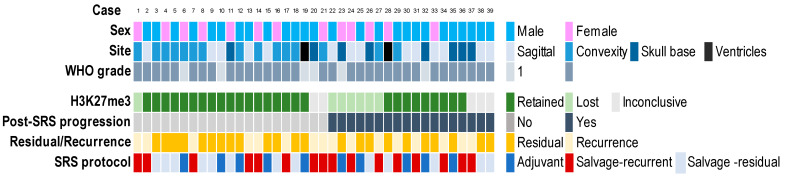
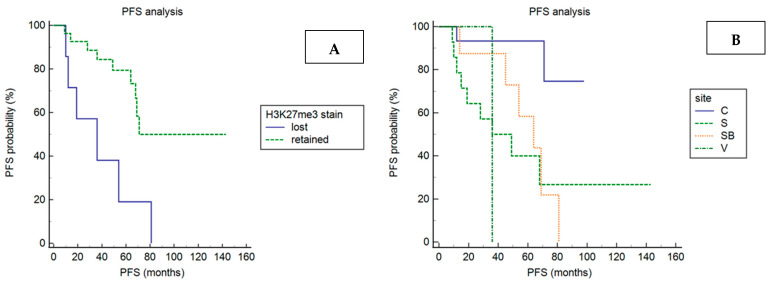
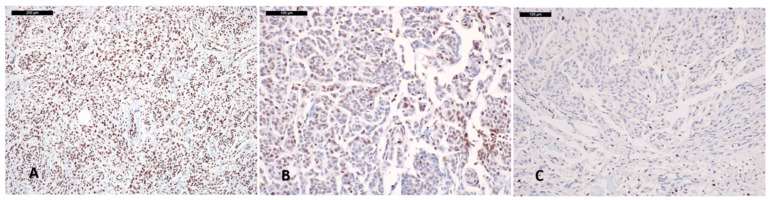
The immunohistochemical loss of histone H3 trimethylated in lysine 27 (H3K27me3) was recently shown to predict recurrence of meningiomas after surgery. However, its association with tumor progression after stereotactic radiosurgery (SRS) is unexplored. To investigate whether H3K27 methylation status may predict progression-free survival (PFS) after SRS, we assessed H3K27me3 immunoexpression in thirty-nine treatment naïve, intracranial, meningiomas, treated with surgery and subsequent SRS for residual (twenty-three cases) or recurrent (sixteen cases) disease. H3K27me3 immunostaining was lost in seven meningiomas, retained in twenty-seven and inconclusive in five. Six of the seven meningiomas (86%) with H3K27me3 loss had tumor progression after SRS, compared to nine of twenty-seven (33%) with H3K27me3 retention ( = 0.0143). In addition, patients harboring a meningioma with H3K27me3 loss had significantly shorter PFS after SRS (range: 10-81 months; median: 34 months), compared to patients featuring a meningioma with retained H3K27me3 (range: 9-143 months; median: 62 months) ( = 0.0036). Nonetheless, tumor sagittal location was the only significant prognostic variable at multivariate analysis for PFS after SRS ( = 0.0142). These findings suggest a previously unreported role of H3K27me3 as a predictor of meningioma progression after SRS for recurrent or residual disease. Modulation of H3K27 methylation status may represent a novel therapeutic strategy to induce radiosensitization of meningiomas.
组蛋白H3赖氨酸27三甲基化(H3K27me3)的免疫组化缺失最近被证明可预测脑膜瘤手术后的复发情况。然而,其与立体定向放射外科治疗(SRS)后肿瘤进展的相关性尚未得到研究。为了探究H3K27甲基化状态是否可预测SRS后的无进展生存期(PFS),我们评估了39例未经治疗的颅内脑膜瘤的H3K27me3免疫表达情况,这些脑膜瘤接受了手术治疗,随后因残留(23例)或复发(16例)疾病接受了SRS治疗。7例脑膜瘤中H3K27me3免疫染色缺失,27例保留,5例结果不明确。7例H3K27me3缺失的脑膜瘤中有6例(86%)在SRS后出现肿瘤进展,相比之下,27例H3K27me3保留的脑膜瘤中有9例(33%)出现进展(P = 0.0143)。此外,与H3K27me3保留的脑膜瘤患者相比,H3K27me3缺失的脑膜瘤患者在SRS后的PFS明显更短(范围:10 - 81个月;中位数:34个月),而H3K27me3保留的脑膜瘤患者的PFS范围为9 - 143个月,中位数为62个月(P = 0.0036)。尽管如此,在多变量分析中,肿瘤矢状位位置是SRS后PFS的唯一显著预后变量(P = 0.0142)。这些发现表明H3K27me3作为复发或残留疾病SRS后脑膜瘤进展的预测指标,其作用此前未被报道。调节H3K27甲基化状态可能代表一种诱导脑膜瘤放射增敏的新型治疗策略。