Division of Hematology and Bone Marrow Transplantation, Chaim Sheba Medical Center, Tel Aviv University, Tel Aviv 6997801, Israel.
Ella Lemelbaum Institute for Immuno Oncology, Chaim Sheba Medical Center, Tel Aviv 6997801, Israel.
Cells. 2022 Mar 28;11(7):1140. doi: 10.3390/cells11071140.
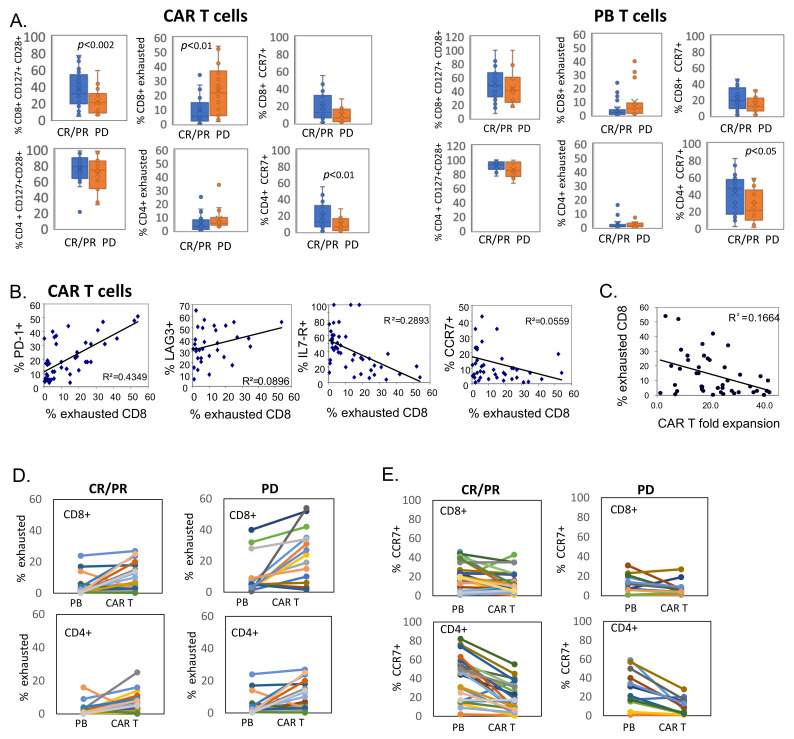
Despite the high rates of complete remission following chimeric antigen receptor (CAR) T cell therapy, its full capacity is currently limited by the generation of dysfunctional CAR T cells. Senescent or exhausted CAR T cells possess poor targeting and effector functions, as well as impaired cell proliferation and persistence in vivo. Strategies to detect, prevent or reverse T cell exhaustion are therefore required in order to enhance the effectiveness of CAR T immunotherapy. Here we report that CD19 CAR T cells from non-responding patients with B cell malignancies show enrichment of CD8 cells with exhausted/senescent phenotype and display a distinct transcriptional signature with dysregulation of genes associated with terminal exhaustion. Furthermore, CAR T cells from non-responding patients exhibit reduced proliferative capacity and decreased IL-2 production in vitro, indicating functional impairment. Overall, our work reveals potential mediators of resistance, paving the way to studies that will enhance the efficacy and durability of CAR T therapy in B cell malignancies.
尽管嵌合抗原受体 (CAR) T 细胞疗法在完全缓解方面的成功率很高,但由于功能失调的 CAR T 细胞的产生,其完全效能目前受到限制。衰老或耗竭的 CAR T 细胞具有较差的靶向和效应功能,以及体内增殖和持久性受损。因此,需要采取策略来检测、预防或逆转 T 细胞耗竭,以增强 CAR T 免疫疗法的效果。在这里,我们报告称,来自 B 细胞恶性肿瘤无反应患者的 CD19 CAR T 细胞富集了具有耗竭/衰老表型的 CD8 细胞,并表现出明显的转录特征,与与终末耗竭相关的基因失调有关。此外,来自无反应患者的 CAR T 细胞表现出体外增殖能力降低和 IL-2 产生减少,表明功能受损。总的来说,我们的工作揭示了耐药的潜在介质,为研究增强 CAR T 疗法在 B 细胞恶性肿瘤中的疗效和持久性铺平了道路。