Adan Ana, Navarro José Francisco
Department of Clinical Psychology and Psychobiology, School of Psychology, University of Barcelona, Passeig de la Vall d'Hebrón 171, 08035 Barcelona, Spain.
Institute of Neurosciences, University of Barcelona, 08035 Barcelona, Spain.
J Clin Med. 2022 Mar 26;11(7):1846. doi: 10.3390/jcm11071846.
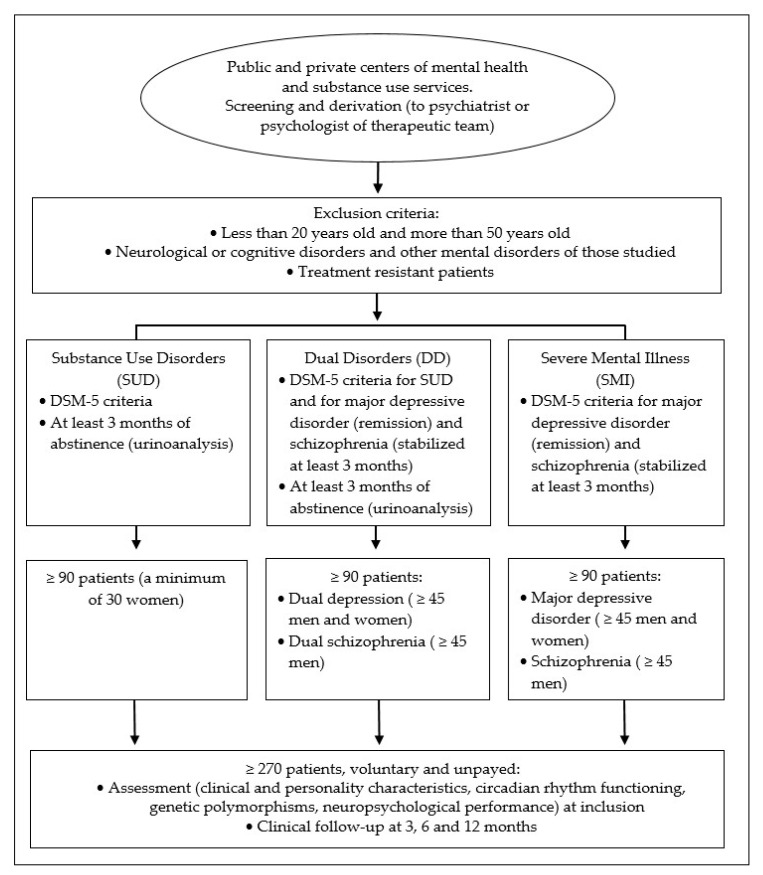
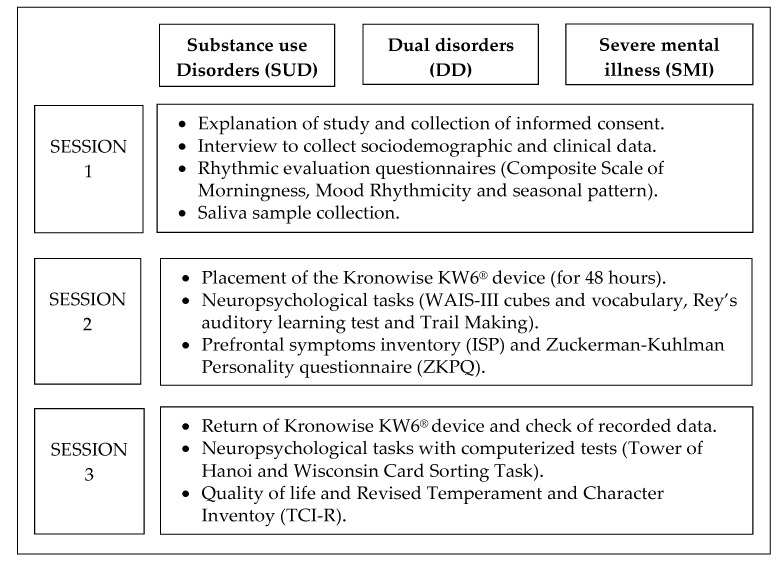
This protocol aims to characterize patients with dual disorders (DD; comorbid major depression and schizophrenia) compared with patients with only a diagnosis of substance use disorder (SUD) and those with only a diagnosis of severe mental illness (SMI; major depression and schizophrenia), evaluating clinical and personality characteristics, circadian rhythmic functioning, genetic polymorphism and neuropsychological performance in order to obtain a clinical endophenotype of differential vulnerability for these diagnostic entities. Patients will be divided into three groups: DD (45 men with comorbid schizophrenia, 45 men and 30 women with major depression), SUD ( = 90, with a minimum of 30 women) and SMI males (45 with schizophrenia, 45 with major depression). All patients will be under treatment, with at least three months of SUD abstinence and/or with SMI in remission or with stabilized symptoms. Outpatients of both sexes with insufficient restoration of circadian rhythmicity with SUD ( = 30) and dual depression ( = 30) will be asked to participate in a second two-month study, being alternately assigned to the condition of the chronobiological adjuvant approach to the treatment of regular hour habits and exposure to light or to the usual treatment (control). The effect of the intervention and patient compliance will be monitored with a Kronowise KW6 ambulatory device during the first two weeks of treatment and again at weeks 4 and 8 weeks. After completing the evaluation, follow-up of the clinical evolution will be carried out at 3, 6 and 12 months. This project will allow us to analyze the functional impact of DD comorbidity and to develop the first study of chronobiological therapy in the treatment of SUD and dual depression, with results transferable to the clinical setting with cost-effective recommendations for a personalized approach.
本方案旨在对双相障碍(DD;合并重度抑郁症和精神分裂症)患者与仅诊断为物质使用障碍(SUD)的患者以及仅诊断为严重精神疾病(SMI;重度抑郁症和精神分裂症)的患者进行特征描述,评估临床和人格特征、昼夜节律功能、基因多态性和神经心理表现,以便获得这些诊断实体的易感性差异的临床内表型。患者将被分为三组:双相障碍组(45名合并精神分裂症的男性,45名男性和30名女性患有重度抑郁症)、物质使用障碍组(n = 90,至少30名女性)和严重精神疾病男性组(45名患有精神分裂症,45名患有重度抑郁症)。所有患者均在接受治疗,至少戒断物质使用障碍三个月和/或重度精神疾病处于缓解期或症状稳定。对于昼夜节律恢复不足的物质使用障碍门诊患者(n = 30)和双相抑郁症门诊患者(n = 30),将邀请他们参加为期两个月的第二项研究,交替分配到采用生物钟辅助方法治疗日常作息习惯和光照暴露的条件下或常规治疗(对照)。在治疗的前两周以及第4周和第8周,使用Kronowise KW6动态监测设备监测干预效果和患者依从性。评估完成后,将在3个月、6个月和12个月进行临床进展的随访。该项目将使我们能够分析双相障碍共病的功能影响,并开展第一项关于生物钟疗法治疗物质使用障碍和双相抑郁症的研究,其结果可转化到临床环境中,并为个性化治疗提供具有成本效益的建议。