South West Field Service, UK Health Security Agency, Bristol BS1 6EH, UK.
Field Epidemiology Training Programme, UK Health Security Agency, London NW9 5EQ, UK.
Int J Environ Res Public Health. 2022 Mar 24;19(7):3876. doi: 10.3390/ijerph19073876.
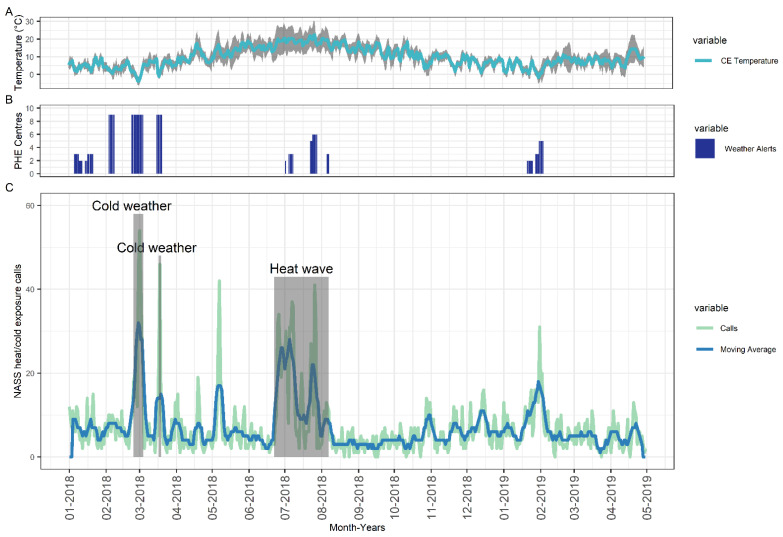
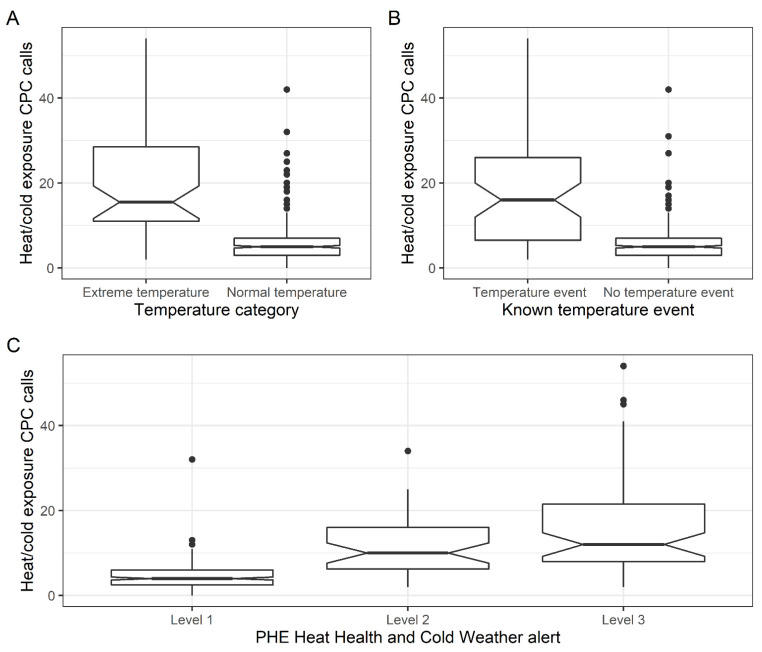
Extreme weather events present significant global threats to health. The National Ambulance Syndromic Surveillance System collects data on 18 syndromes through chief presenting complaint (CPC) codes. We aimed to determine the utility of ambulance data to monitor extreme temperature events for action. Daily total calls were observed between 01/01/2018−30/04/2019. Median daily ’Heat/Cold’ CPC calls during “known extreme temperature” (identified a priori), “extreme temperature”; (within 5th or 95th temperature percentiles for central England) and meteorological alert periods were compared to all other days using Wilcoxon signed-rank test. During the study period, 12,585,084 calls were recorded. In 2018, median daily “Heat/Cold” calls were higher during periods of known extreme temperature: heatwave (16/day, 736 total) and extreme cold weather events (28/day, 339 total) compared to all other days in 2018 (6/day, 1672 total). Median daily “Heat/Cold” calls during extreme temperature periods (16/day) were significantly higher than non-extreme temperature periods (5/day, p < 0.001). Ambulance data can be used to identify adverse impacts during periods of extreme temperature. Ambulance data are a low resource, rapid and flexible option providing real-time data on a range of indicators. We recommend ambulance data are used for the surveillance of presentations to healthcare related to extreme temperature events.
极端天气事件对全球健康构成重大威胁。国家救护车综合征监测系统通过主要就诊主诉 (CPC) 代码收集 18 种综合征的数据。我们旨在确定使用救护车数据来监测极端温度事件以采取行动的效用。观察了 2018 年 1 月 1 日至 2019 年 4 月 30 日期间的每日总呼叫次数。在“已知极端温度”(预先确定)、“极端温度”期间(英格兰中部温度第 5 或第 95 百分位范围内)和气象警报期间,每天的“热/冷” CPC 呼叫中位数与所有其他日子进行比较,使用 Wilcoxon 符号秩检验。在研究期间,共记录了 12585084 次呼叫。在 2018 年,已知极端温度期间每天的“热/冷”呼叫中位数较高:热浪(16/天,共 736 次)和极端寒冷天气事件(28/天,共 339 次)与 2018 年所有其他日子相比(6/天,共 1672 次)。极端温度期间(16/天)的“热/冷”呼叫中位数明显高于非极端温度期间(5/天,p<0.001)。救护车数据可用于识别极端温度期间的不利影响。救护车数据是一种低资源、快速且灵活的选择,可提供与极端温度事件相关的一系列指标的实时数据。我们建议使用救护车数据来监测与极端温度事件相关的就诊情况。