Department of Microbiology, College of Medicine, Imam Abdulrahman Bin Faisal University (IAU), Dammam, Saudi Arabia.
Department of Pathology, College of Medicine, King Fahad Hospital of the University, Imam Abdulrahman Bin Faisal University, Dammam, Saudi Arabia.
PLoS One. 2022 Apr 12;17(4):e0266603. doi: 10.1371/journal.pone.0266603. eCollection 2022.
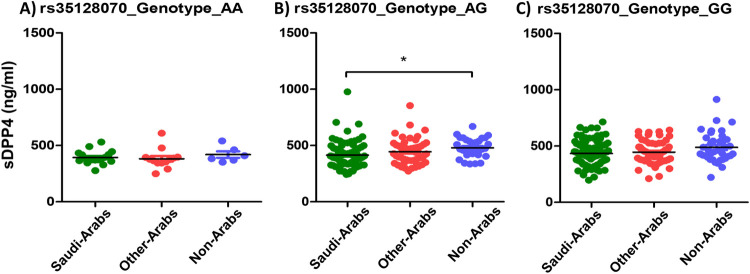
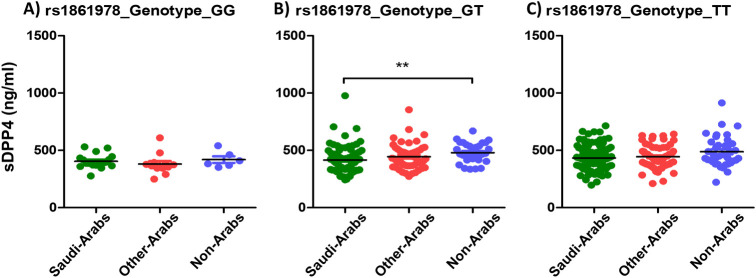
Most of the cases of Middle East respiratory syndrome coronavirus (MERS-CoV) were reported in Saudi Arabia. Dipeptidyl peptidase-4 (DPP4) was identified as the receptor for the virus. The level of soluble DPP4 (sDPP4) was found to be reduced in MERS-CoV infected patients while high levels of sDPP4 were suggested to be protective against MERS-CoV in animal models. We investigated whether the Saudi population has lower levels of sDPP4 which makes them more susceptible to MERS-CoV infection and, therefore, could explain the larger number of cases from the country. Blood samples were collected from 219 Saudi blood donors and 200 blood donors from other ethnic groups. The plasma level of sDPP4 was measured by ELISA and the following SNPs in the DPP4 gene; rs35128070, rs1861978, rs79700168, and rs17574, were genotyped by TaqMan SNP genotyping assay. The average level of plasma sDDP4 was significantly lower in Saudis than other Arabs and non-Arabs (P value 0.0003 and 0.012, respectively). The genotypes AG of rs35128070 and GT of rs1861978 were significantly associated with lower sDPP4 among Saudis (P value 0.002 for each). While both genotypes AA and AG of rs79700168 and rs17574 were associated with significantly lower average sDPP4 level in Saudis compared to other ethnic groups (P value 0.031 and 0.032, and 0.027 and 0.014, respectively). Herein, we report that the Saudi population has lower levels of plasma sDPP4 than other ethnic groups, which is associated with genetic variants in the DPP4 gene. This may have contributed to increase the susceptibility of the Saudi population to MERS-CoV infection and could be a factor in the long-lasting persistence of the virus in the country.
中东呼吸综合征冠状病毒(MERS-CoV)的大多数病例报告发生在沙特阿拉伯。二肽基肽酶 4(DPP4)被鉴定为该病毒的受体。研究发现,感染 MERS-CoV 的患者可溶性 DPP4(sDPP4)水平降低,而动物模型中高水平的 sDPP4 被认为对 MERS-CoV 具有保护作用。我们调查了沙特人群的 sDPP4 水平是否较低,这使他们更容易感染 MERS-CoV,因此可以解释该国报告的大量病例。从 219 名沙特献血者和 200 名来自其他种族的献血者中采集血液样本。通过 ELISA 测量 sDPP4 的血浆水平,并通过 TaqMan SNP 基因分型检测 DPP4 基因中的以下 SNPs:rs35128070、rs1861978、rs79700168 和 rs17574。沙特人的血浆 sDDP4 平均水平明显低于其他阿拉伯人和非阿拉伯人(P 值分别为 0.0003 和 0.012)。rs35128070 的 AG 基因型和 rs1861978 的 GT 基因型与沙特人的 sDPP4 水平降低显著相关(P 值分别为 0.002)。而 rs79700168 和 rs17574 的 AA 和 AG 基因型与沙特人与其他种族相比,sDPP4 的平均水平明显降低(P 值分别为 0.031 和 0.032,0.027 和 0.014)。在此,我们报告说,与其他种族相比,沙特人群的血浆 sDPP4 水平较低,这与 DPP4 基因中的遗传变异有关。这可能导致沙特人群对 MERS-CoV 感染的易感性增加,并且可能是该病毒在该国长期持续存在的一个因素。