Institute for Research in Biomedicine (IRB Barcelona), Barcelona Institute of Science and Technology (BIST), Barcelona 08028, Spain.
Department of Discovery Oncology, Genentech, South San Francisco, CA 94080, USA.
Development. 2022 Apr 15;149(8). doi: 10.1242/dev.200361. Epub 2022 Apr 22.
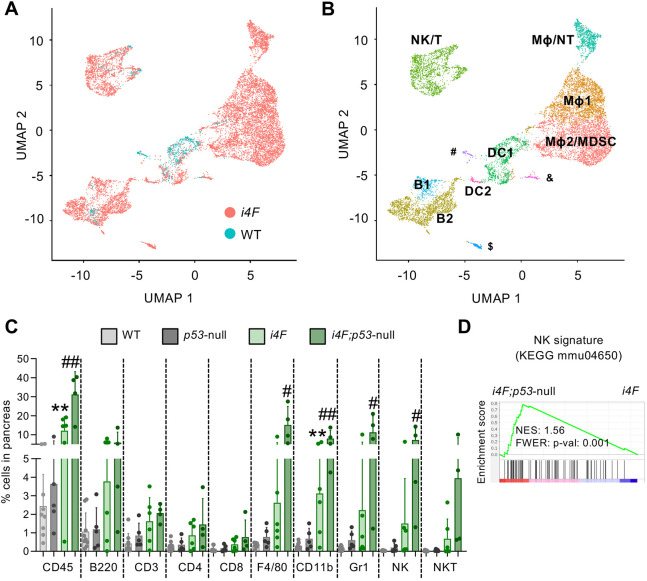
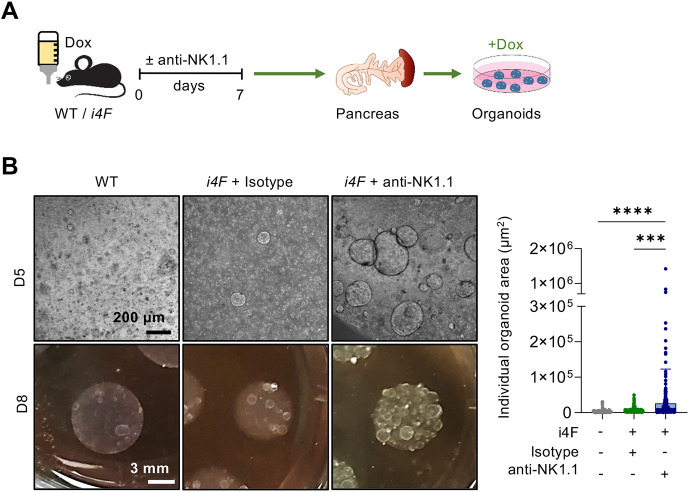
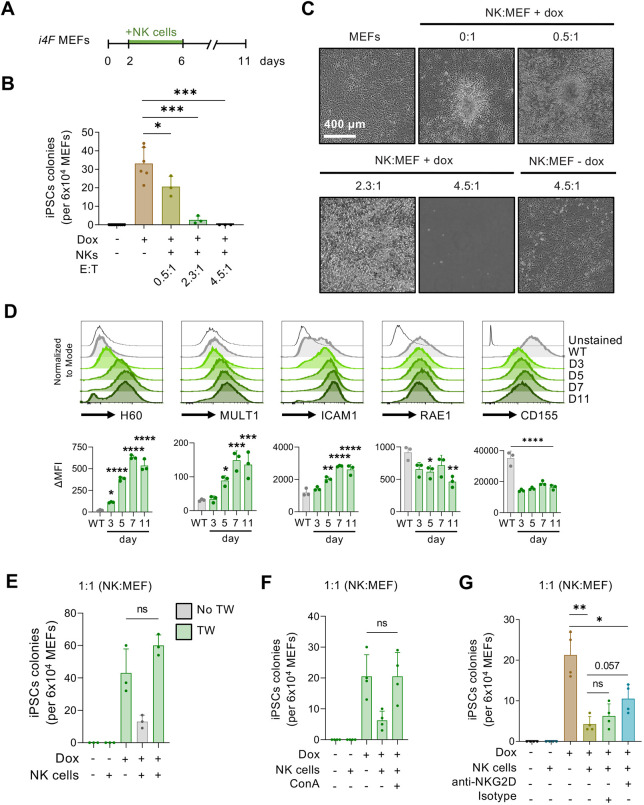
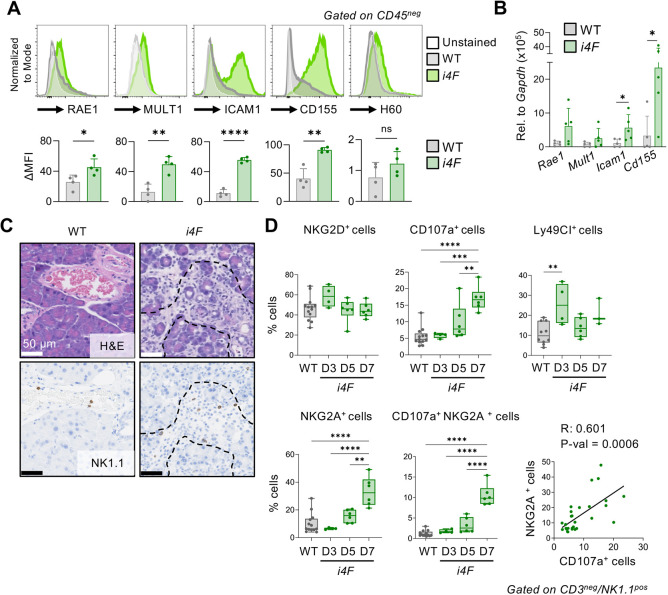
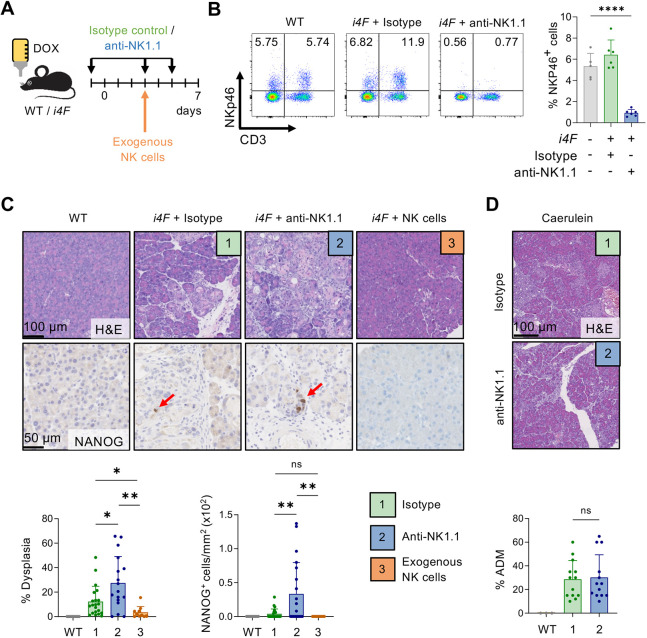
The ectopic expression of the transcription factors OCT4, SOX2, KLF4 and MYC (OSKM) enables reprogramming of differentiated cells into pluripotent embryonic stem cells. Methods based on partial and reversible in vivo reprogramming are a promising strategy for tissue regeneration and rejuvenation. However, little is known about the barriers that impair reprogramming in an in vivo context. We report that natural killer (NK) cells significantly limit reprogramming, both in vitro and in vivo. Cells and tissues in the intermediate states of reprogramming upregulate the expression of NK-activating ligands, such as MULT1 and ICAM1. NK cells recognize and kill partially reprogrammed cells in a degranulation-dependent manner. Importantly, in vivo partial reprogramming is strongly reduced by adoptive transfer of NK cells, whereas it is significantly increased by their depletion. Notably, in the absence of NK cells, the pancreatic organoids derived from OSKM-expressing mice are remarkably large, suggesting that ablating NK surveillance favours the acquisition of progenitor-like properties. We conclude that NK cells pose an important barrier for in vivo reprogramming, and speculate that this concept may apply to other contexts of transient cellular plasticity.
转录因子 OCT4、SOX2、KLF4 和 MYC(OSKM)的异位表达可将分化细胞重编程为多能胚胎干细胞。基于部分和可逆体内重编程的方法是组织再生和年轻化的有前途的策略。然而,对于在体内环境中阻碍重编程的障碍知之甚少。我们报告称,自然杀伤 (NK) 细胞在体外和体内均显著限制重编程。处于重编程中间状态的细胞和组织上调表达 NK 激活配体,如 MULT1 和 ICAM1。NK 细胞以脱颗粒依赖性方式识别和杀死部分重编程的细胞。重要的是,通过 NK 细胞的过继转移,体内部分重编程强烈减少,而其耗竭则显著增加。值得注意的是,在没有 NK 细胞的情况下,源自表达 OSKM 小鼠的胰腺类器官显著增大,表明消除 NK 监视有利于获得祖细胞样特性。我们得出结论,NK 细胞是体内重编程的一个重要障碍,并推测这一概念可能适用于其他短暂细胞可塑性的情况。