
中温下移动床中SO脱除的放大实验及NO的促进行为。
Scale-up experiments of SO removal and the promoting behavior of NO in moving beds at medium temperatures.
作者信息
Ma Shuangchen, Bie Xuan, Gong Chunqin, Qu Baozhong, Liu Daokuan
机构信息
Hebei Key Lab of Power Plant Flue Gas Multi-Pollutants Control, Department of Environmental Science and Engineering, North China Electric Power University Baoding 071003 PR China
MOE Key Laboratory of Resources and Environmental Systems Optimization, College of Environmental Science and Engineering, North China Electric Power University Beijing 102206 PR China.
出版信息
RSC Adv. 2021 Feb 26;11(15):8846-8856. doi: 10.1039/d0ra10164h. eCollection 2021 Feb 23.
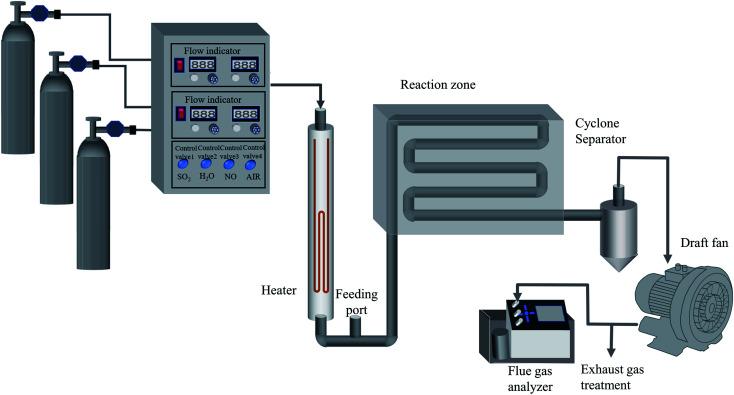
The dry flue gas desulfurization (FGD) method was studied, which is a part of the integrated removal of multi-pollutants at medium temperatures. Although dry flue gas treatment is a simple and effective method, it is still a highly empirical-led application technology. A superior desulfurization adsorbent, fine powder of NaHCO (hereinafter called fine NaHCO), was selected by scale-up experiments. A deep understanding of the reaction process and mechanism is then explored, which helps the further optimization of dry desulfurization. Based on the multi-factor experiments for NaHCO, the effect mechanism of NO on desulfurization using NaHCO is also proposed. The conversion of SO → SO is promoted by the existence of NO. Therefore, a slight decline can be found. According to the influences of the SO concentration and the residence time, it is concluded that the diffusion of SO into the channel of NaHCO is the rate-limiting step. Impressively, the reaction process of reactants was clearly studied by FTIR spectroscopy to determine the whole process. Moreover, the recycling of NaHCO is the main direction for reducing adsorbent consumption in the next step. The predictable insights are beneficial for profoundly understanding the gas composition synergetic interaction for the SO removal by the dry treatment using NaHCO.
研究了中温多污染物一体化脱除中的干式烟气脱硫(FGD)方法。虽然干式烟气处理是一种简单有效的方法,但它仍然是一种高度依赖经验的应用技术。通过放大实验筛选出了一种性能优良的脱硫吸附剂——碳酸氢钠细粉(以下简称细NaHCO)。进而深入探究反应过程和机理,这有助于干式脱硫的进一步优化。基于对NaHCO的多因素实验,还提出了NO对使用NaHCO脱硫的影响机制。NO的存在促进了SO₂向SO₃的转化。因此,可以发现脱硫效率略有下降。根据SO₂浓度和停留时间的影响,得出SO₂向NaHCO通道内扩散是限速步骤。令人印象深刻的是,通过傅里叶变换红外光谱(FTIR)对反应物的反应过程进行了清晰的研究,以确定整个过程。此外,NaHCO的循环利用是下一步降低吸附剂消耗的主要方向。这些可预测的见解有助于深刻理解使用NaHCO进行干式处理脱除SO₂时气体成分的协同相互作用。




 Zotero 插件