Eijsink Linda E, Sardjan Andy S, Sinnema Esther G, den Besten Hugo, van den Berg Keimpe J, Flapper Jitte, van Gemert Rogier, Feringa Ben L, Browne Wesley R
Stratingh Institute for Chemistry, Faculty of Science and Engineering, University of Groningen Nijenborgh 4 Groningen 9747AG The Netherlands
Akzo Nobel Car Refinishes N.V. Rijksstraatweg 31 Sassenheim 2171 AJ The Netherlands.
RSC Adv. 2022 Jan 19;12(5):2537-2548. doi: 10.1039/d1ra09386j. eCollection 2022 Jan 18.
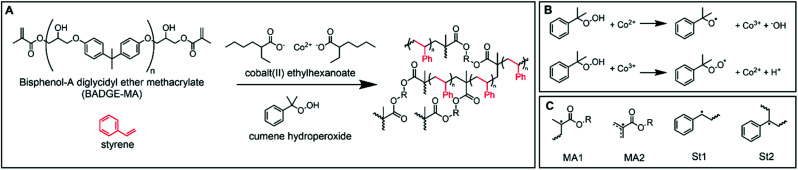
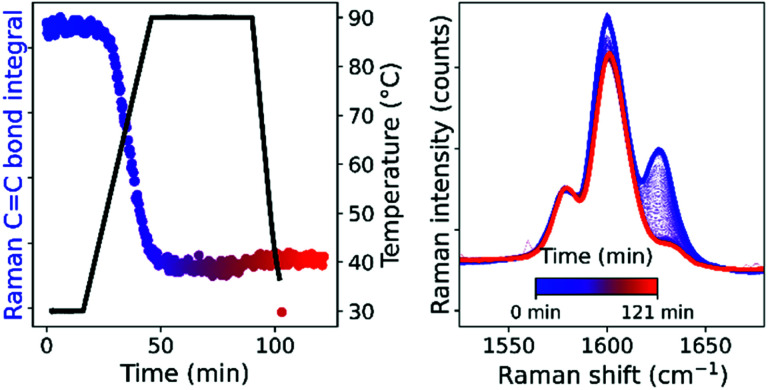
The curing of bis-methacrylate-styrene resins initiated by the cobalt catalyzed decomposition of cumyl hydroperoxide is monitored at ambient temperatures by EPR and Raman spectroscopy. EPR spectroscopy shows the appearance of organic radicals after 1 h from initiation with an increase in intensity from both polystyrene and methacrylate based radical species over a further 2 h period to reach a maximum spin concentration of 2-3 mM. Alkene conversion to polymer was monitored by Raman spectroscopy in real time with EPR spectroscopy and reveals that the appearance of the radical signals is first observed only as the conversion approaches its maximum extent (70% at room temperature), , the resin reaches a glass-like state. The radicals persist for several months on standing at room temperature. Flash frozen samples (77 K) did not show EPR signals within 1 h of initiation. The nature of the radicals responsible for the EPR spectra observed were explored by DFT methods and isotope labelling experiments (D-styrene) and correspond to radicals of both methacrylate and polystyrene. Combined temperature dependent EPR and Raman spectroscopy shows that conversion increases rapidly upon heating of a cured sample, reaching full conversion at 80 °C with initially little effect on the EPR spectrum. Over time ( subsequent to reaching full conversion of alkene) there was a small but clear increase in the EPR signal due to the methacrylate based radicals and minor decrease in the signal due to the polystyrene based radicals. The appearance of the radical signals as the reaction reaches completion and their absence in samples flash frozen before polymerization has halted, indicate that the observed radicals are non-propagating. The formation of the radicals due to stress within the samples is excluded. Hence, the observed radicals are a representative of the steady state concentration of radicals present in the resin over the entire timespan of the polymerization. The data indicate that the lack of EPR signals is most likely due to experimental aspects, in particular spin saturation, rather than low steady state concentrations of propagating radicals during polymerization.
通过电子顺磁共振(EPR)和拉曼光谱在环境温度下监测由枯基过氧化氢的钴催化分解引发的双甲基丙烯酸酯 - 苯乙烯树脂的固化过程。EPR光谱显示引发后1小时出现有机自由基,在接下来的2小时内,基于聚苯乙烯和甲基丙烯酸酯的自由基种类的强度均增加,达到最大自旋浓度2 - 3 mM。通过拉曼光谱与EPR光谱实时监测烯烃向聚合物的转化,结果表明仅在转化率接近其最大程度(室温下为70%)时才首次观察到自由基信号,此时树脂达到玻璃状状态。自由基在室温下放置数月仍会持续存在。快速冷冻的样品(77 K)在引发后1小时内未显示EPR信号。通过密度泛函理论(DFT)方法和同位素标记实验(D - 苯乙烯)探索了所观察到的EPR光谱的自由基性质,其对应于甲基丙烯酸酯和聚苯乙烯的自由基。结合温度依赖的EPR和拉曼光谱表明,固化样品加热时转化率迅速增加,在80°C时达到完全转化,最初对EPR光谱影响很小。随着时间推移(烯烃达到完全转化之后),基于甲基丙烯酸酯的自由基导致EPR信号有小但明显的增加,而基于聚苯乙烯的自由基信号略有下降。反应完成时自由基信号的出现以及聚合停止前快速冷冻样品中自由基信号的缺失,表明所观察到的自由基是非增长性的。排除了样品内部应力导致自由基形成的可能性。因此,所观察到的自由基代表了聚合整个时间段内树脂中自由基的稳态浓度。数据表明EPR信号缺失最可能是由于实验方面的原因,特别是自旋饱和,而不是聚合过程中增长自由基的稳态浓度低。