Department of Paediatric Surgery, Altona Children's Hospital, Hamburg, Germany.
Department of Paediatric Surgery, University Medical Center Hamburg-Eppendorf (UKE), Hamburg, Germany.
Euro Surveill. 2022 Apr;27(15). doi: 10.2807/1560-7917.ES.2022.27.15.2001567.
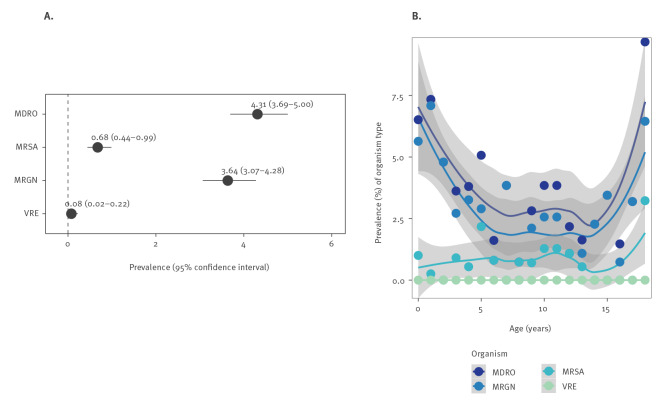
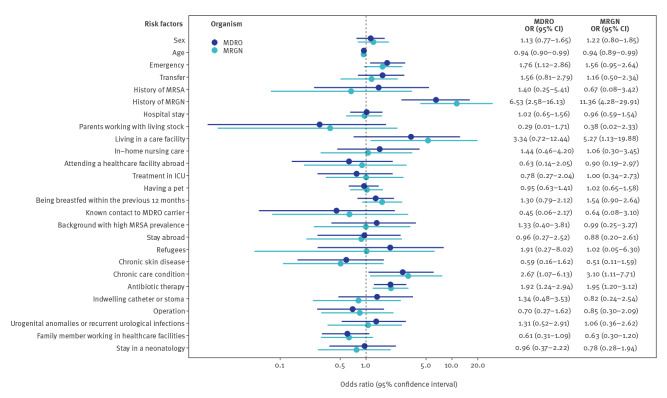
BackgroundIncreasing resistance to antibiotics poses medical challenges worldwide. Prospective data on carriage prevalence of multidrug resistant organisms (MDRO) in children at hospital admission are limited and associated risk factors are poorly defined.AimTo determine prevalence of MDRO carriage in children at admission to our paediatric hospital in Hamburg and to identify MDRO carriage risk factors.MethodsWe prospectively obtained and cultured nasal/throat and inguinal/anal swabs from children (≤ 18 years) at admission between September 2018 and May 2019 to determine prevalence of meticillin-resistant (MRSA), multidrug-resistant Gram-negative bacteria (MRGN) and vancomycin-resistant enterococcus (VRE) and associated species. We collected medical histories using a questionnaire and evaluated 31 risk factors using logistic regression models.ResultsMDRO carriage prevalence of 3,964 children was 4.31% (95% confidence interval (CI): 3.69-5.00). MRSA carriage prevalence was 0.68% (95% CI: 0.44-0.99), MRGN prevalence was 3.64% (95% CI: 3.07-4.28) and VRE prevalence 0.08% (95% CI: 0.02-0.22). MDRO carriage was associated with MRGN history (odds ratio (OR): 6.53; 95% CI: 2.58-16.13), chronic condition requiring permanent care (OR: 2.67; 95% CI: 1.07-6.13), antibiotic therapy (OR: 1.92, 95% CI: 1.24-2.94), living in a care facility (OR: 3.34; 95% CI: 0.72-12.44) and refugee status in previous 12 months (OR: 1.91; 95% CI: 0.27-8.02). Compared to established practice, screening using risk-factors had better diagnostic sensitivity (86.13%; 95% CI: 80.89-91.40) and specificity (73.54%; 95% CI: 72.12-74.97).ConclusionMRGN carriage was higher than MRSA and VRE. Extended risk-factor-based admission screening system seems warranted.
抗生素耐药性的增加给全球的医疗带来了挑战。目前关于儿童入院时携带多药耐药菌(MDRO)的流行率的前瞻性数据有限,相关的危险因素也未得到明确界定。
确定我院(德国汉堡的一家儿科医院)收治的患儿入院时携带 MDRO 的流行率,并确定 MDRO 携带的危险因素。
我们前瞻性地采集了 2018 年 9 月至 2019 年 5 月间入院的≤18 岁患儿的鼻/咽和腹股沟/肛周拭子,并进行培养,以确定耐甲氧西林金黄色葡萄球菌(MRSA)、多重耐药革兰氏阴性菌(MRGN)和万古霉素耐药肠球菌(VRE)的流行率和相关种类。我们使用问卷收集病史,并使用逻辑回归模型评估了 31 个危险因素。
3964 名患儿的 MDRO 携带率为 4.31%(95%置信区间(CI):3.69-5.00)。MRSA 携带率为 0.68%(95% CI:0.44-0.99),MRGN 携带率为 3.64%(95% CI:3.07-4.28),VRE 携带率为 0.08%(95% CI:0.02-0.22)。MDRO 携带与 MRGN 病史(比值比(OR):6.53;95% CI:2.58-16.13)、需要长期护理的慢性疾病(OR:2.67;95% CI:1.07-6.13)、抗生素治疗(OR:1.92,95% CI:1.24-2.94)、居住在护理机构(OR:3.34;95% CI:0.72-12.44)和过去 12 个月的难民身份(OR:1.91;95% CI:0.27-8.02)有关。与既定实践相比,基于危险因素的筛查具有更高的诊断敏感性(86.13%;95% CI:80.89-91.40)和特异性(73.54%;95% CI:72.12-74.97)。
MRGN 的携带率高于 MRSA 和 VRE。似乎需要建立一个基于扩展危险因素的入院筛查系统。