Ecology, Evolution, and Organismal Biology, Brown University, Providence, RI 02912, USA.
Center for Computational Molecular Biology, Brown University, Providence, RI 02912, USA.
Philos Trans R Soc Lond B Biol Sci. 2022 Jun 6;377(1852):20200411. doi: 10.1098/rstb.2020.0411. Epub 2022 Apr 18.
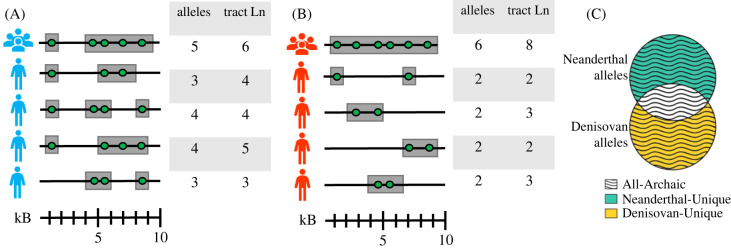
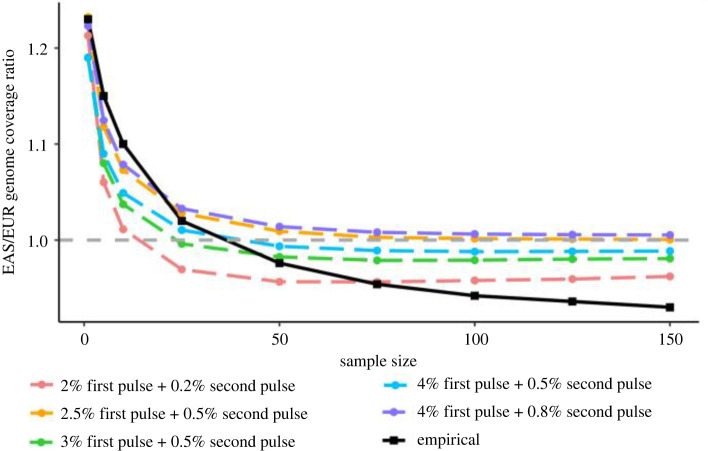
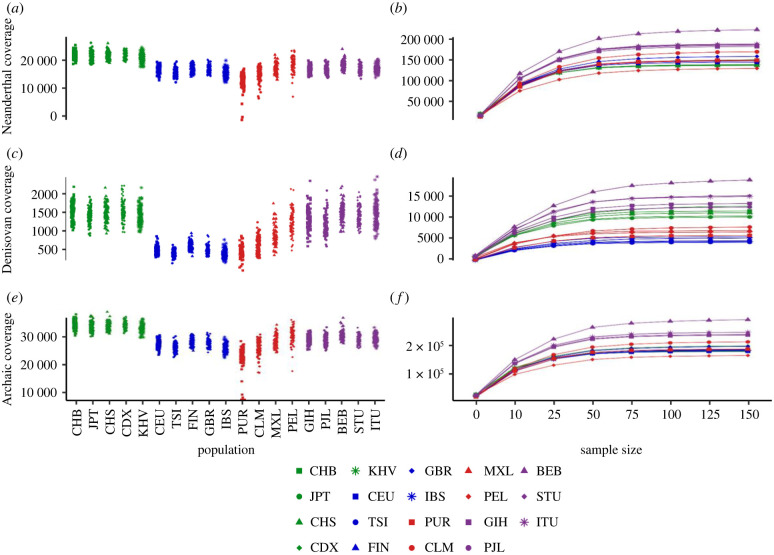
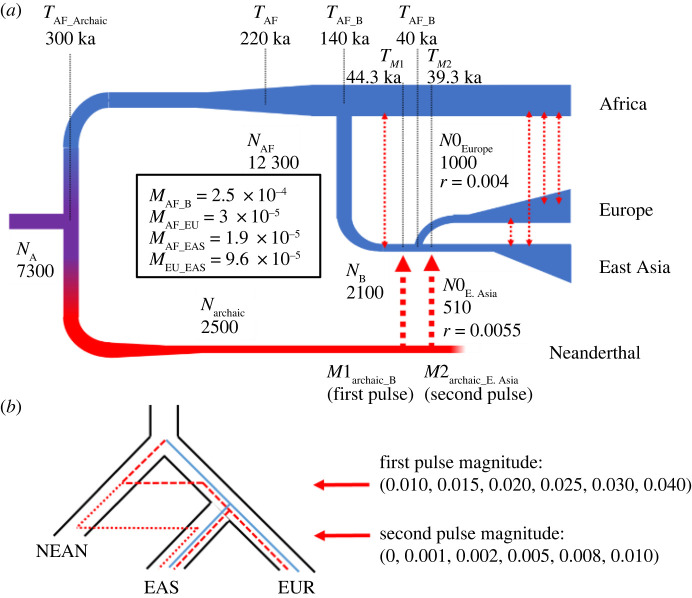
The apportionment of human genetic diversity within and between populations has been measured to understand human relatedness and demographic history. Likewise, the distribution of archaic ancestry in modern populations can be leveraged to better understand the interaction between our species and its archaic relatives. Resolving the interactions between modern and archaic human populations can be difficult, as archaic variants in modern populations have been shaped by genetic drift, bottlenecks and gene flow. Here, we investigate the distribution of archaic variation in Eurasian populations. We find that archaic ancestry coverage at the individual- and population-level present distinct patterns in modern human populations: South Asians have nearly twice the number of population-unique archaic alleles compared with Europeans or East Asians, indicating that these populations experienced differing demographic and archaic admixture events. We confirm previous observations that East Asian individuals have more Neanderthal ancestry than European individuals, but surprisingly, when we compare the number of single nucleotide polymorphisms with archaic alleles found across a population, Europeans have more Neanderthal ancestry than East Asians. We compare these results to simulated models and conclude that these patterns are consistent with multiple admixture events between modern humans and Neanderthals. This article is part of the theme issue 'Celebrating 50 years since Lewontin's apportionment of human diversity'.
人类群体内部和群体之间的遗传多样性分配已被测量,以了解人类的亲缘关系和人口历史。同样,现代人群中古老祖先的分布也可以用来更好地了解我们的物种与其古老亲属之间的相互作用。解决现代人和古代人类群体之间的相互作用可能很困难,因为现代人群中的古代变体受到遗传漂变、瓶颈和基因流的影响。在这里,我们研究了欧亚人群中古老变异的分布。我们发现,个体和群体层面的古老祖先覆盖率在现代人类群体中呈现出不同的模式:南亚人拥有的独特古老等位基因数量几乎是欧洲人或东亚人的两倍,这表明这些群体经历了不同的人口和古老混合事件。我们证实了之前的观察结果,即东亚个体比欧洲个体拥有更多的尼安德特人祖先,但令人惊讶的是,当我们比较一个种群中发现的单核苷酸多态性与古老等位基因的数量时,欧洲人比东亚人拥有更多的尼安德特人祖先。我们将这些结果与模拟模型进行比较,并得出结论,这些模式与现代人类和尼安德特人之间的多次混合事件一致。本文是主题为“庆祝Lewontin 人类多样性分配 50 周年”的一部分。