Langford John T, DiRito Jenna R, Doilicho Natty, Chickering Graylen R, Stern David A, Ouyang Xinshou, Mehal Wajahat, Tietjen Gregory T
Department of Surgery, Yale University School of Medicine, New Haven, CT, United States.
Department of Biomedical Engineering, Yale University, New Haven, CT, United States.
Front Immunol. 2022 Mar 25;13:830992. doi: 10.3389/fimmu.2022.830992. eCollection 2022.
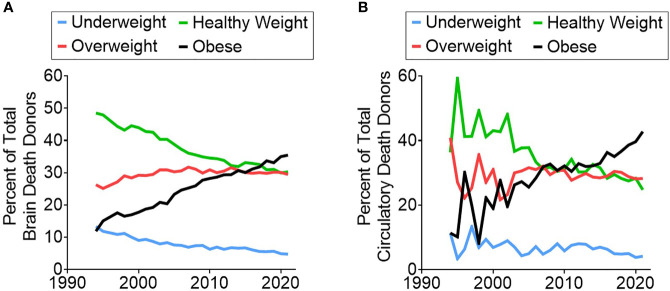
The current obesity epidemic has caused a significant decline in the health of our donor population. Organs from obese deceased donors are more prone to ischemia reperfusion injury resulting from organ preservation. As a consequence, these donors are more likely to be discarded under the assumption that nothing can be done to make them viable for transplant. Our current methods of organ preservation-which remain relatively unchanged over the last ~40 years-were originally adopted in the context of a much healthier donor population. But methods that are suitable for healthier deceased donors are likely not optimal for organs from obese donors. Naturally occurring models of acute obesity and fasting in hibernating mammals demonstrate that obesity and resilience to cold preservation-like conditions are not mutually exclusive. Moreover, recent advances in our understanding of the metabolic dysfunction that underlies obesity suggest that it may be possible to improve the resilience of organs from obese deceased donors. In this mini-review, we explore how we might adapt our current practice of organ preservation to better suit the current reality of our deceased donor population.
当前的肥胖流行已导致我们供体人群的健康状况显著下降。肥胖已故供体的器官更容易因器官保存而发生缺血再灌注损伤。因此,在认为无法采取任何措施使其适合移植的假设下,这些供体更有可能被弃用。我们目前的器官保存方法——在过去约40年里相对没有变化——最初是在供体人群健康得多的背景下采用的。但适用于健康已故供体的方法可能并非肥胖供体器官的最佳选择。冬眠哺乳动物中自然发生的急性肥胖和禁食模型表明,肥胖与对低温保存样条件的耐受性并非相互排斥。此外,我们对肥胖背后代谢功能障碍的最新认识进展表明,有可能提高肥胖已故供体器官的耐受性。在这篇小型综述中,我们探讨如何调整当前的器官保存做法,以更好地适应我们已故供体人群的当前现实。