Philippi Frederik, Pugh David, Rauber Daniel, Welton Tom, Hunt Patricia A
Department of Chemistry, Molecular Sciences Research Hub, Imperial College London White City Campus London W12 0BZ UK
Department of Chemistry Britannia House, 7 Trinity Street London SE1 1DB UK.
Chem Sci. 2020 May 26;11(25):6405-6422. doi: 10.1039/d0sc01379j. eCollection 2020 Jul 7.
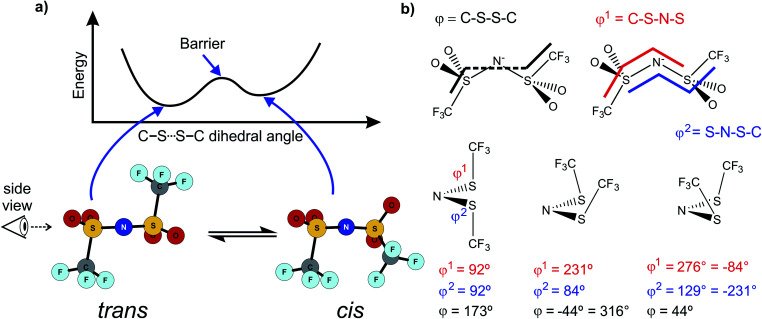
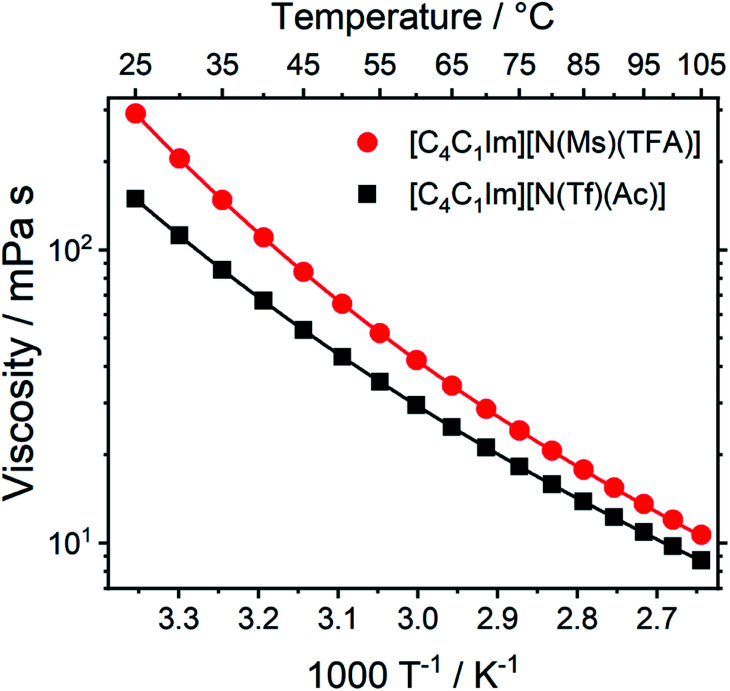
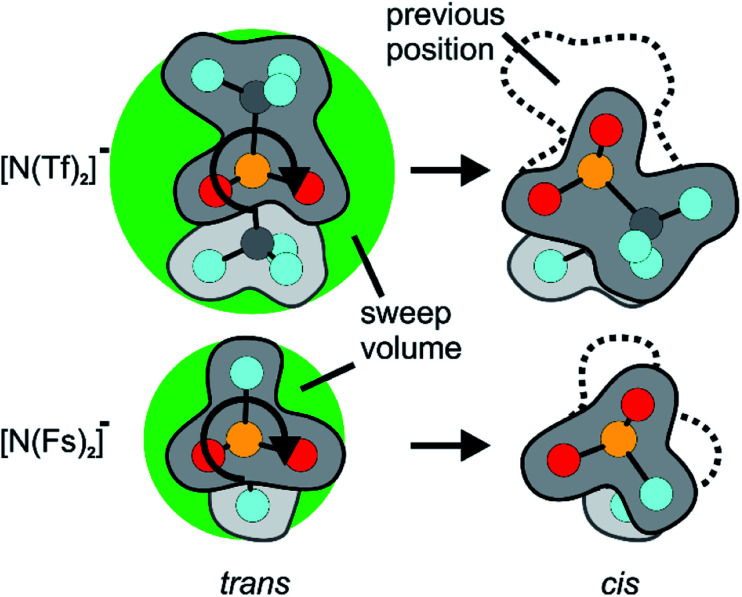
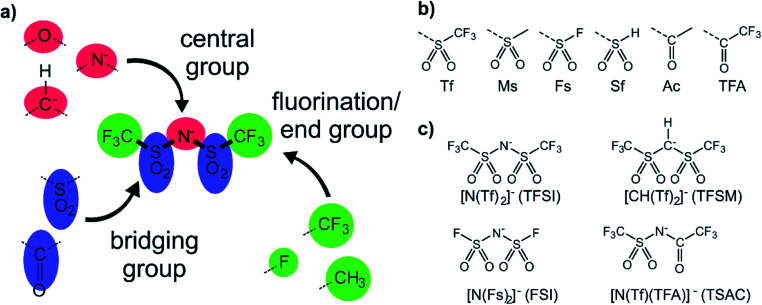
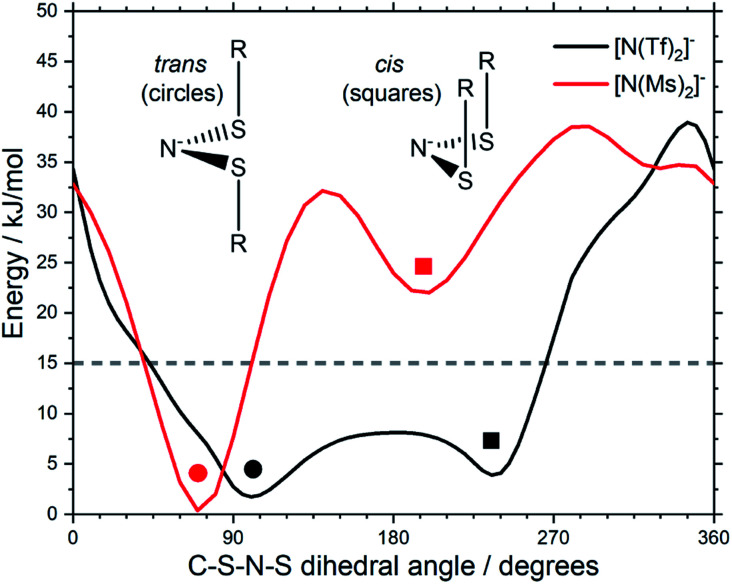
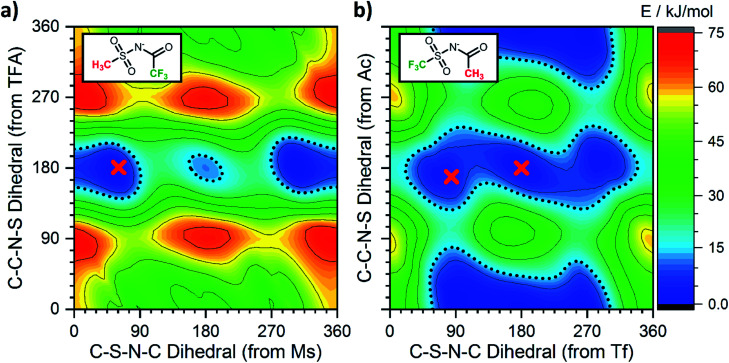
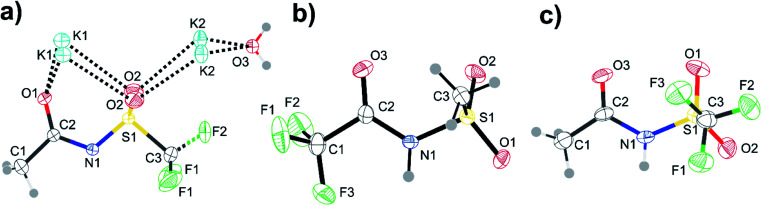
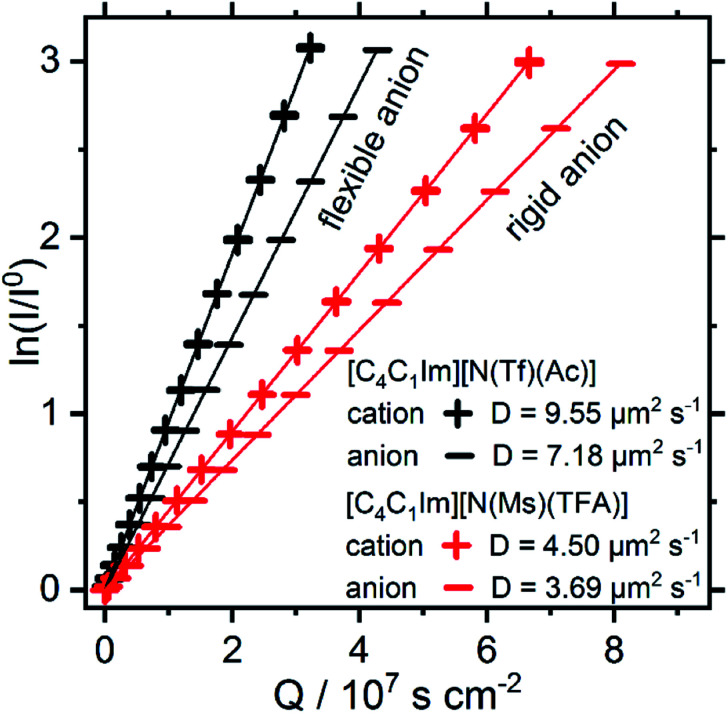
The identification of specific design concepts for the design of ionic liquids (ILs) has been accomplished using theoretical methods. Molecular building blocks, such as interchangeable functional groups, are used to design new ILs which have subsequently been experimentally investigated. The conformational design concepts are developed by separately and systematically changing the central (imide), bridging (sulfonyl) and end (trifluoromethyl) group of the bis(trifluoromethanesulfonyl)imide [N(Tf)] anion and examining the resultant potential energy surfaces. It is shown that these design concepts can be used to tune separately the minimum energy geometry, transition state barrier height and relative stability of different conformers. The insights obtained have been used to design two novel anions for ILs, trifluoroacetyl(methylsulfonyl)imide [N(Ms)(TFA)] and acetyl(trifluoromethanesulfonyl)imide [N(Tf)(Ac)]. The computationally predicted structures show excellent agreement with experimental structures obtained from X-ray crystallography. [CCim][N(Tf)(Ac)] and [CCim][N(Ms)(TFA)] ILs have been synthesised and ion diffusion coefficients examined using pulsed field gradient stimulated echo NMR spectroscopy. Significantly increased diffusion was observed for the more flexible [N(Tf)(Ac)] compared with the more rigid [N(Ms)(TFA)] analogue. Furthermore, a pronounced impact on the fluidity was observed. The viscosity of the IL with the rigid anion was found to be twice as high as the viscosity of the IL with the flexible anion. The design concepts presented in this work will enable researchers in academia and industry to tailor anions to provide ILs with specific desired properties.
利用理论方法已完成了离子液体(ILs)设计中特定设计概念的识别。分子构建单元,如可互换的官能团,被用于设计新的离子液体,随后对其进行了实验研究。通过分别且系统地改变双(三氟甲磺酰)亚胺[N(Tf)]阴离子的中心(酰亚胺)、桥连(磺酰)和末端(三氟甲基)基团,并研究所得的势能面,开发了构象设计概念。结果表明,这些设计概念可分别用于调节不同构象体的最低能量几何结构、过渡态势垒高度和相对稳定性。所获得的见解已被用于设计两种新型的离子液体阴离子,三氟乙酰(甲基磺酰)亚胺[N(Ms)(TFA)]和乙酰(三氟甲磺酰)亚胺[N(Tf)(Ac)]。计算预测的结构与通过X射线晶体学获得的实验结构显示出极好的一致性。已合成了[CCim][N(Tf)(Ac)]和[CCim][N(Ms)(TFA)]离子液体,并使用脉冲场梯度刺激回波核磁共振光谱法检测了离子扩散系数。与刚性更强的[N(Ms)(TFA)]类似物相比,观察到更具柔性的[N(Tf)(Ac)]的扩散显著增加。此外,还观察到对流动性有明显影响。发现具有刚性阴离子的离子液体的粘度是具有柔性阴离子的离子液体粘度的两倍。这项工作中提出的设计概念将使学术界和工业界的研究人员能够定制阴离子,以提供具有特定所需性质的离子液体。