Victor Joshua, Jordan Tristan, Lamkin Erica, Ikeh Kanayo, March Anthony, Frere Justin, Crompton Andrew, Allen Lindsay, Fanning James, Lim Won Young, Muoio Daniela, Fouquerel Elise, Martindale Rachel, Dewitt John, deLance Nicole, Taatjes Douglas, Dragon Julie, Holcombe Randall, Greenblatt Marc, Kaminsky David, Hong Jiyong, Zhou Pei, tenOever Benjamin, Chatterjee Nimrat
University of Vermont.
Icahn School of Medicine at Mount Sinai.
Res Sq. 2022 Apr 14:rs.3.rs-1556634. doi: 10.21203/rs.3.rs-1556634/v1.
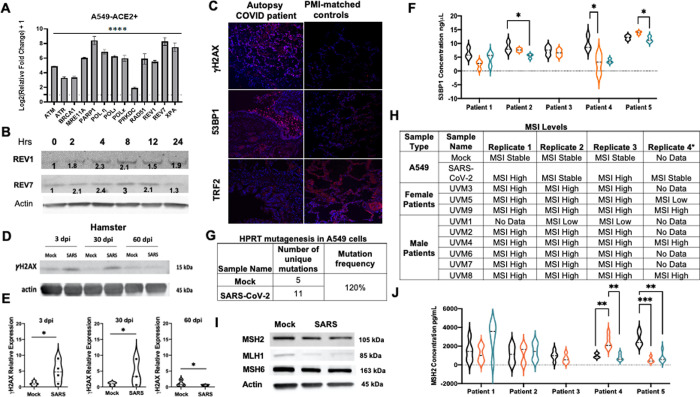
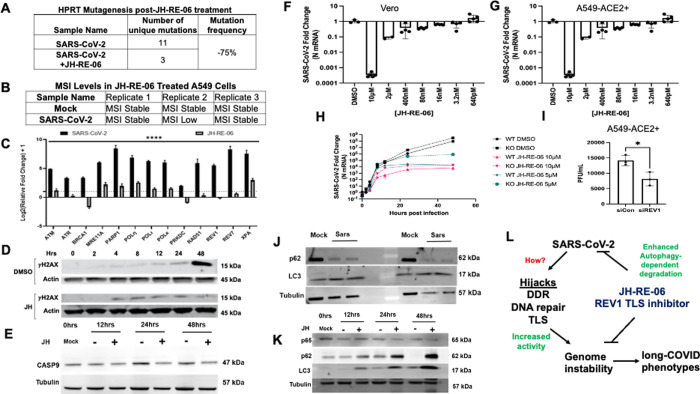
The repertoire of coronavirus disease 2019 (COVID-19)-mediated adverse health outcomes has continued to expand in infected patients, including the susceptibility to developing long-COVID; however, the molecular underpinnings at the cellular level are poorly defined. In this study, we report that SARS-CoV-2 (severe acute respiratory syndrome coronavirus 2) infection triggers host cell genome instability by modulating the expression of molecules of DNA repair and mutagenic translesion synthesis. Further, SARS-CoV-2 infection causes genetic alterations, such as increased mutagenesis, telomere dysregulation, and elevated microsatellite instability (MSI). The MSI phenotype was coupled to reduced MLH1, MSH6, and MSH2 in infected cells. Strikingly, pre-treatment of cells with the REV1-targeting translesion DNA synthesis inhibitor, JH-RE-06, suppresses SARS-CoV-2 proliferation and dramatically represses the SARS-CoV-2-dependent genome instability. Mechanistically, JH-RE-06 treatment induces autophagy, which we hypothesize limits SARS-CoV-2 proliferation and, therefore, the hijacking of host-cell genome instability pathways. These results have implications for understanding the pathobiological consequences of COVID-19.
2019年冠状病毒病(COVID-19)介导的不良健康后果在感染患者中持续增加,包括发展为长期COVID的易感性;然而,细胞水平的分子基础仍不清楚。在本研究中,我们报告严重急性呼吸综合征冠状病毒2(SARS-CoV-2)感染通过调节DNA修复和诱变跨损伤合成分子的表达引发宿主细胞基因组不稳定。此外,SARS-CoV-2感染会导致基因改变,如诱变增加、端粒失调和微卫星不稳定性(MSI)升高。MSI表型与感染细胞中MLH1、MSH6和MSH2的减少有关。引人注目的是,用靶向REV1的跨损伤DNA合成抑制剂JH-RE-06预处理细胞可抑制SARS-CoV-2增殖,并显著抑制SARS-CoV-2依赖性基因组不稳定。从机制上讲,JH-RE-06处理诱导自噬,我们推测这限制了SARS-CoV-2增殖,从而限制了对宿主细胞基因组不稳定途径的劫持。这些结果对理解COVID-19的病理生物学后果具有重要意义。