Department of Virology, National Health Laboratory Service, Charlotte Maxeke Johannesburg Academic Hospital, Johannesburg, South Africa.
School of Pathology, Faculty of Health Sciences, University of the Witwatersrand, Johannesburg, South Africa.
J Med Virol. 2022 Aug;94(8):3676-3684. doi: 10.1002/jmv.27797. Epub 2022 May 8.
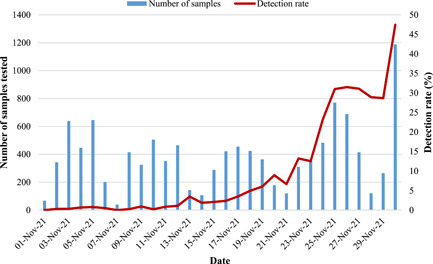
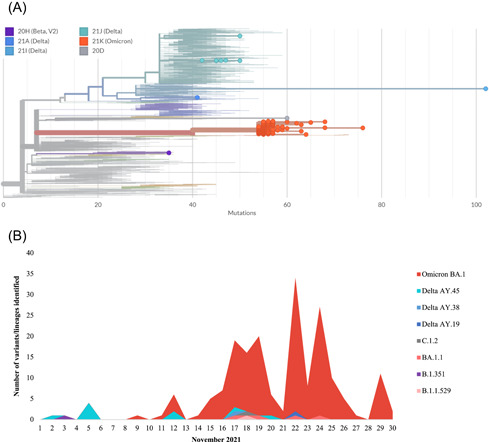
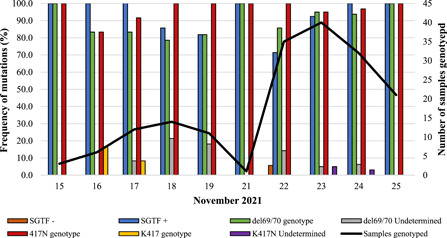
The circulation of Omicron BA.1 led to the rapid increase in severe acute respiratory syndrome coronavirus 2 (SARS-CoV-2) cases in South Africa in November 2021, which warranted the use of more rapid detection methods. We, therefore, assessed the ability to detect Omicron BA.1 using genotyping assays to identify specific mutations in SARS-CoV-2 positive samples, Gauteng province, South Africa. The TaqPath™ COVID-19 real-time polymerase chain reaction assay was performed on all samples selected to identify spike gene target failure (SGTF). SARS-CoV-2 genotyping assays were used for the detection of del69/70 and K417N mutation. Whole-genome sequencing was performed on a subset of genotyped samples to confirm these findings. Of the positive samples received, 11.0% (175/1589) were randomly selected to assess if SGTF and genotyping assays, that detect del69/70 and K417N mutations, could identify Omicron BA.1. We identified SGTF in 98.9% (173/175) of samples, of which 88.0% (154/175) had both the del69/70 and K417N mutation. The genotyped samples (45.7%; 80/175) that were sequenced confirmed Omicron BA.1 (97.5%; 78/80). Our data show that genotyping for the detection of the del69/70 and K417N coupled with SGTF is efficient to exclude Alpha and Beta variants and rapidly detect Omicron BA.1. However, we still require assays for the detection of unique mutations that will allow for the differentiation between other Omicron sublineages. Therefore, the use of genotyping assays to detect new dominant or emerging lineages of SARS-CoV-2 will be beneficial in limited-resource settings.
2021 年 11 月,南非出现的奥密克戎 BA.1 型迅速引发了严重急性呼吸系统综合征冠状病毒 2(SARS-CoV-2)病例的剧增,这使得更快速的检测方法得以应用。因此,我们评估了使用基因分型检测来识别 SARS-CoV-2 阳性样本中特定突变的能力,以检测南非豪登省的奥密克戎 BA.1 型。对所有选定的样本进行 TaqPath™ COVID-19 实时聚合酶链反应检测,以识别尖峰蛋白基因目标失败(SGTF)。使用 SARS-CoV-2 基因分型检测来检测德尔塔 69/70 和 K417N 突变。对部分基因分型样本进行全基因组测序以确认这些发现。在所收到的阳性样本中,随机选择 11.0%(175/1589)的样本,以评估 SGTF 和基因分型检测是否可以识别德尔塔 69/70 和 K417N 突变,从而识别奥密克戎 BA.1。我们在 98.9%(173/175)的样本中发现了 SGTF,其中 88.0%(154/175)的样本同时存在德尔塔 69/70 和 K417N 突变。对基因分型样本(45.7%;175/380)进行测序,证实了奥密克戎 BA.1(97.5%;78/80)的存在。我们的数据表明,针对德尔塔 69/70 和 K417N 检测的基因分型与 SGTF 相结合,能够有效地排除 Alpha 和 Beta 变体,并快速检测奥密克戎 BA.1。然而,我们仍然需要检测独特突变的检测方法,以区分其他奥密克戎亚谱系。因此,在资源有限的情况下,使用基因分型检测来检测 SARS-CoV-2 的新主导或新兴谱系将是有益的。