Department of Clinical Pharmacy, College of Pharmacy, King Saud University, Riyadh, Saudi Arabia.
Pharmacoeconomics Research Unit, College of Pharmacy, King Saud University, Riyadh, Saudi Arabia.
PLoS One. 2022 Apr 20;17(4):e0265928. doi: 10.1371/journal.pone.0265928. eCollection 2022.
Despite the empirical literature demonstrating the efficacy of antidepressant medications for treatment of depression disorder, these medications' effect on patients' overall well-being and health-related quality of life (HRQoL) remains controversial. This study investigates the effect of antidepressant medication use on patient-reported HRQoL for patients who have depression.
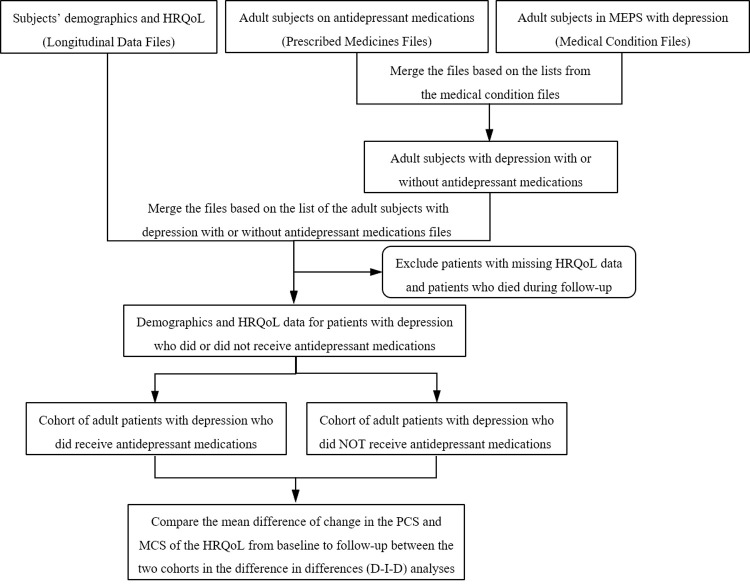
A comparative cohort, secondary database analysis was conducted using data from the United States' Medical Expenditures Panel Survey for patients who had depression. HRQoL was measured using the SF-12 and reported as physical and mental component summaries (PCS and MCS). A cohort of patients that used antidepressant medications were compared to a cohort of patients that did not. Univariate and multivariate difference-in-differences (D-I-D) analyses were used to assess the significance of the mean difference of change on the PCS and MCS from baseline to follow-up.
On average, 17.5 million adults were diagnosed with depression disorder each year during the period 2005-2016. The majority were female (67.9%), a larger proportion of whom received antidepressant medications (60.5% vs. 51.5% of males). Although use of antidepressants was associated with some improvement on the MCS, D-I-D univariate analysis revealed no significant difference between the two cohorts in PCS (-0.35 vs. -0.34, p = 0.9595) or MCS (1.28 vs. 1.13, p = 0.6405). The multivariate D-I-D analyses ensured the robustness of these results.
The real-world effect of using antidepressant medications does not continue to improve patients' HRQoL over time. Future studies should not only focus on the short-term effect of pharmacotherapy, it should rather investigate the long-term impact of pharmacological and non-pharmacological interventions on these patients' HRQoL.
尽管有实证文献证明抗抑郁药物治疗抑郁症的疗效,但这些药物对患者整体健康和健康相关生活质量(HRQoL)的影响仍存在争议。本研究调查了抗抑郁药物使用对患有抑郁症的患者报告的 HRQoL 的影响。
使用美国医疗支出面板调查的数据库进行了比较队列、二次数据库分析,该调查针对患有抑郁症的患者。使用 SF-12 测量 HRQoL,并报告为身体和心理成分综合评分(PCS 和 MCS)。将使用抗抑郁药物的患者队列与未使用抗抑郁药物的患者队列进行比较。使用单变量和多变量差异(D-I-D)分析来评估从基线到随访时 PCS 和 MCS 变化的均值差异的显著性。
平均而言,在 2005-2016 年期间,每年有 1750 万成年人被诊断患有抑郁症。其中大多数为女性(67.9%),其中更大比例的人接受了抗抑郁药物治疗(60.5%比男性的 51.5%)。尽管使用抗抑郁药与 MCS 的某些改善有关,但 D-I-D 单变量分析显示两组在 PCS(-0.35 比 -0.34,p = 0.9595)或 MCS(1.28 比 1.13,p = 0.6405)方面没有显著差异。多变量 D-I-D 分析确保了这些结果的稳健性。
使用抗抑郁药物的实际效果并不会随着时间的推移继续改善患者的 HRQoL。未来的研究不仅应关注药物治疗的短期效果,还应研究药物和非药物干预对这些患者 HRQoL 的长期影响。