From the Nivel, Netherlands Institute for Health Services Research, Utrecht.
Institute of Medical Education Research Rotterdam (iMERR), Erasmus Medical Centre, Rotterdam.
J Patient Saf. 2022 Dec 1;18(8):e1135-e1141. doi: 10.1097/PTS.0000000000001007. Epub 2022 Apr 22.
Human error plays a vital role in diagnostic errors in the emergency department. A thorough analysis of these human errors, using information-rich reports of serious adverse events (SAEs), could help to better study and understand the causes of these errors and formulate more specific recommendations.
We studied 23 SAE reports of diagnostic events in emergency departments of Dutch general hospitals and identified human errors. Two researchers independently applied the Safer Dx Instrument, Diagnostic Error Evaluation and Research Taxonomy, and the Model of Unsafe acts to analyze reports.
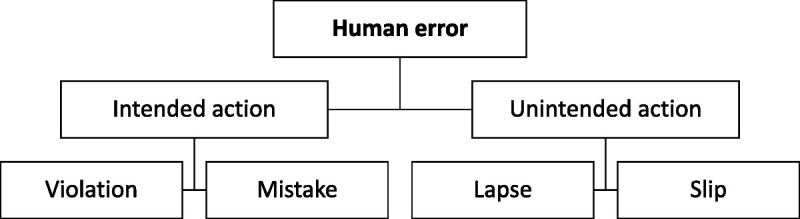
Twenty-one reports contained a diagnostic error, in which we identified 73 human errors, which were mainly based on intended actions (n = 69) and could be classified as mistakes (n = 56) or violations (n = 13). Most human errors occurred during the assessment and testing phase of the diagnostic process.
The combination of different instruments and information-rich SAE reports allowed for a deeper understanding of the mechanisms underlying diagnostic error. Results indicated that errors occurred most often during the assessment and the testing phase of the diagnostic process. Most often, the errors could be classified as mistakes and violations, both intended actions. These types of errors are in need of different recommendations for improvement, as mistakes are often knowledge based, whereas violations often happen because of work and time pressure. These analyses provided valuable insights for more overarching recommendations to improve diagnostic safety and would be recommended to use in future research and analysis of (serious) adverse events.
人为错误在急诊科的诊断错误中起着至关重要的作用。通过对这些人为错误进行详细分析,利用严重不良事件(SAE)的信息丰富的报告,可以帮助更好地研究和理解这些错误的原因,并制定更具体的建议。
我们研究了荷兰综合医院急诊科 23 份 SAE 报告中的诊断事件,并确定了人为错误。两名研究人员独立应用 Safer Dx Instrument、Diagnostic Error Evaluation and Research Taxonomy 和 Model of Unsafe acts 来分析报告。
21 份报告包含诊断错误,其中我们确定了 73 个人为错误,这些错误主要基于预期行为(n = 69),可以分为错误(n = 56)或违规(n = 13)。大多数人为错误发生在诊断过程的评估和测试阶段。
不同仪器的结合和信息丰富的 SAE 报告使我们能够更深入地了解诊断错误的潜在机制。结果表明,错误最常发生在诊断过程的评估和测试阶段。大多数情况下,这些错误可以归类为错误和违规,都是预期行为。这些类型的错误需要不同的改进建议,因为错误通常是基于知识的,而违规通常是由于工作和时间压力造成的。这些分析为提高诊断安全性提供了有价值的见解,并建议在未来的研究和(严重)不良事件分析中使用。