Department of Trauma and Microreconstructive Surgery, the First Affiliated Hospital of Xinjiang Medical University, Urumqi, Xinjiang, China.
BMC Musculoskelet Disord. 2022 Apr 20;23(1):369. doi: 10.1186/s12891-022-05324-7.
Tardy ulnar nerve palsy is a common late complication of traumatic cubitus valgus. At present, the treatment of tardy ulnar nerve palsy associated with traumatic cubitus valgus is still controversial, whether these two problems can be corrected safely and effectively in one operation is still unclear. To investigate the supracondylar shortening wedge rotary osteotomy combined with in situ tension release of the ulnar nerve in the treatment of tardy ulnar nerve palsy associated with traumatic cubitus valgus.
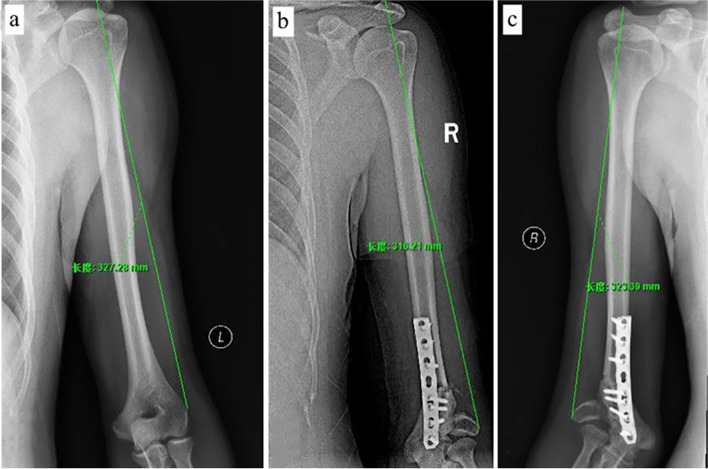
Between 2012 and 2019, 16 patients who had traumatic cubitus valgus deformities with tardy ulnar nerve palsy were treated with simultaneous supracondylar shortening wedge rotary osteotomy and ulnar nerve in situ tension release. we compared a series of indicators of preoperative and postoperative follow-up for at least 24 months, (1) elbow range of motion; (2) the radiographic correction of the preoperative and postoperative humerus-elbow-wrist angles; (3) the static two-point discrimination and grip strength; and (4) the preoperative and postoperative DASH scores of upper limb function. The minimum follow-up was 24 months postoperative (mean, 33 months; range, 24 ~ 44 months).
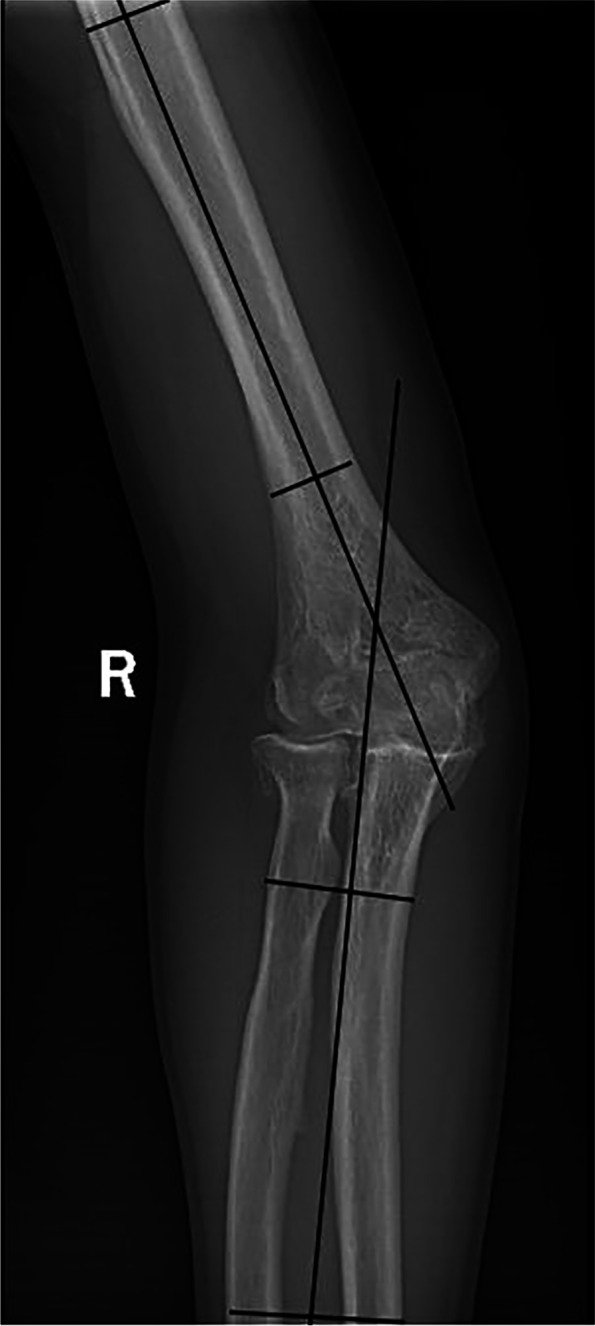
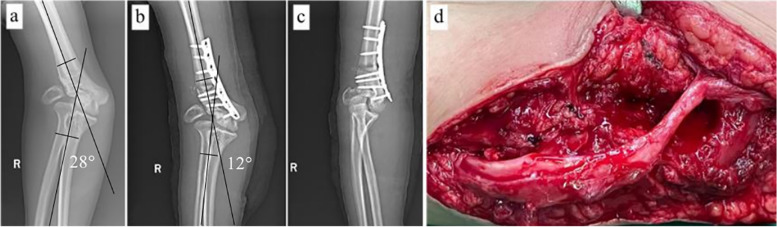
The mean ROM was improved from 107 ° preoperatively to 122 ° postoperatively (P = 0.001). The mean preoperative elbow wrist angle was 24.6 °, and the mean postoperative humerus-elbow wrist angle was 12.1 ° (P < 0.001). The average grip strength and static two-point discrimination improved from 21 kgf and 8 mm to 28 kgf and 4.0 mm (P < 0.001 and P < 0.001, respectively). The ulnar nerve symptoms were improved in all patients except one. The mean HASH score improved from 29 to 16 (P < 0.001).
Supracondylar shortening wedge rotary osteotomy combined with in situ tension release of ulnar nerve is an effective method for the treatment of traumatic cubitus valgus with tardy ulnar nerve palsy, which restored the normal biomechanical characteristics of the affected limb and improved the elbow joint function.
迟发性尺神经麻痹是创伤性肘内翻的常见晚期并发症。目前,创伤性肘内翻伴迟发性尺神经麻痹的治疗仍存在争议,这两个问题是否能在一次手术中安全有效地矫正尚不清楚。探讨尺神经原位张力松解联合尺神经上髁缩短楔形截骨旋转截骨治疗创伤性肘内翻迟发性尺神经麻痹。
2012 年至 2019 年,16 例创伤性肘内翻伴迟发性尺神经麻痹患者行尺神经原位张力松解联合尺神经上髁缩短楔形截骨旋转截骨术。我们比较了术前和术后至少 24 个月的一系列随访指标,(1)肘活动范围;(2)术前和术后肱骨-肘-腕角的影像学矫正;(3)静态两点辨别觉和握力;(4)上肢功能的术前和术后 DASH 评分。术后随访时间最短 24 个月(平均 33 个月;范围 24~44 个月)。
平均 ROM 从术前的 107°改善到术后的 122°(P=0.001)。术前平均肘腕角为 24.6°,术后平均肱骨-肘-腕角为 12.1°(P<0.001)。平均握力和静态两点辨别觉分别从 21kgf 和 8mm 改善至 28kgf 和 4.0mm(P<0.001 和 P<0.001)。除 1 例外,所有患者的尺神经症状均得到改善。平均 HASH 评分从 29 分改善至 16 分(P<0.001)。
尺神经上髁缩短楔形截骨旋转截骨联合尺神经原位松解是治疗创伤性肘内翻伴迟发性尺神经麻痹的有效方法,恢复了患肢正常的生物力学特性,改善了肘关节功能。