Public Health and Social Protection Professional, Kathmandu, Nepal.
Department of Economics, Nepal Commerce Campus, Tribhuvan University, New Baneshwor, Kathmandu, Nepal.
Global Health. 2022 Apr 20;18(1):42. doi: 10.1186/s12992-022-00834-4.
Child undernutrition continues to be a major public health problem in many countries, including Nepal. The repercussions of undernutrition are not only limited to the affected children and families but also transcend to the national and global economy. Earlier studies from Nepal have predominantly used either ordinary least squares (OLS) regression or binary regression to analyse the socioeconomic and demographic correlates of the nutritional outcome. In this study, quantile regression was used to understand a complete and more precise estimate of the effects of the covariates on the child nutritional status.
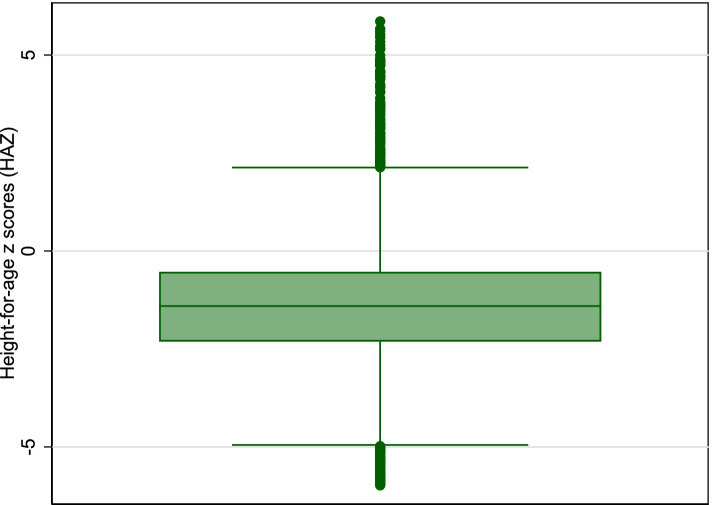
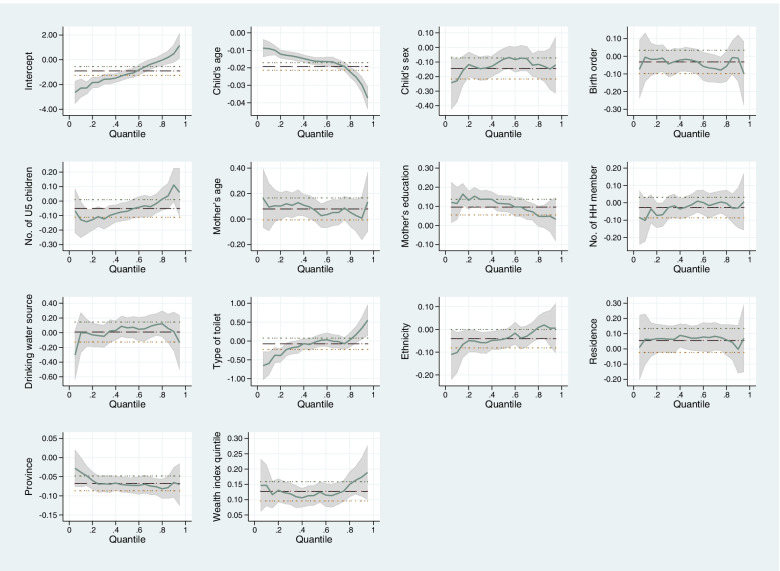
This study was based on the most recent nationally representative Nepal Multiple Indicator Cluster Survey (MICS) 2019. Height-for-age z scores (HAZ) were used as an indicator for assessing the nutritional status of under-five children. Quantile regression was used to examine the heterogeneous association of covariates with conditional HAZ distribution across the different quantiles (0.10, 0.30, 0.50, 0.85). As a comparison, the effects of covariates at conditional mean of HAZ using OLS regression was also analysed. The graphs were plotted to visualize the changes in the coefficients for each regressor across the entire conditional HAZ distribution.
Age of children, sex of children, province and wealth had a consistent and statistically significant association with HAZ in both OLS and quantile regression. Improved toilet facility was positively correlated with HAZ at the lower tails (tenth and thirtieth percentiles). Ethnicity (Janajati and Newer) was positively correlated with HAZ at the lower tail (thirtieth percentile) and mean (OLS regression). Maternal education was a significant predictor of improved height-for-age across conditional quantiles, except at the tenth percentile. Maternal age, number of under-five children in household, number of household members, and improved source of drinking water showed heterogeneous effects across different quantiles of conditional HAZ distribution.
Use of quantile regression approach showed that the effect of different factors differed across the conditional distribution of HAZ. Policymakers should consider the heterogeneous effect of different factors on HAZ so that the targeted intervention could be implemented to maximize the nutritional benefits to children.
儿童营养不良仍然是许多国家(包括尼泊尔)的主要公共卫生问题。营养不良的影响不仅限于受影响的儿童和家庭,还会超越国家和全球经济。尼泊尔以前的研究主要使用普通最小二乘法(OLS)回归或二元回归来分析营养结果的社会经济和人口统计学相关性。在这项研究中,使用分位数回归来了解协变量对儿童营养状况的影响的完整和更精确的估计。
本研究基于最近的全国代表性尼泊尔多指标类集调查(MICS)2019 年数据。身高年龄 z 分数(HAZ)被用作评估五岁以下儿童营养状况的指标。使用分位数回归来检查协变量与条件 HAZ 分布在不同分位数(0.10、0.30、0.50、0.85)之间的异质关联。作为比较,还使用 OLS 回归分析了协变量对 HAZ 条件均值的影响。绘制了图表,以可视化整个条件 HAZ 分布中每个回归量的系数变化。
儿童年龄、儿童性别、省份和财富与 OLS 和分位数回归中的 HAZ 均具有一致且具有统计学意义的关联。改善的厕所设施与 HAZ 的较低尾(十分位数和第三十分位数)呈正相关。少数民族(Janajati 和 Newer)与 HAZ 的较低尾(第三十分位数)和均值(OLS 回归)呈正相关。母亲教育是提高各条件分位数 HAZ 的重要预测因素,但十分位数除外。母亲年龄、家庭中五岁以下儿童人数、家庭人数和改善的饮用水来源在不同条件 HAZ 分布分位数之间表现出异质效应。
使用分位数回归方法表明,不同因素的影响在 HAZ 的条件分布中有所不同。决策者应考虑不同因素对 HAZ 的异质影响,以便实施有针对性的干预措施,使儿童最大程度地受益于营养。