Tannir Nizar M, Cho Daniel C, Diab Adi, Sznol Mario, Bilen Mehmet A, Balar Arjun V, Grignani Giovanni, Puente Erika, Tang Lily, Chien David, Hoch Ute, Choudhury Arkopal, Yu Danni, Currie Sue L, Tagliaferri Mary A, Zalevsky Jonathan, Siefker-Radtke Arlene O, Hurwitz Michael E
University of Texas MD Anderson Cancer Center, Houston, Texas, USA
New York Medical College, Westchester Medical Center, Valhalla, New York, USA.
J Immunother Cancer. 2022 Apr;10(4). doi: 10.1136/jitc-2021-004419.
Immune checkpoint inhibitor-based combinations have expanded the treatment options for patients with renal cell carcinoma (RCC); however, tolerability remains challenging. The aim of this study was to evaluate the safety and efficacy of the immunostimulatory interleukin-2 cytokine prodrug bempegaldesleukin (BEMPEG) plus nivolumab (NIVO) as first-line therapy in patients with advanced clear-cell RCC.
This was an open-label multicohort, multicenter, single-arm phase 1/2 study; here, we report results from the phase 1/2 first-line RCC cohort (N=49). Patients received BEMPEG 0.006 mg/kg plus NIVO 360 mg intravenously every 3 weeks. The primary objectives were safety and objective response rate (ORR; patients with measurable disease at baseline and at least one postbaseline tumor response assessment). Secondary objectives included overall survival (OS) and progression-free survival (PFS). Exploratory biomarker analyses: association between baseline biomarkers and ORR.
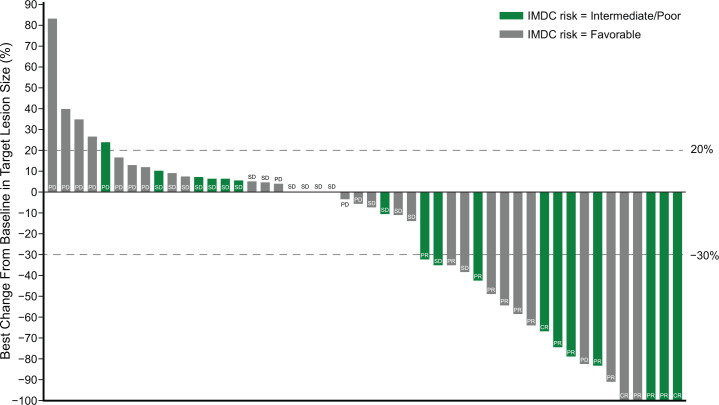
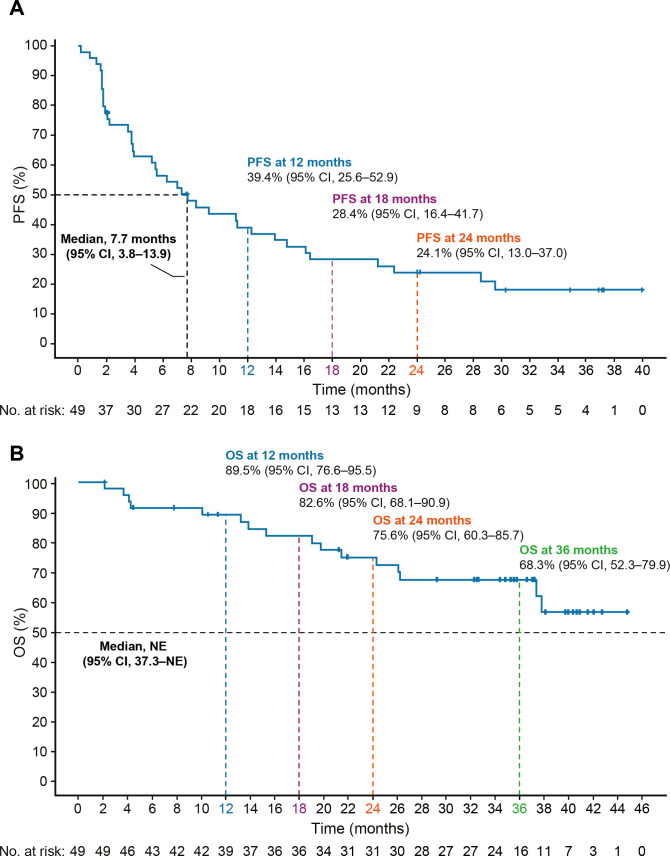
At a median follow-up of 32.7 months, the ORR was 34.7% (17/49 patients); 3/49 patients (6.1%) had a complete response. Of the 17 patients with response, 14 remained in response for >6 months, and 6 remained in response for >24 months. Median PFS was 7.7 months (95% CI 3.8 to 13.9), and median OS was not reached (95% CI 37.3 to not reached). Ninety-eight per cent (48/49) of patients experienced ≥1 treatment-related adverse event (TRAE) and 38.8% (19/49) had grade 3/4 TRAEs, most commonly syncope (8.2%; 4/49) and increased lipase (6.1%; 3/49). No association between exploratory biomarkers and ORR was observed. Limitations include the small sample size and single-arm design.
BEMPEG plus NIVO showed preliminary antitumor activity as first-line therapy in patients with advanced clear-cell RCC and was well tolerated. These findings warrant further investigation.
基于免疫检查点抑制剂的联合疗法扩大了肾细胞癌(RCC)患者的治疗选择;然而,耐受性仍然是一个挑战。本研究的目的是评估免疫刺激性白细胞介素-2细胞因子前药贝姆培吉德白介素(BEMPEG)联合纳武利尤单抗(NIVO)作为晚期透明细胞RCC患者一线治疗的安全性和疗效。
这是一项开放标签的多队列、多中心、单臂1/2期研究;在此,我们报告1/2期一线RCC队列(N = 49)的结果。患者每3周静脉注射一次BEMPEG 0.006 mg/kg加NIVO 360 mg。主要目标是安全性和客观缓解率(ORR;基线时有可测量疾病且至少有一次基线后肿瘤反应评估的患者)。次要目标包括总生存期(OS)和无进展生存期(PFS)。探索性生物标志物分析:基线生物标志物与ORR之间的关联。
中位随访32.7个月时,ORR为34.7%(17/49例患者);3/49例患者(6.1%)完全缓解。在17例有反应的患者中,14例反应持续>6个月,6例反应持续>24个月。中位PFS为7.7个月(95%CI 3.8至13.9),中位OS未达到(95%CI 37.3至未达到)。98%(48/49)的患者经历了≥1次治疗相关不良事件(TRAE),38.8%(19/49)的患者发生3/4级TRAE,最常见的是晕厥(8.2%;4/49)和脂肪酶升高(6.1%;3/49)。未观察到探索性生物标志物与ORR之间的关联。局限性包括样本量小和单臂设计。
BEMPEG联合NIVO作为晚期透明细胞RCC患者的一线治疗显示出初步抗肿瘤活性,且耐受性良好。这些发现值得进一步研究。