
利培酮与胃癌的关联:来自细胞研究、动物研究和队列研究的三角测量法
Association of Risperidone With Gastric Cancer: Triangulation Method From Cell Study, Animal Study, and Cohort Study.
作者信息
Chen Vincent Chin-Hung, Hsu Tsai-Ching, Lin Chiao-Fan, Huang Jing-Yu, Chen Yi-Lung, Tzang Bor-Show, McIntyre Roger S
机构信息
Department of Psychiatry, School of Medicine, Chang Gung University, Taoyuan, Taiwan.
Department of Psychiatry, Chang Gung Medical Foundation, Chiayi Chang Gung Memorial Hospital, Chiayi, Taiwan.
出版信息
Front Pharmacol. 2022 Apr 4;13:846455. doi: 10.3389/fphar.2022.846455. eCollection 2022.
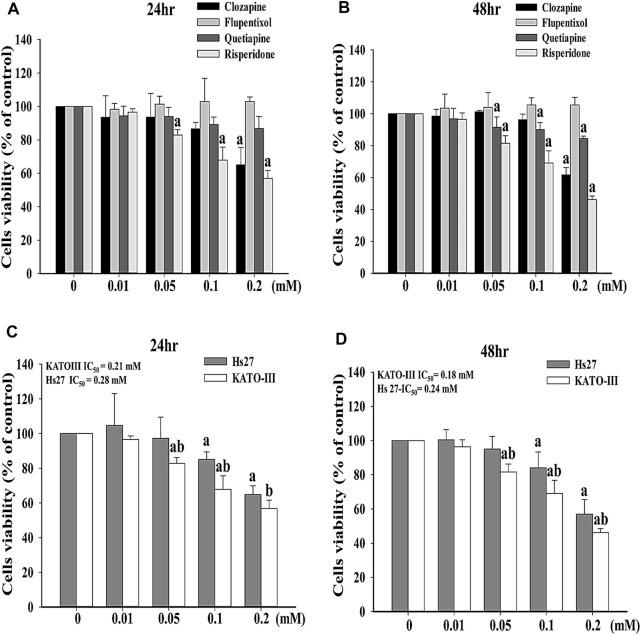
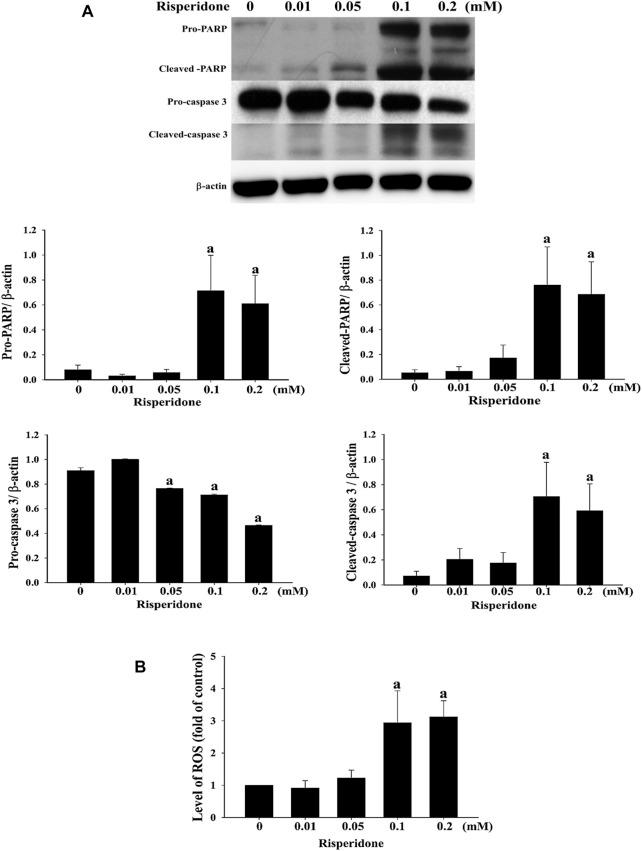
To examine the effects of risperidone, an atypical antipsychotic agent, on gastric cancer. A triangulation method comprising bench studies, including cell and animal experiments, and a retrospective cohort study, was subsequently performed. The bench study indicated that risperidone exerted more prominent tumor inhibition effects than other atypical antipsychotics on the proliferation of KATO-III cells, a human gastric cancer cell line. Significant and dose-dependent cell viability was observed in Hs27 cells (control cells) in the presence of risperidone compared with in KATO-III cells. Both and results indicated that risperidone significantly inhibited the proliferation of KATO-III cells by inducing ROS and apoptosis, and that it suppressed the growth of xenografted KATO-III tumors in nude mice. In addition, the population-based cohort study found that risperidone users had reduced risks of gastric cancer compared with non-users, with lowered adjusted hazard ratios (HRs) for two induction periods (HR = 0.75; 95% confidence interval [CI] 0.68-0.83 for the one-year induction period, and HR = 0.68; 95% CI 0.61-0.75 for the two-year induction period). The findings are consistent with anticancer effects associated with risperidone, but further research and evaluations are warranted.
为研究非典型抗精神病药物利培酮对胃癌的影响。随后采用了一种三角测量法,包括细胞和动物实验等实验室研究以及一项回顾性队列研究。实验室研究表明,与其他非典型抗精神病药物相比,利培酮对人胃癌细胞系KATO-III细胞的增殖具有更显著的肿瘤抑制作用。与KATO-III细胞相比,在利培酮存在的情况下,Hs27细胞(对照细胞)观察到显著的剂量依赖性细胞活力。两项结果均表明,利培酮通过诱导活性氧(ROS)和细胞凋亡显著抑制KATO-III细胞的增殖,并抑制裸鼠体内移植的KATO-III肿瘤的生长。此外,基于人群的队列研究发现,与未使用利培酮的人相比,使用利培酮的人患胃癌的风险降低,两个诱导期的调整后风险比(HR)降低(一年诱导期的HR = 0.75;95%置信区间[CI] 0.68 - 0.83,两年诱导期的HR = 0.68;95% CI 0.61 - 0.75)。这些发现与利培酮的抗癌作用一致,但仍需要进一步的研究和评估。




 Zotero 插件