Department of Biochemistry and Molecular Biology, Complutense University of Madrid, Madrid, Spain.
Division of Cellular Pneumology, Research Center Borstel, Leibniz Lung Center, Borstel, Germany.
Front Immunol. 2022 Apr 4;13:860262. doi: 10.3389/fimmu.2022.860262. eCollection 2022.
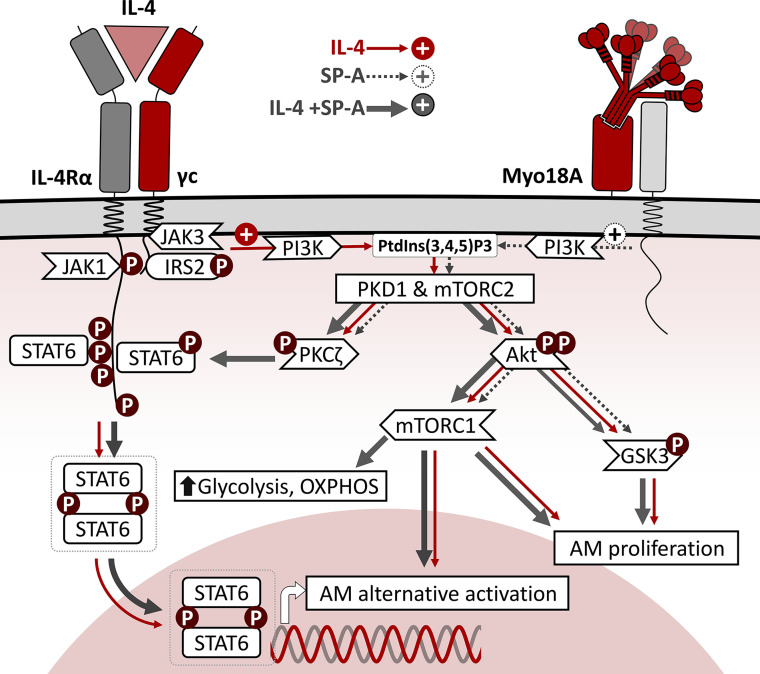
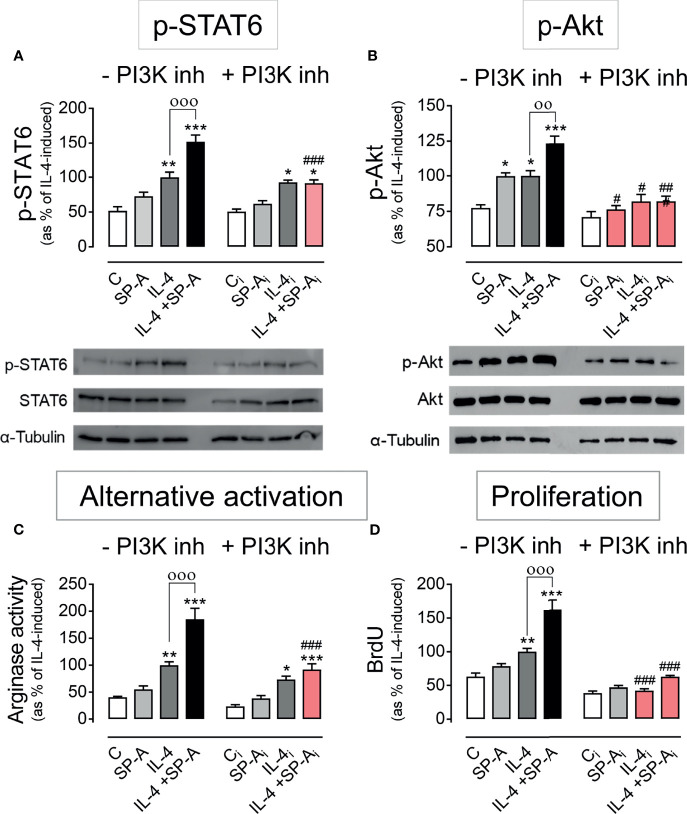
Activation of tissue repair program in macrophages requires the integration of IL-4/IL-13 cytokines and tissue-specific signals. In the lung, surfactant protein A (SP-A) is a tissue factor that amplifies IL-4Rα-dependent alternative activation and proliferation of alveolar macrophages (AMs) through the myosin18A receptor. However, the mechanism by which SP-A and IL-4 synergistically increase activation and proliferation of AMs is unknown. Here we show that SP-A amplifies IL-4-mediated phosphorylation of STAT6 and Akt by binding to myosin18A. Blocking PI3K activity or the myosin18A receptor abrogates SP-A´s amplifying effects on IL-4 signaling. SP-A alone activates Akt, mTORC1, and PKCζ and inactivates GSK3α/β by phosphorylation, but it cannot activate arginase-1 activity or AM proliferation on its own. The combined effects of IL-4 and SP-A on the mTORC1 and GSK3 branches of PI3K-Akt signaling contribute to increased AM proliferation and alternative activation, as revealed by pharmacological inhibition of Akt (inhibitor VIII) and mTORC1 (rapamycin and torin). On the other hand, the IL-4+SP-A-driven PKCζ signaling axis appears to intersect PI3K activation with STAT6 phosphorylation to achieve more efficient alternative activation of AMs. Consistent with IL-4+SP-A-driven activation of mTORC1 and mTORC2, both agonists synergistically increased mitochondrial respiration and glycolysis in AMs, which are necessary for production of energy and metabolic intermediates for proliferation and alternative activation. We conclude that SP-A signaling in AMs activates PI3K-dependent branched pathways that amplify IL-4 actions on cell proliferation and the acquisition of AM effector functions.
组织修复程序在巨噬细胞中的激活需要整合白细胞介素 4/白细胞介素 13 细胞因子和组织特异性信号。在肺部,表面活性蛋白 A(SP-A)是一种组织因子,通过肌球蛋白 18A 受体放大白细胞介素 4 受体α(IL-4Rα)依赖性的肺泡巨噬细胞(AMs)的替代激活和增殖。然而,SP-A 和白细胞介素 4 协同增加 AM 激活和增殖的机制尚不清楚。在这里,我们发现 SP-A 通过与肌球蛋白 18A 结合来放大白细胞介素 4 介导的 STAT6 和 Akt 的磷酸化。阻断 PI3K 活性或肌球蛋白 18A 受体可消除 SP-A 对白细胞介素 4 信号的放大作用。SP-A 本身可激活 Akt、mTORC1 和 PKCζ,并通过磷酸化使 GSK3α/β失活,但不能单独激活精氨酸酶-1 活性或 AM 增殖。IL-4 和 SP-A 对 mTORC1 和 PI3K-Akt 信号的 GSK3 分支的联合作用有助于增加 AM 增殖和替代激活,如通过 Akt(抑制剂 VIII)和 mTORC1(雷帕霉素和 torin)的药理学抑制所揭示的那样。另一方面,IL-4+SP-A 驱动的 PKCζ 信号轴似乎与 STAT6 磷酸化相交,以实现 AM 更有效的替代激活。与 IL-4+SP-A 驱动的 mTORC1 和 mTORC2 激活一致,两种激动剂协同增加 AM 中的线粒体呼吸和糖酵解,这是增殖和替代激活所需的能量和代谢中间产物的产生所必需的。我们得出结论,SP-A 在 AM 中的信号转导激活了 PI3K 依赖性分支途径,该途径放大了白细胞介素 4 对细胞增殖和 AM 效应功能获得的作用。