Zheng Chun-Hui, Xu Kai, Shan Wen-Ping, Zhang Ya-Kun, Su Zhi-De, Gao Xiang-Jin, Wang Yu-Jue, Qi Jian-Yu, Ding Xiao-Yan, Wang Chun-Ping, Wang Yong-Sheng
Breast Cancer Center, Shandong Cancer Hospital and Institute, Shandong First Medical University and Shandong Academy of Medical Sciences, Jinan, China.
Department of Breast Surgery, Weifang People's Hospital, Weifang, China.
Front Oncol. 2022 Apr 4;11:617167. doi: 10.3389/fonc.2021.617167. eCollection 2021.
Patients with concentric shrinkage mode after neoadjuvant chemotherapy (NAC) is considered to be ideal candidates for breast conserving treatment (BCT). While, what proportion of patients would represent CSM have not been well defined. This study was conducted to pool the rates of concentric shrinkage mode (CSM) in patients undergoing NAC, determine the impact of hormonal receptor on the shrinkage mode after NAC and estimate the rates of the CSM in various subgroups.
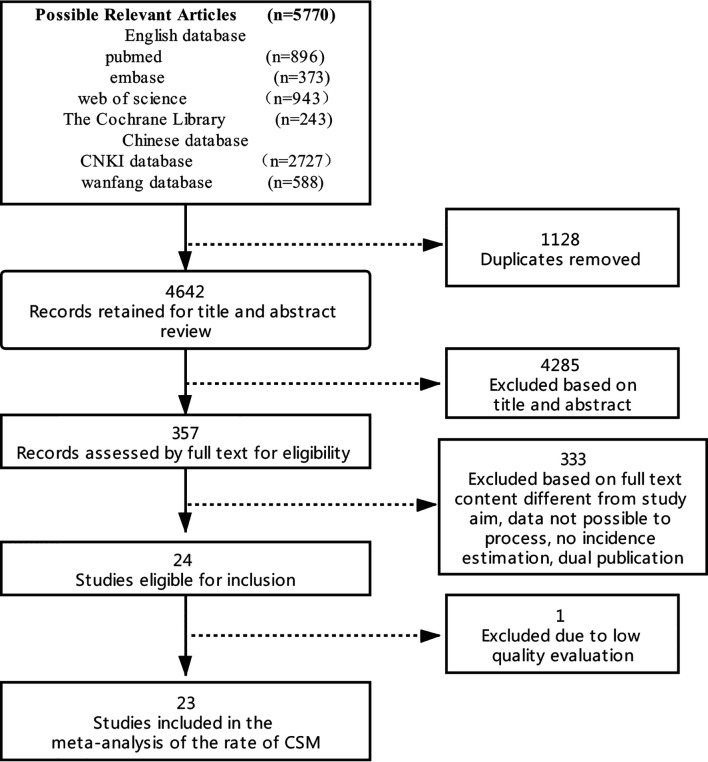
We conducted a systematic review following the guidelines for Meta-Analyses and Systematic reviews for the PRISMA guidelines. We systematically searched the literature about shrinkage mode after NAC from PubMed, Web of Science, Embase, The Cochrane Library, CNKI, Wanfang database published from January 2002 to June 2020 on breast cancer shrinkage mode after NAC and carefully screened the literature by using eligibility criteria: (1) patients with primary breast cancer treated with NAC; (2) publications with available data of shrinkage mode measured by magnetic resonance imaging (MRI), or data of pathology and hormonal receptor. The association between shrinkage mode and hormonal receptor was estimated using Stata 15.1 software.
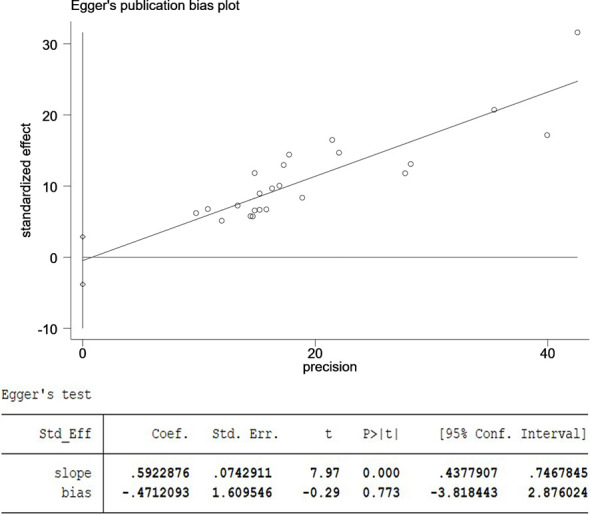
This analysis included a total of 2434 tumors from 23 papers. The included studies were heterogeneous (I2 = 89.4%, P<0.01). Random effects model was used to estimate the overall rates of CSM: 56.6% [95%CI (50.5%, 62.7%)]. According to the analysis of hormonal receptor, 10 of the paper was included for HR+ (hormone receptor positive) type analysis and the rate of CSM for HR+ type was 45.7% [95%CI (36.4%, 55.0%)]; 9 of the paper was used for HR- type (hormone receptor negative) analysis and the incidence of HR-CSM is 63.1% [95%CI (50.0%, 76.1%)]; with HR+ type as the control, the OR of the HR- CSM rate is 2.32 (1.32, 4.08) folds of HR+ type. From subgroup analyses, the CSM% of luminal A, luminal B, Her2+, and triple negative were 29.7% (16.5%, 42.8%); 47.2% (19.1%, 75.3%); 59.0% (39.7%, 78.3%); 66.2% (52.8%, 79.6%), respectively.
Breast cancer patients undergoing NAC did not get an ideal odds ratio of CSM. The incidence of CSM in breast cancer after NAC is associated with hormonal receptor. Patients with triple-negative breast cancers have the highest rates of CSM after NAC. More care should be taken to select patients with the luminal subtypes for BCT throughout NAC.
新辅助化疗(NAC)后呈向心性收缩模式的患者被认为是保乳治疗(BCT)的理想候选者。然而,出现向心性收缩模式的患者比例尚未明确界定。本研究旨在汇总接受NAC患者的向心性收缩模式(CSM)发生率,确定激素受体对NAC后收缩模式的影响,并估计各亚组的CSM发生率。
我们按照PRISMA指南的Meta分析和系统评价指南进行了系统评价。我们系统检索了2002年1月至2020年6月在PubMed、Web of Science、Embase、Cochrane图书馆、中国知网、万方数据库上发表的关于NAC后乳腺癌收缩模式的文献,并使用纳入标准仔细筛选文献:(1)接受NAC治疗的原发性乳腺癌患者;(2)有通过磁共振成像(MRI)测量的收缩模式可用数据,或病理和激素受体数据的出版物。使用Stata 15.1软件估计收缩模式与激素受体之间的关联。
该分析共纳入了23篇论文中的2434个肿瘤。纳入的研究具有异质性(I2 = 89.4%,P<0.01)。采用随机效应模型估计CSM的总体发生率:56.6% [95%CI(50.5%,62.7%)]。根据激素受体分析,纳入10篇论文进行HR +(激素受体阳性)类型分析,HR +类型的CSM发生率为45.7% [95%CI(36.4%,55.0%)];纳入9篇论文进行HR -类型(激素受体阴性)分析,HR - CSM的发生率为63.1% [95%CI(50.0%,76.1%)];以HR +类型为对照,HR - CSM发生率的OR为2.32(1.32,4.08)倍于HR +类型。亚组分析显示,腔面A型、腔面B型、Her2 +型和三阴性的CSM%分别为29.7%(16.5%,42.8%);47.2%(19.1%,75.3%);59.0%(39.7%,78.3%);66.2%(52.8%,79.6%)。
接受NAC的乳腺癌患者未获得理想的CSM优势比。NAC后乳腺癌中CSM的发生率与激素受体有关。三阴性乳腺癌患者在NAC后CSM发生率最高。在整个NAC过程中,应更加谨慎地选择腔面亚型患者进行BCT。