Institute for Physiology, Pathophysiology and Toxicology, ZBAF, Witten/Herdecke University, Stockumer Strasse 12, 58453, Witten, Germany.
Physiology and Pathophysiology of Cells and Membranes, Medical School EWL, Bielefeld University, R.1 B2-13, Morgenbreede 1, 33615 Bielefeld, Germany.
Arch Toxicol. 2022 Jun;96(6):1573-1607. doi: 10.1007/s00204-022-03285-3. Epub 2022 Apr 21.
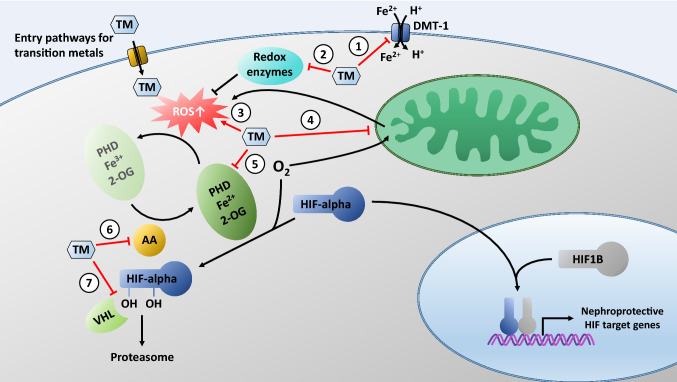
The kidney is the main organ that senses changes in systemic oxygen tension, but it is also the key detoxification, transit and excretion site of transition metals (TMs). Pivotal to oxygen sensing are prolyl-hydroxylases (PHDs), which hydroxylate specific residues in hypoxia-inducible factors (HIFs), key transcription factors that orchestrate responses to hypoxia, such as induction of erythropoietin (EPO). The essential TM ion Fe is a key component and regulator of the hypoxia-PHD-HIF-EPO (HPHE) signaling axis, which governs erythropoiesis, angiogenesis, anaerobic metabolism, adaptation, survival and proliferation, and hence cell and body homeostasis. However, inadequate concentrations of essential TMs or entry of non-essential TMs in organisms cause toxicity and disrupt health. Non-essential TMs are toxic because they enter cells and displace essential TMs by ionic and molecular mimicry, e. g. in metalloproteins. Here, we review the molecular mechanisms of HPHE interactions with TMs (Fe, Co, Ni, Cd, Cr, and Pt) as well as their implications in renal physiology, pathophysiology and toxicology. Some TMs, such as Fe and Co, may activate renal HPHE signaling, which may be beneficial under some circumstances, for example, by mitigating renal injuries from other causes, but may also promote pathologies, such as renal cancer development and metastasis. Yet some other TMs appear to disrupt renal HPHE signaling, contributing to the complex picture of TM (nephro-)toxicity. Strikingly, despite a wealth of literature on the topic, current knowledge lacks a deeper molecular understanding of TM interaction with HPHE signaling, in particular in the kidney. This precludes rationale preventive and therapeutic approaches to TM nephrotoxicity, although recently activators of HPHE signaling have become available for therapy.
肾脏是感知全身氧张力变化的主要器官,但也是过渡金属 (TM) 的主要解毒、转运和排泄部位。氧感应的关键是脯氨酰-羟化酶 (PHD),它羟化缺氧诱导因子 (HIF) 中的特定残基,HIF 是协调缺氧反应的关键转录因子,例如促红细胞生成素 (EPO) 的诱导。必需 TM 离子 Fe 是缺氧-PHD-HIF-EPO (HPHE) 信号轴的关键组成部分和调节剂,该信号轴控制着红细胞生成、血管生成、无氧代谢、适应、存活和增殖,从而维持细胞和身体的稳态。然而,必需 TM 的浓度不足或非必需 TM 进入生物体都会导致毒性并破坏健康。非必需 TM 具有毒性,因为它们进入细胞并通过离子和分子模拟取代必需 TM,例如在金属蛋白中。在这里,我们综述了 HPHE 与 TM(Fe、Co、Ni、Cd、Cr 和 Pt)相互作用的分子机制及其在肾脏生理学、病理生理学和毒理学中的意义。一些 TM,如 Fe 和 Co,可能会激活肾脏 HPHE 信号,这在某些情况下可能是有益的,例如减轻其他原因引起的肾脏损伤,但也可能促进病理学,例如肾癌的发展和转移。然而,其他一些 TM 似乎会破坏肾脏 HPHE 信号,导致 TM(肾)毒性的复杂情况。值得注意的是,尽管关于该主题有大量文献,但目前的知识缺乏对 TM 与 HPHE 信号相互作用的更深入的分子理解,特别是在肾脏中。这使得针对 TM 肾毒性的合理预防和治疗方法变得困难,尽管最近 HPHE 信号激活剂已可用于治疗。