Bapir Rawa, Ahmed Shaho F, Gharib Soran Mohammeed, Qader Deedar, Kakamad Fahmi H, Popov Elenko, Buchholz Noor, Salih Abduwahid M
Department of Urology, Sulaimani Teaching Hospital, Sulaimani, Kurdistan, Iraq; Smart Health Tower, Madam Mitterrand Street, Sulaimani, Kurdistan, Iraq; U-merge Ltd. (Urology in Emerging Countries), London, Athens, Dubai, United Kingdom of Great Britain and Northern Ireland.
Smart Health Tower, Madam Mitterrand Street, Sulaimani, Kurdistan, Iraq.
Int J Surg Case Rep. 2022 May;94:107008. doi: 10.1016/j.ijscr.2022.107008. Epub 2022 Apr 4.
Pheochromocytomas are rare tumors of the adrenal gland. Intestinal pseudo-obstruction is a very rare presentation of a functioning catecholamine-secreting tumor. We present a case of intestinal pseudo-obstruction due to a large functioning pheochromocytoma.
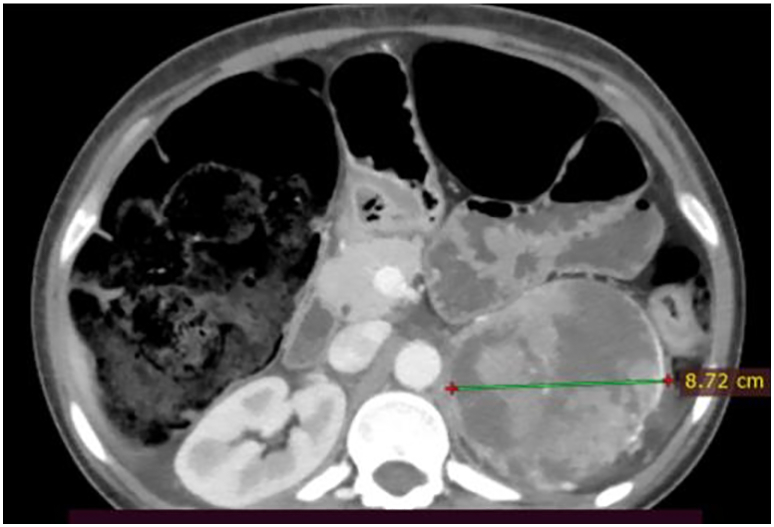
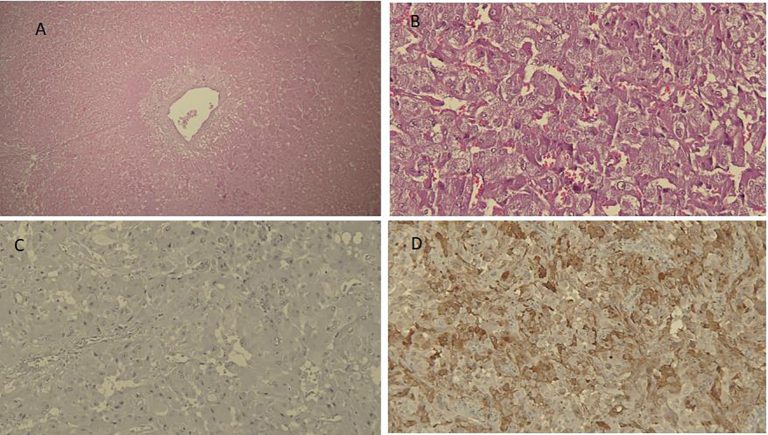
A 29-year-old female presented with abdominal distension, pain, nausea, and vomiting with constipation for 3 weeks. She was hypertensive and diabetic and was on multiple medications. She reported frequent spells of severe headaches, palpitations, night sweats, and a 17 kg weight loss over 6 months. She had pallor, dyspnea, marked abdominal distension, and diminished bowel sounds. Her blood pressure was high at 200/120 mmHg. She had tachycardia (pulse 120 bpm) and tachypnea (35 pm). Serum metanephrine levels were significantly elevated, measuring 1203 pg/ml. Abdominal CT showed a heterogeneous, hyper-vascular mass near the upper pole of the left kidney, measuring 10.75 cm × 8.72 cm. Open left adrenalectomy was performed through an anterior subcostal approach to remove the tumor with the left adrenal gland. Histopathological examinations were consistent with pheochromocytoma.
Some authors documented the correlation between tumor size and metabolic activity of catecholamine-secreting tumors with intestinal pseudo-obstruction by paralytic ileus. This case corresponds with these findings, with a tumor mass of 350 g and a serum metanephrine level of 1203 pg/ml.
Although it is extremely rare, functioning pheochomocytoma could be a cause of instestinal obstruction or pseudo-obstruction.
嗜铬细胞瘤是肾上腺的罕见肿瘤。肠道假性梗阻是分泌儿茶酚胺的功能性肿瘤极为罕见的一种表现形式。我们报告一例因巨大功能性嗜铬细胞瘤导致肠道假性梗阻的病例。
一名29岁女性,出现腹胀、腹痛、恶心、呕吐及便秘3周。她患有高血压和糖尿病,正在服用多种药物。她自述频繁发作严重头痛、心悸、盗汗,6个月内体重减轻17千克。她面色苍白、呼吸急促、腹部明显膨隆,肠鸣音减弱。血压高达200/120mmHg。心率过速(脉搏120次/分),呼吸急促(35次/分)。血清甲氧基肾上腺素水平显著升高,为1203pg/ml。腹部CT显示左肾上极附近有一大小为10.75cm×8.72cm的不均匀、高血管性肿块。通过肋下前入路行左侧肾上腺切除术,切除肿瘤及左侧肾上腺。组织病理学检查结果符合嗜铬细胞瘤。
一些作者记录了分泌儿茶酚胺的肿瘤大小与代谢活性和因麻痹性肠梗阻导致的肠道假性梗阻之间的相关性。该病例与此类发现相符,肿瘤质量为350克,血清甲氧基肾上腺素水平为1203pg/ml。
尽管极为罕见,但功能性嗜铬细胞瘤可能是肠梗阻或假性梗阻的病因。