Ren Jie, Ding Rui, Li Shuaixia, Zhang Mingming, Wei Dongtao, Feng Chunliang, Xu Pengfei, Luo Wenbo
Research Center of Brain and Cognitive Neuroscience, Liaoning Normal University, Dalian 116029, China.
Key Laboratory of Brain and Cognitive Neuroscience, Dalian 116029, China.
Brain Sci. 2022 Mar 31;12(4):466. doi: 10.3390/brainsci12040466.
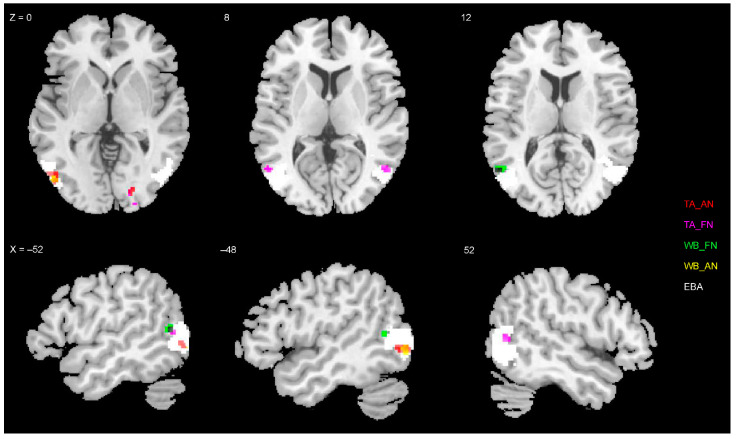
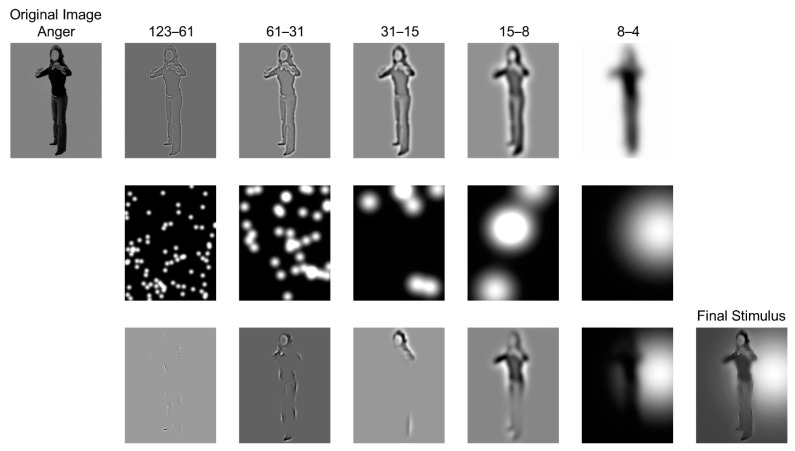
Social species perceive emotion via extracting diagnostic features of body movements. Although extensive studies have contributed to knowledge on how the entire body is used as context for decoding bodily expression, we know little about whether specific body parts (e.g., arms and legs) transmit enough information for body understanding. In this study, we performed behavioral experiments using the Bubbles paradigm on static body images to directly explore diagnostic body parts for categorizing angry, fearful and neutral expressions. Results showed that subjects recognized emotional bodies through diagnostic features from the torso with arms. We then conducted a follow-up functional magnetic resonance imaging (fMRI) experiment on body part images to examine whether diagnostic parts modulated body-related brain activity and corresponding neural representations. We found greater activations of the extra-striate body area (EBA) in response to both anger and fear than neutral for the torso and arms. Representational similarity analysis showed that neural patterns of the EBA distinguished different bodily expressions. Furthermore, the torso with arms and whole body had higher similarities in EBA representations relative to the legs and whole body, and to the head and whole body. Taken together, these results indicate that diagnostic body parts (i.e., torso with arms) can communicate bodily expression in a detectable manner.
社会性物种通过提取身体动作的诊断特征来感知情绪。尽管大量研究有助于我们了解如何将整个身体作为解码身体表情的背景,但我们对特定身体部位(如手臂和腿部)是否能传递足够信息以实现对身体的理解知之甚少。在本研究中,我们使用气泡范式对静态身体图像进行行为实验,以直接探索用于对愤怒、恐惧和中性表情进行分类的诊断性身体部位。结果表明,受试者通过带有手臂的躯干的诊断特征来识别情绪化的身体。然后,我们对身体部位图像进行了后续的功能磁共振成像(fMRI)实验,以检查诊断性部位是否调节与身体相关的大脑活动及相应的神经表征。我们发现,相对于中性表情,额外纹状体身体区域(EBA)对愤怒和恐惧表情中躯干和手臂的激活程度更高。表征相似性分析表明,EBA的神经模式能够区分不同的身体表情。此外,相对于腿部与全身以及头部与全身,带有手臂的躯干与全身在EBA表征上具有更高的相似性。综上所述,这些结果表明,诊断性身体部位(即带有手臂的躯干)能够以可检测的方式传达身体表情。