Department of Neurosurgery, Washington University School of Medicine, St. Louis, MO 63110, USA.
Department of Neurosurgery, Johns Hopkins All Children's Hospital, St. Petersburg, FL 33701, USA.
Curr Oncol. 2022 Apr 8;29(4):2550-2563. doi: 10.3390/curroncol29040209.
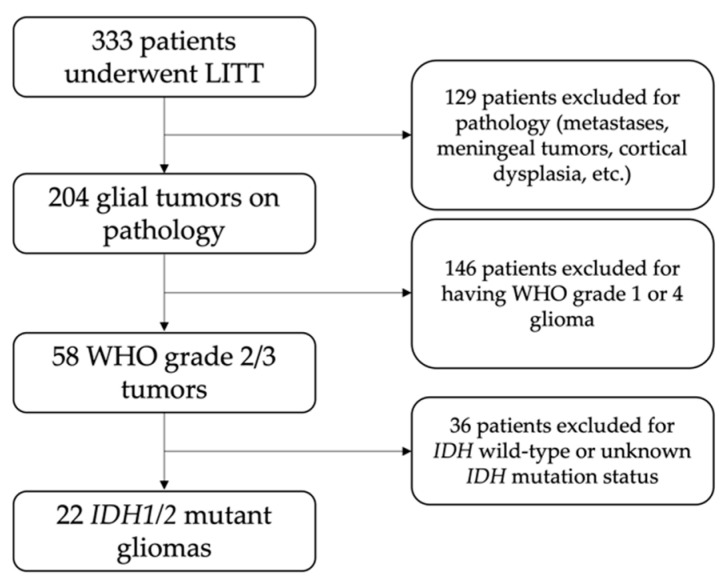
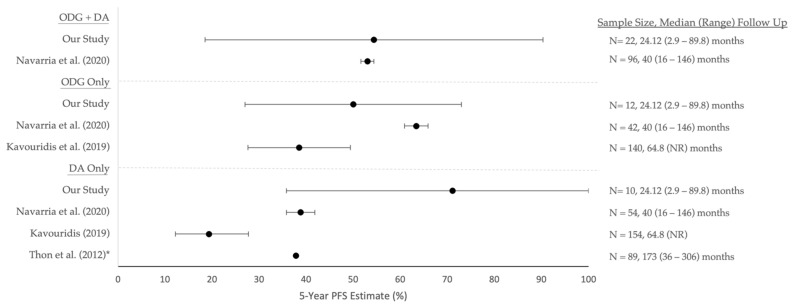
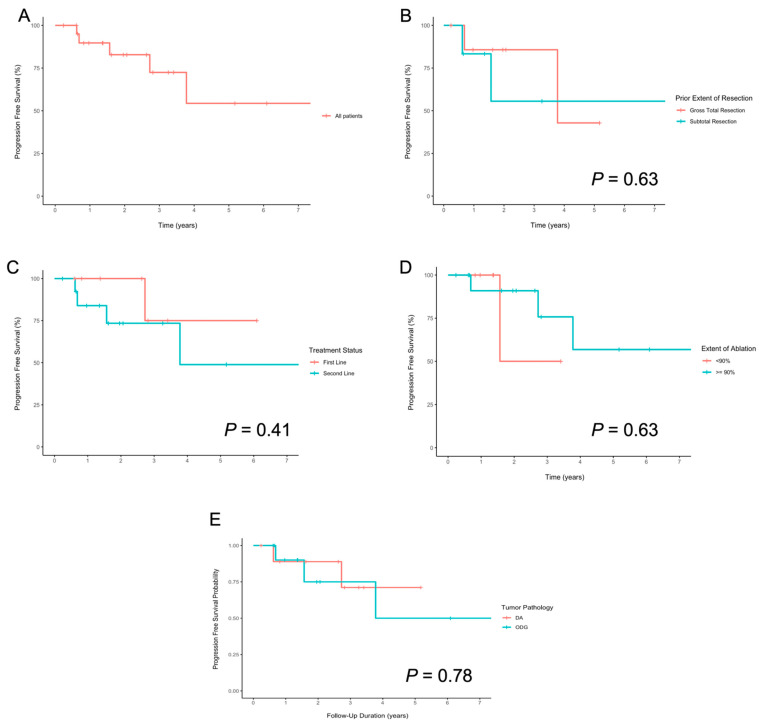
Laser interstitial thermal therapy (LITT) has become an increasingly utilized alternative to surgical resection for the treatment of glioma in patients. However, treatment outcomes in isocitrate dehydrogenase 1 and 2 () mutant glioma, specifically, have not been reported. The objective of this study was to characterize a single institution's cohort of mutant grade 2/3 glioma patients treated with LITT. We collected data on patient presentation, radiographic features, tumor molecular profile, complications, and outcomes. We calculated progression-free survival (PFS) and tested factors for significant association with longer PFS. Overall, 22.7% of our cohort experienced progression at a median follow up of 1.8 years. The three- and five-year estimates of PFS were 72.5% and 54.4%, respectively. This is the first study to characterize outcomes in patients with mutant glioma after LITT. Our results suggest that LITT is an effective treatment option for mutant glioma.
激光间质热疗 (LITT) 已成为治疗胶质瘤患者的一种越来越受欢迎的替代手术切除的方法。然而,对于异柠檬酸脱氢酶 1 和 2 () 突变型胶质瘤,其治疗效果尚未得到报道。本研究的目的是描述一家机构的 突变型 2/3 级胶质瘤患者接受 LITT 治疗的队列。我们收集了患者表现、影像学特征、肿瘤分子特征、并发症和结果的数据。我们计算了无进展生存期 (PFS),并测试了与更长 PFS 显著相关的因素。总的来说,我们队列中有 22.7%的患者在中位随访 1.8 年后出现进展。3 年和 5 年的 PFS 估计分别为 72.5%和 54.4%。这是第一项描述 LITT 后 突变型胶质瘤患者结局的研究。我们的结果表明,LITT 是 突变型胶质瘤的有效治疗选择。