Department of Psychology (Biological Psychology, Clinical Psychology, and Psychotherapy), University of Würzburg, Würzburg, Germany.
Department of Psychology, Technische Universität Dresden, Dresden, Germany.
Sci Rep. 2022 Apr 21;12(1):6576. doi: 10.1038/s41598-022-09931-1.
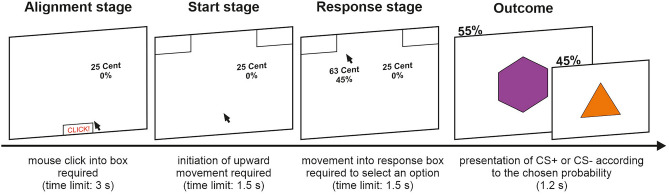
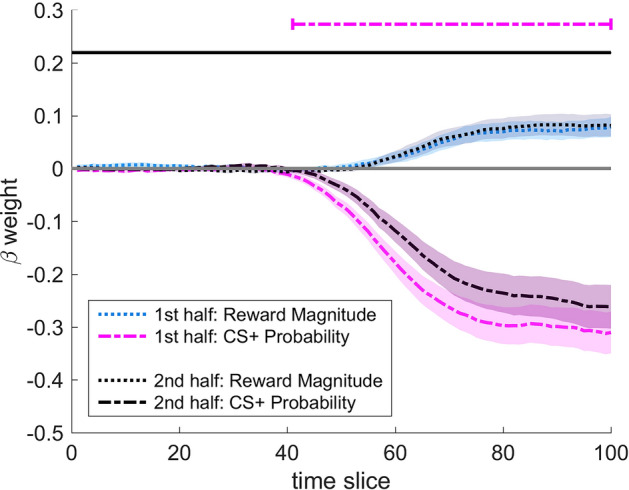
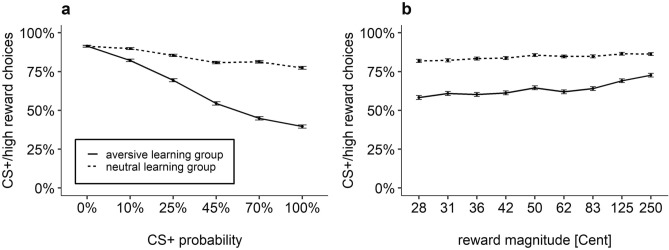
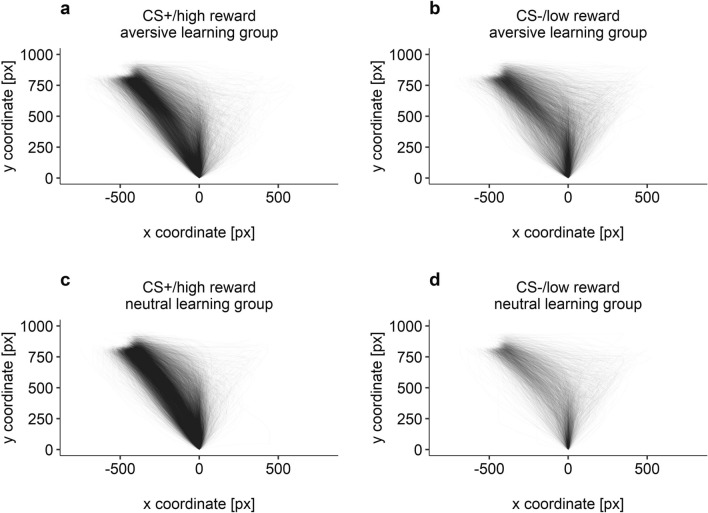
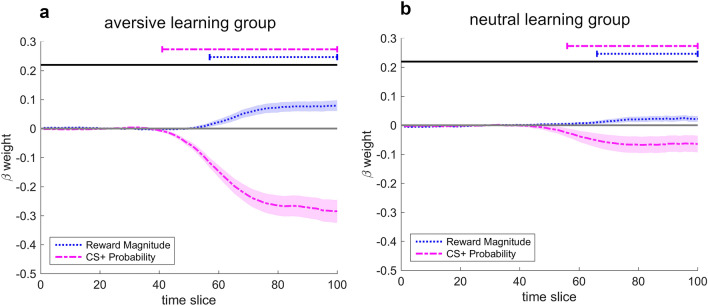
Conflicts between avoiding feared stimuli versus approaching them for competing rewards are essential for functional behavior and anxious psychopathology. Yet, little is known about the underlying decision process. We examined approach-avoidance decisions and their temporal dynamics when avoiding Pavlovian fear stimuli conflicted with gaining rewards. First, a formerly neutral stimulus (CS+) was repeatedly paired with an aversive stimulus (US) to establish Pavlovian fear. Another stimulus (CS-) was never paired with the US. A control group received neutral tones instead of aversive USs. Next, in each of 324 trials, participants chose between a CS-/low reward and a CS+/high reward option. For the latter, probability of CS+ presentation (Pavlovian fear information) and reward magnitude (reward information) varied. Computer mouse movements were tracked to capture the decision dynamics. Although no more USs occurred, pronounced and persistent costly avoidance of the Pavlovian fear CS+ was found. Time-continuous multiple regression of movement trajectories revealed a stronger and faster impact of Pavlovian fear compared to reward information during decision-making. The impact of fear information, but not reward information, modestly decreased across trials. These findings suggest a persistently stronger weighting of fear compared to reward information during approach-avoidance decisions, which may facilitate the development of pathological avoidance.
避免恐惧刺激与接近竞争奖励之间的冲突对于功能行为和焦虑性精神病理学至关重要。然而,人们对潜在的决策过程知之甚少。我们研究了在避免条件性恐惧刺激与获得奖励发生冲突时的趋近回避决策及其时间动态。首先,一个以前是中性的刺激(CS+)与一个令人厌恶的刺激(US)反复配对,以建立条件性恐惧。另一个刺激(CS-)从未与 US 配对。对照组接受中性音而非厌恶 US。接下来,在 324 次试验中的每一次,参与者在 CS-/低奖励和 CS+/高奖励选项之间进行选择。对于后者,CS+呈现的概率(条件性恐惧信息)和奖励幅度(奖励信息)会发生变化。通过跟踪计算机鼠标运动来捕捉决策动态。尽管不再出现 US,但仍发现明显且持续的、对条件性恐惧 CS+的高代价回避。运动轨迹的连续时间多元回归显示,在决策过程中,条件性恐惧信息的影响比奖励信息更强、更快。恐惧信息的影响,但不是奖励信息的影响,随着试验的进行而适度降低。这些发现表明,在趋近回避决策中,恐惧信息的权重比奖励信息持续更强,这可能有助于病理性回避的发展。