Nour Muhammad, Elgibaly Ahmed A, Farahat Mohamed S, Mahmoud Omar
Qarun Petroleum Company (QPC), Cairo 11728, Egypt.
Department of Petroleum Engineering, Faculty of Petroleum and Mining Engineering, Suez University, Suez 11252, Egypt.
ACS Omega. 2022 Apr 4;7(14):12374-12389. doi: 10.1021/acsomega.2c00924. eCollection 2022 Apr 12.
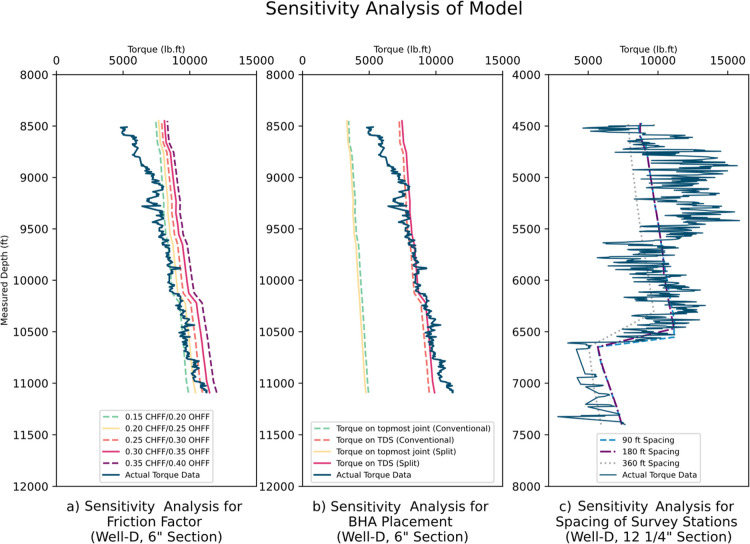
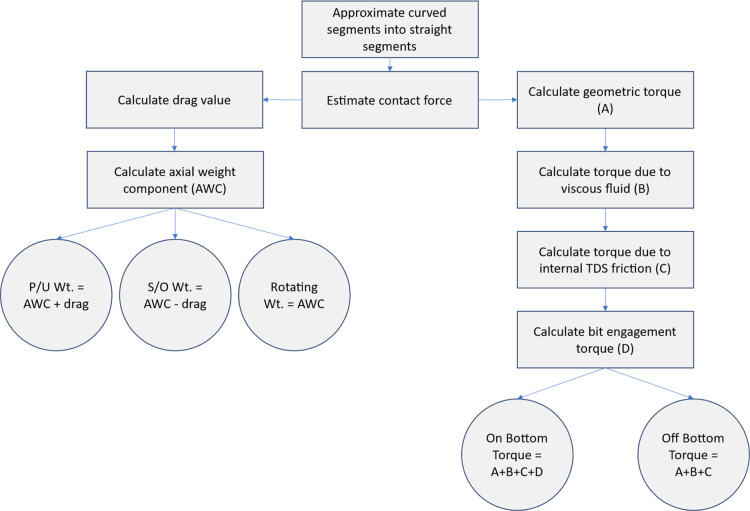
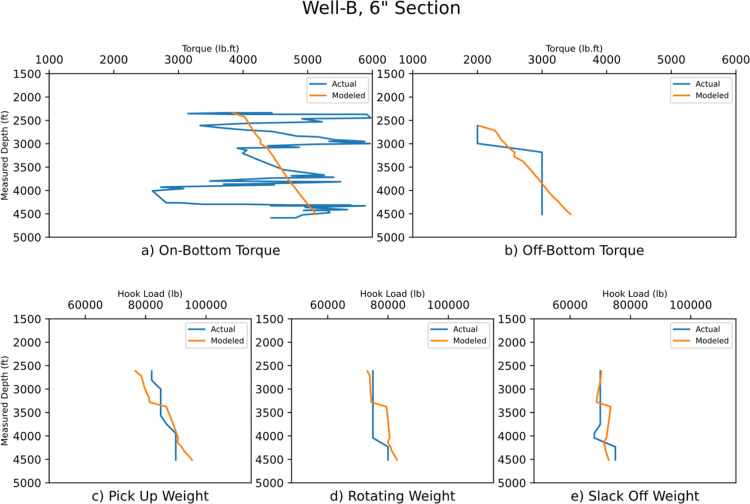
Planning high-angle wells involves diverse areas; one of the most important of these areas is torque and drag (T&D) management. Not only could uncontrolled T&D cause various drilling problems like drill string (D/S) failures, casing wear, stuck pipes, and slow rates of penetration but it could also entirely stop the drilling progress, if torque and/or drag exceed rig or string capabilities. Modeling T&D in advance would alleviate these problems by prediction of friction forces to be encountered and urging the drilling team to take the required measures to mitigate these forces or upgrade the drilling hardware (rig equipment and/or D/S). Modeling T&D is still a complex and time-consuming job to be carried out at the rig site while drilling, so that an accurate and rig-friendly model would be very useful to industry. In this work, a novel and simple model had been developed to predict T&D values while drilling both curve and tangent sections of high-angle wells based on a soft-string concept, in which the D/S is assumed to be a chain lying on the lower side of the well that can transmit torsional forces. Despite the simplicity of the calculations, the model accounts for components of drilling torque that are overlooked in most complex packages. Friction within the top drive system had been considered to predict the torque acting on the D/S only. In addition, the torque applied on the D/S by the viscous drilling fluid was accounted for by reversing the concept of viscometers. The model proved to be practical and reliable for the two-dimensional wellbore and thus is superior in terms of quick field application. The developed model was tested using data from the Western Desert, Egypt. Statistical analysis had been used to assure the accuracy of the proposed model and to assess the effect of different drilling parameters and practices on both T&D. The reliability of the model had been proven with a negligible error for drag calculations and 10% error on average for torque calculations. Also, the effect of distance between successive survey stations on T&D modeling had been proven mathematically. This research narrows the gap between theory and practice by studying the dominant factors and determining the extent of the effect of each of them on wellbore friction forces. In addition, the work sheds light on the best practices concluded from the application of the developed model on field data.
规划大斜度井涉及多个领域;其中最重要的领域之一是扭矩与摩阻(T&D)管理。不受控制的扭矩与摩阻不仅会引发各种钻井问题,如钻柱(D/S)故障、套管磨损、卡钻以及钻速缓慢,而且如果扭矩和/或摩阻超过钻机或钻柱的能力,还可能使钻井作业完全停止。提前对扭矩与摩阻进行建模,可以通过预测将会遇到的摩擦力,并促使钻井团队采取必要措施来减小这些力或升级钻井硬件(钻机设备和/或钻柱),从而缓解这些问题。在钻井过程中,在现场对扭矩与摩阻进行建模仍然是一项复杂且耗时的工作,因此一个准确且便于在钻机上使用的模型对该行业将非常有用。在这项工作中,基于软绳概念开发了一种新颖且简单的模型,用于预测大斜度井曲线段和直线段钻进时的扭矩与摩阻值,在该概念中,钻柱被假定为位于井眼下部的链条,能够传递扭矩力。尽管计算简单,但该模型考虑了大多数复杂软件包中被忽视的钻井扭矩组成部分。仅考虑了顶部驱动系统内的摩擦力来预测作用在钻柱上的扭矩。此外,通过颠倒粘度计的概念来计算粘性钻井液作用在钻柱上的扭矩。该模型对于二维井筒被证明是实用且可靠的,因此在快速现场应用方面具有优势。使用来自埃及西部沙漠的数据对所开发的模型进行了测试。已采用统计分析来确保所提出模型的准确性,并评估不同钻井参数和作业对扭矩与摩阻的影响。该模型的可靠性已得到证明,摩阻计算误差可忽略不计,扭矩计算平均误差为10%。此外,已从数学上证明了连续测量站之间的距离对扭矩与摩阻建模的影响。这项研究通过研究主要因素并确定每个因素对井筒摩擦力的影响程度,缩小了理论与实践之间的差距。此外,这项工作揭示了将所开发的模型应用于现场数据后得出的最佳实践方法。