Ghilu Samson, Morton Christopher L, Vaseva Angelina V, Zheng Siyuan, Kurmasheva Raushan T, Houghton Peter J
Department of Molecular Medicine, Greehey Children's Cancer Research Institute, UT Health, San Antonio, TX 78229, USA.
Department of Surgery, St. Jude Children's Research Hospital, Memphis, TN 38105, USA.
Cancer Drug Resist. 2022;5(1):80-89. doi: 10.20517/cdr.2021.112. Epub 2022 Jan 4.
Despite aggressive multiagent protocols, patients with metastatic rhabdomyosarcoma (RMS) have poor prognosis. In a recent high-risk trial (ARST0431), 25% of patients failed within the first year, while on therapy and 80% had tumor progression within 24 months. However, the mechanisms for tumor resistance are essentially unknown. Here we explore the use of preclinical models to develop resistance to complex chemotherapy regimens used in ARST0431.
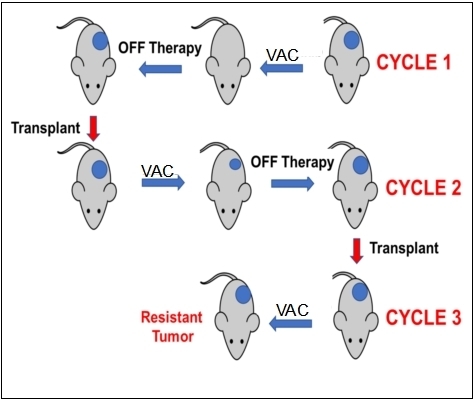
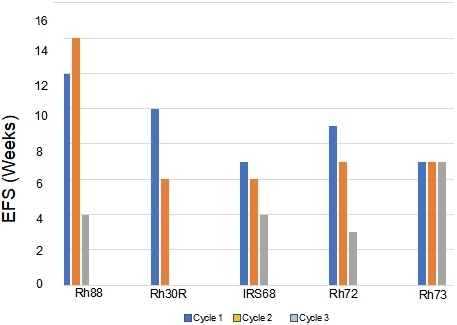
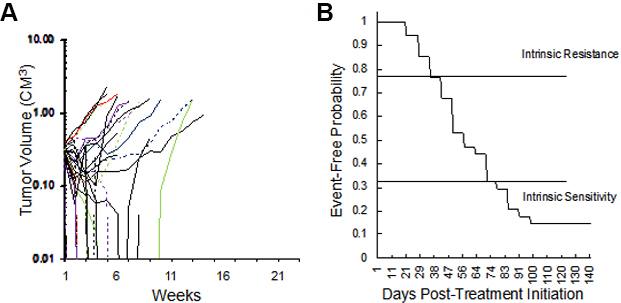
A Single Mouse Testing (SMT) protocol was used to evaluate the sensitivity of 34 RMS xenograft models to one cycle of vincristine, actinomycin D, cyclophosphamide (VAC) treatment. Tumor response was determined by caliper measurement, and tumor regression and event-free survival (EFS) were used as endpoints for evaluation. Treated tumors at regrowth were transplanted into recipient mice, and the treatment was repeated until tumors progressed during the treatment period (i.e., became resistant). At transplant, tumor tissue was stored for biochemical and omics analysis.
The sensitivity to VAC of 34 RMS models was determined. EFS varied from 3 weeks to > 20 weeks. Tumor models were classified as having intrinsic resistance, intermediate sensitivity, or high sensitivity to VAC therapy. Resistance to VAC was developed in multiple models after 2-5 cycles of therapy; however, there were examples where sensitivity remained unchanged after 3 cycles of treatment.
The SMT approach allows for assessment of drug sensitivity and development of drug resistance in a large number of RMS models. As such, it provides a platform for assessing drug resistance mechanisms at a "population" level, simulating conditions that lead to clinical resistance. These VAC-resistant models represent "high-risk" tumors that mimic a preclinical phase 2 population and will be valuable for identifying novel agents active against VAC-resistant disease.
尽管采用了积极的多药联合方案,但转移性横纹肌肉瘤(RMS)患者的预后仍然很差。在最近一项针对高危患者的试验(ARST0431)中,25%的患者在第一年接受治疗期间病情恶化,80%的患者在24个月内出现肿瘤进展。然而,肿瘤耐药的机制基本上仍不清楚。在此,我们探索利用临床前模型来诱导对ARST0431中使用的复杂化疗方案产生耐药性。
采用单只小鼠测试(SMT)方案评估34个RMS异种移植模型对长春新碱、放线菌素D、环磷酰胺(VAC)一个周期治疗的敏感性。通过卡尺测量确定肿瘤反应,并将肿瘤消退和无事件生存期(EFS)作为评估终点。将治疗后复发的肿瘤移植到受体小鼠体内,并重复治疗,直到肿瘤在治疗期间进展(即产生耐药性)。在移植时,保存肿瘤组织用于生化和组学分析。
确定了34个RMS模型对VAC的敏感性。EFS从3周变化到超过20周。肿瘤模型被分类为对VAC治疗具有固有耐药性、中度敏感性或高度敏感性。多个模型在2 - 5个周期的治疗后对VAC产生了耐药性;然而,也有一些例子显示,在3个周期的治疗后敏感性仍未改变。
SMT方法能够在大量RMS模型中评估药物敏感性并诱导耐药性。因此,它提供了一个在“群体”水平评估耐药机制的平台,模拟导致临床耐药的条件。这些对VAC耐药的模型代表了“高危”肿瘤,模拟了临床前2期人群,对于识别对VAC耐药疾病有效的新型药物将具有重要价值。