Hamid Agus Rizal Ardy Hariandy, Rustandi Reginald, Matondang Sahat, Saraswati Meilania, Sari Lenny, Panigoro Sonar Soni
Department of Urology, Faculty of Medicine, Universitas Indonesia, Jakarta, Indonesia.
Department of Urology, Faculty of Medicine, Universitas Indonesia, Jakarta, Indonesia.
Int J Surg Case Rep. 2022 May;94:107020. doi: 10.1016/j.ijscr.2022.107020. Epub 2022 Apr 5.
Renal cell carcinoma (RCC) skin metastasis is a rare disease. However, there are no data on the effect of a Tyrosine Kinase Inhibitor (TKI) on its treatment.
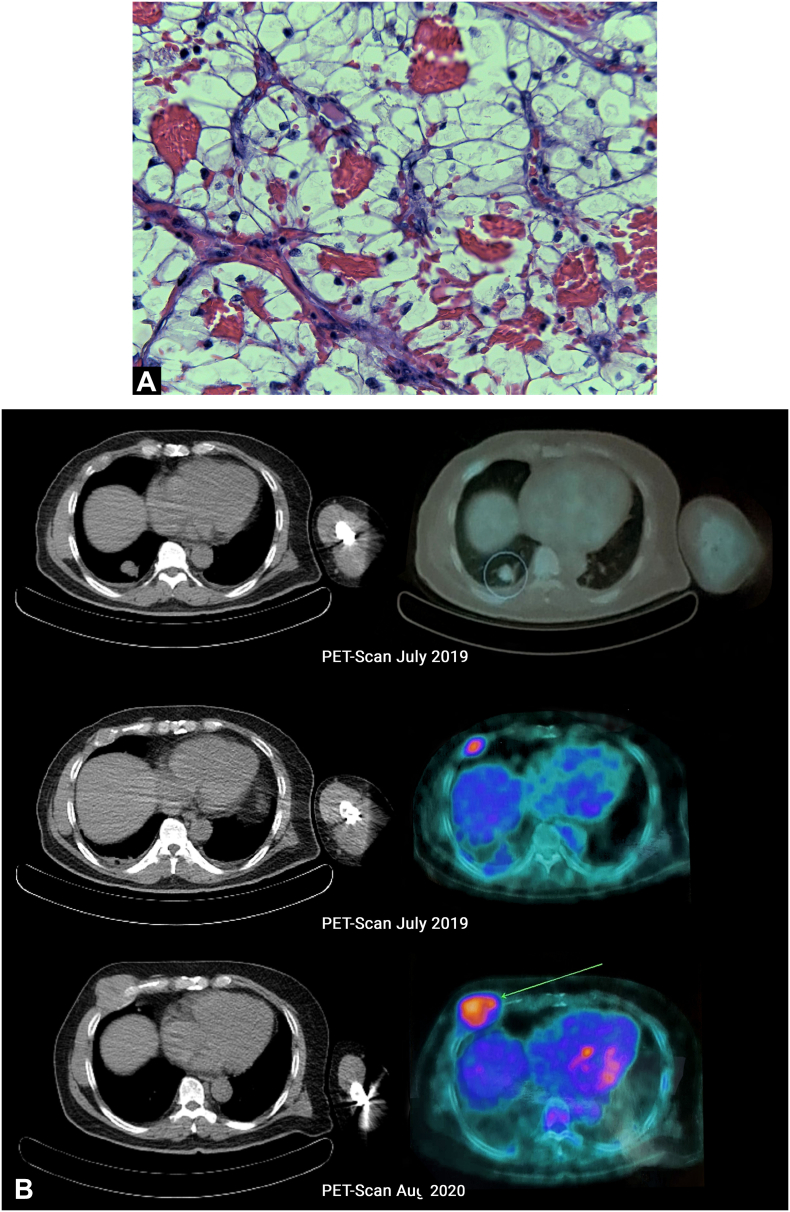
A 54-year-old male patient with renal cell carcinoma developed subcutaneous metastasis three months after radical nephrectomy and there was no discoloration or pain. Furthermore, an excision biopsy confirmed the metastatic lesion, and pazopanib was initiated as a treatment method. After 1-month of treatment, the patient developed ulceration and subsided after treatment was stopped. Similarly, a follow-up PET scan was performed almost a year after stopping the treatment, which showed improvement over metastatic pulmonary lesions.
Renal cell carcinoma (RCC) major metastases were observed in pulmonary, costal, and skin. Tumor burden and location of metastasis influences progression free-survival of RCC patients treated with TKI.
In this case, TKI treatment showed a long-term partial response, despite its lack of continuous therapy.
肾细胞癌(RCC)皮肤转移是一种罕见疾病。然而,关于酪氨酸激酶抑制剂(TKI)对其治疗效果的数据尚无。
一名54岁男性肾细胞癌患者在根治性肾切除术后三个月出现皮下转移,无变色或疼痛。此外,切除活检证实为转移病灶,并开始使用帕唑帕尼作为治疗方法。治疗1个月后,患者出现溃疡,停药后溃疡消退。同样,在停药近一年后进行了一次随访PET扫描,结果显示转移性肺部病变有所改善。
肾细胞癌(RCC)主要转移部位见于肺、肋骨和皮肤。肿瘤负荷和转移部位影响接受TKI治疗的RCC患者的无进展生存期。
在本病例中,尽管缺乏持续治疗,TKI治疗仍显示出长期部分缓解。