Barbieri Elisa, Liberati Cecilia, Cantarutti Anna, Di Chiara Costanza, Lupattelli Angela, Sharland Michael, Giaquinto Carlo, Hsia Yingfen, Doná Daniele
Division of Paediatric Infectious Diseases, Department for Women's and Children's Health, University of Padua, 35100 Padua, Italy.
Unit of Biostatistics, Epidemiology and Public Health, Department of Statistics and Quantitative Methods, University of Milano-Bicocca, 20126 Milan, Italy.
Antibiotics (Basel). 2022 Mar 29;11(4):457. doi: 10.3390/antibiotics11040457.
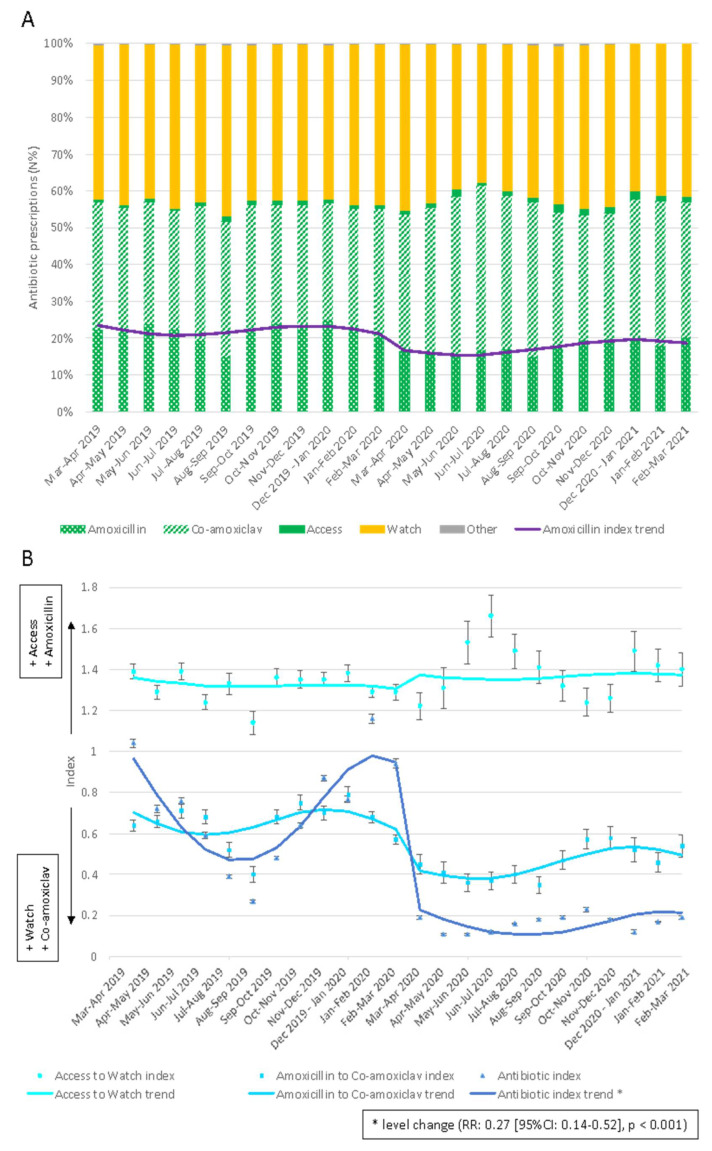
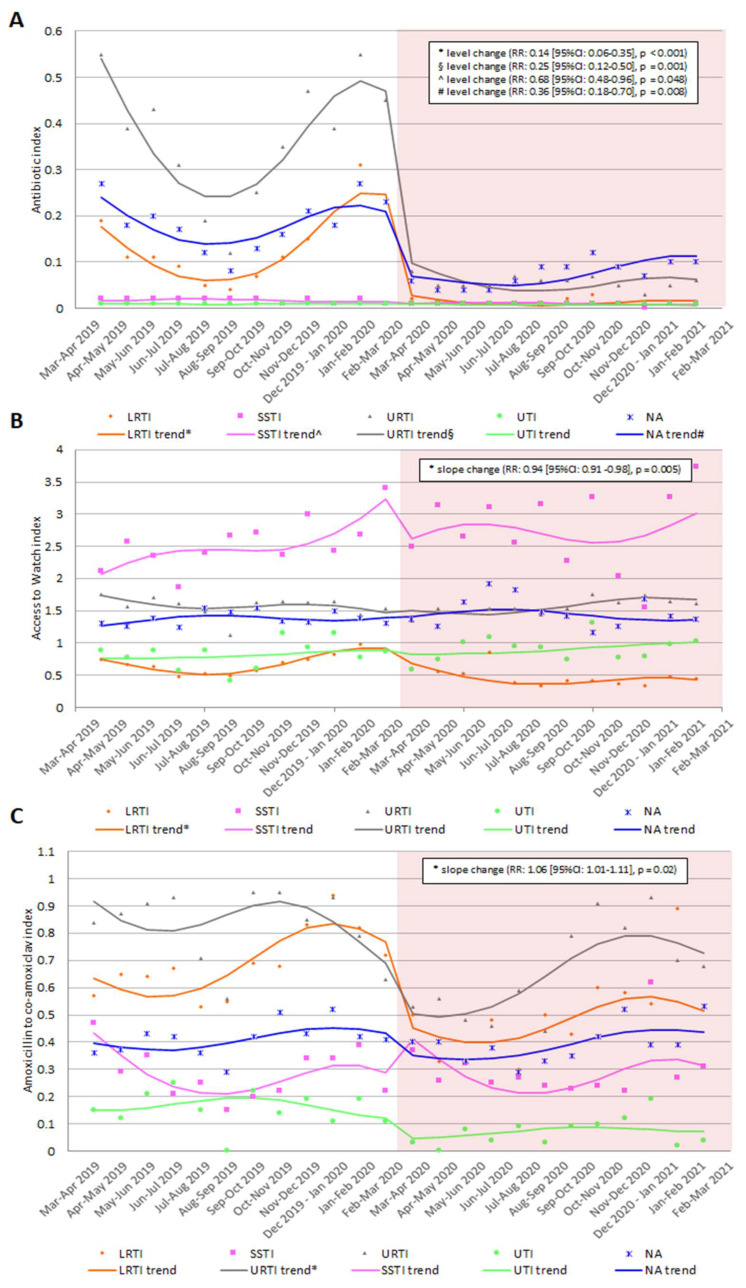
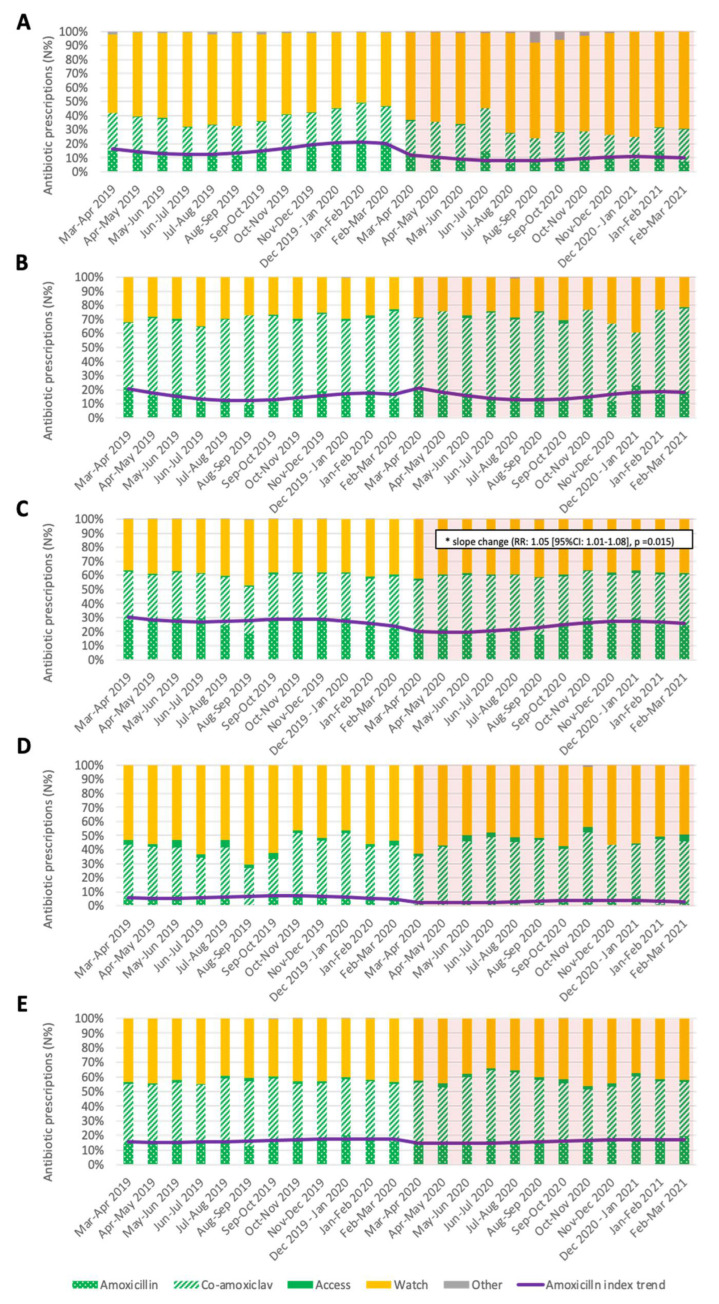
The containment measures following COVID-19 pandemic drastically reduced airway infections, but they also limited the access of patients to healthcare services. We aimed to assess the antibiotic prescription patterns in the Italian paediatric primary care setting before and after the containment measures implementation. For this retrospective analysis, we used a population database, Pedianet, collecting data of patients aged 0-14 years enrolled with family paediatricians (FP) from March 2019 to March 2021. Antibiotic prescriptions were classified according to WHO AWaRe classification. An interrupted time series evaluating the impact of the containment measures implementation on the monthly antibiotic index, on the access to watch index, and on the amoxicillin to co-amoxiclav index stratified by diagnosis was performed. Overall, 121,304 antibiotic prescriptions were retrieved from 134 FP, for a total of 162,260 children. From March 2020, the antibiotic index dropped by more than 80% for respiratory infections. The Access to Watch trend did not change after the containment measures, reflecting the propensity to prescribe more broad-spectrum antibiotics for respiratory infections even during the pandemic. Similarly, co-amoxiclav was prescribed more often than amoxicillin alone for all the diagnoses, with a significant variation in the trend slope for upper respiratory tract infections prescriptions.
新冠疫情后的防控措施大幅减少了呼吸道感染,但也限制了患者获得医疗服务的机会。我们旨在评估意大利儿科初级保健机构在实施防控措施前后的抗生素处方模式。对于这项回顾性分析,我们使用了一个人口数据库Pedianet,该数据库收集了2019年3月至2021年3月期间在家庭儿科医生(FP)处登记的0至14岁患者的数据。抗生素处方根据世界卫生组织的AWaRe分类进行分类。进行了一项中断时间序列分析,以评估实施防控措施对每月抗生素指数、观察类抗生素使用指数以及按诊断分层的阿莫西林与阿莫西林克拉维酸指数的影响。总体而言,从134名家庭儿科医生处检索到121,304份抗生素处方,涉及总共162,260名儿童。从2020年3月起,呼吸道感染的抗生素指数下降了80%以上。实施防控措施后,观察类抗生素使用趋势没有变化,这反映出即使在疫情期间,对于呼吸道感染也倾向于开具更多广谱抗生素。同样,对于所有诊断,阿莫西林克拉维酸的处方频率都高于单独使用阿莫西林,在上呼吸道感染处方的趋势斜率上有显著差异。