Zhong Xiaomin, Pate Alexander, Yang Ya-Ting, Fahmi Ali, Ashcroft Darren M, Goldacre Ben, MacKenna Brian, Mehrkar Amir, Bacon Sebastian Cj, Massey Jon, Fisher Louis, Inglesby Peter, Hand Kieran, van Staa Tjeerd, Palin Victoria
Centre for Health Informatics, School of Health Sciences, Faculty of Biology, Medicine, and Health, the University of Manchester, M13 9PL, UK.
Centre for Pharmacoepidemiology and Drug Safety, School of Health Sciences, Faculty of Biology, Medicine and Health, University of Manchester, Oxford Road, Manchester, M13 9PL, UK.
Lancet Reg Health Eur. 2023 May 16;30:100653. doi: 10.1016/j.lanepe.2023.100653.
The COVID-19 pandemic impacted the healthcare systems, adding extra pressure to reduce antimicrobial resistance. Therefore, we aimed to evaluate changes in antibiotic prescription patterns after COVID-19 started.
With the approval of NHS England, we used the OpenSAFELY platform to access the TPP SystmOne electronic health record (EHR) system in primary care and selected patients prescribed antibiotics from 2019 to 2021. To evaluate the impact of COVID-19 on broad-spectrum antibiotic prescribing, we evaluated prescribing rates and its predictors and used interrupted time series analysis by fitting binomial logistic regression models.
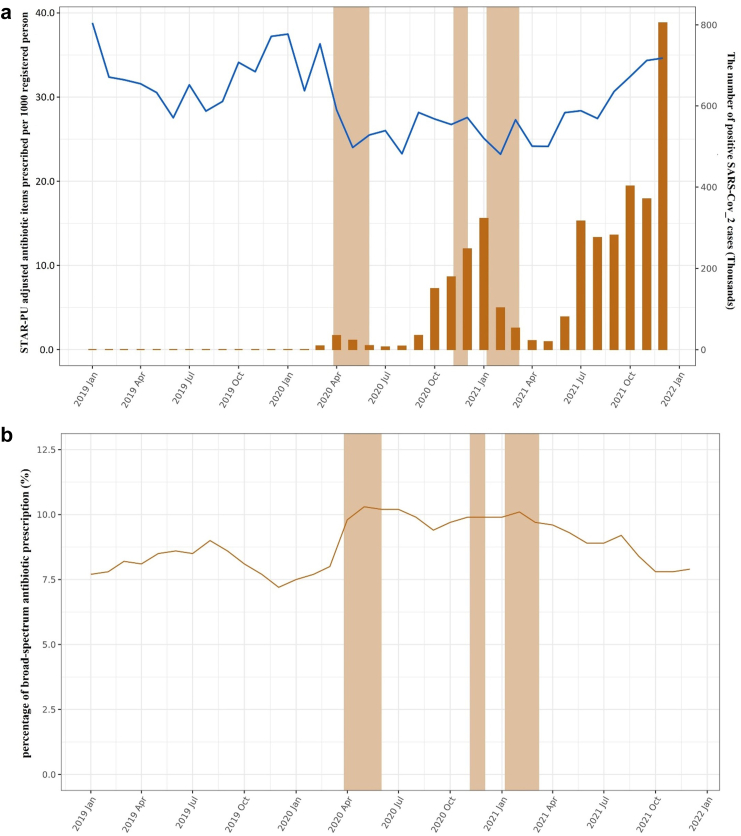
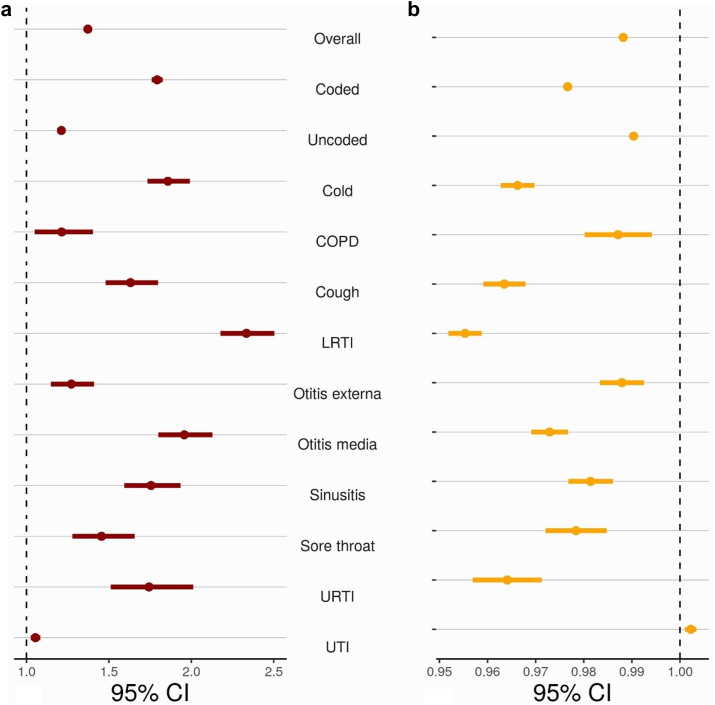
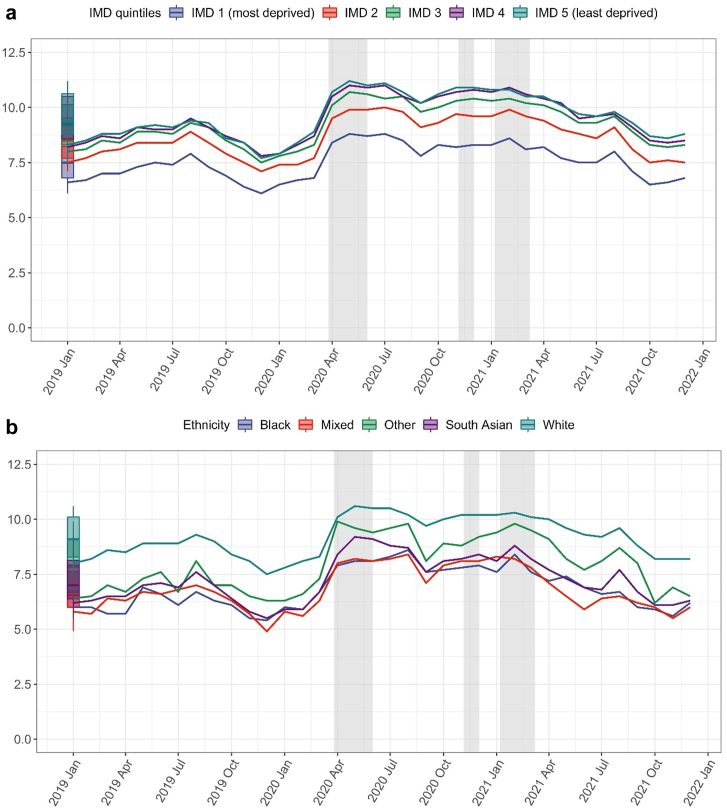
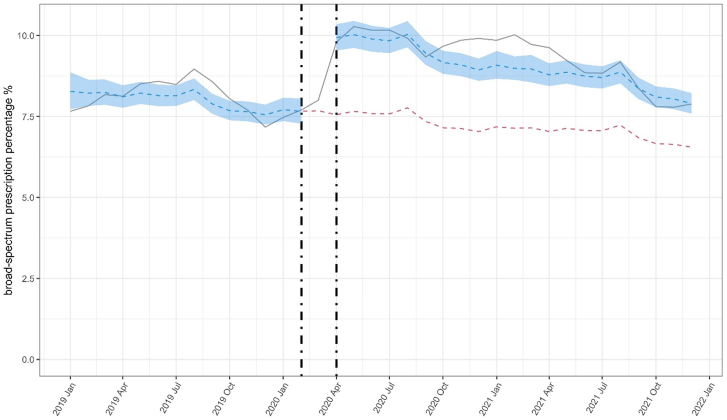
Over 32 million antibiotic prescriptions were extracted over the study period; 8.7% were broad-spectrum. The study showed increases in broad-spectrum antibiotic prescribing (odds ratio [OR] 1.37; 95% confidence interval [CI] 1.36-1.38) as an immediate impact of the pandemic, followed by a gradual recovery with a 1.1-1.2% decrease in odds of broad-spectrum prescription per month. The same pattern was found within subgroups defined by age, sex, region, ethnicity, and socioeconomic deprivation quintiles. More deprived patients were more likely to receive broad-spectrum antibiotics, which differences remained stable over time. The most significant increase in broad-spectrum prescribing was observed for lower respiratory tract infection (OR 2.33; 95% CI 2.1-2.50) and otitis media (OR 1.96; 95% CI 1.80-2.13).
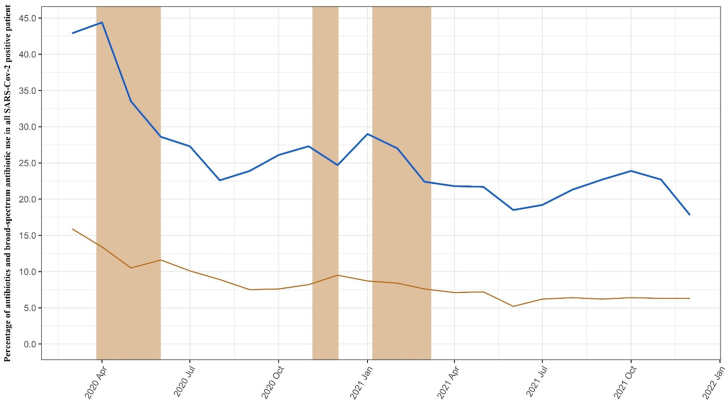
An immediate reduction in antibiotic prescribing and an increase in the proportion of broad-spectrum antibiotic prescribing in primary care was observed. The trends recovered to pre-pandemic levels, but the consequence of the COVID-19 pandemic on AMR needs further investigation.
This work was supported by Health Data Research UK and by National Institute for Health Research.
新冠疫情对医疗系统产生了影响,给减少抗生素耐药性带来了额外压力。因此,我们旨在评估新冠疫情开始后抗生素处方模式的变化。
在英国国家医疗服务体系(NHS)英格兰地区的批准下,我们使用OpenSAFELY平台访问基层医疗中的TPP SystmOne电子健康记录(EHR)系统,并选取了2019年至2021年期间开具抗生素处方的患者。为了评估新冠疫情对广谱抗生素处方的影响,我们评估了处方率及其预测因素,并通过拟合二项逻辑回归模型进行中断时间序列分析。
在研究期间共提取了超过3200万份抗生素处方;其中8.7%为广谱抗生素。研究表明,作为疫情的直接影响,广谱抗生素处方量有所增加(优势比[OR]为1.37;95%置信区间[CI]为1.36 - 1.38),随后逐渐恢复,每月广谱处方的优势比下降1.1 - 1.2%。在按年龄、性别、地区、种族和社会经济剥夺五分位数定义的亚组中也发现了相同的模式。社会经济地位较低的患者更有可能接受广谱抗生素治疗,且这种差异随时间保持稳定。下呼吸道感染(OR为2.33;95% CI为2.1 - 2.50)和中耳炎(OR为1.96;95% CI为1.80 - 2.13)的广谱处方增加最为显著。
观察到基层医疗中抗生素处方量立即减少,广谱抗生素处方比例增加。这些趋势恢复到了疫情前的水平,但新冠疫情对抗生素耐药性的影响仍需进一步研究。
这项工作得到了英国健康数据研究中心和英国国家卫生研究院的支持。