Lee Hyoung Yool, Back Kyoungwhan
Department of Biotechnology, College of Agriculture and Life Sciences, Chonnam National University, Gwangju 61186, Korea.
Antioxidants (Basel). 2022 Apr 8;11(4):737. doi: 10.3390/antiox11040737.
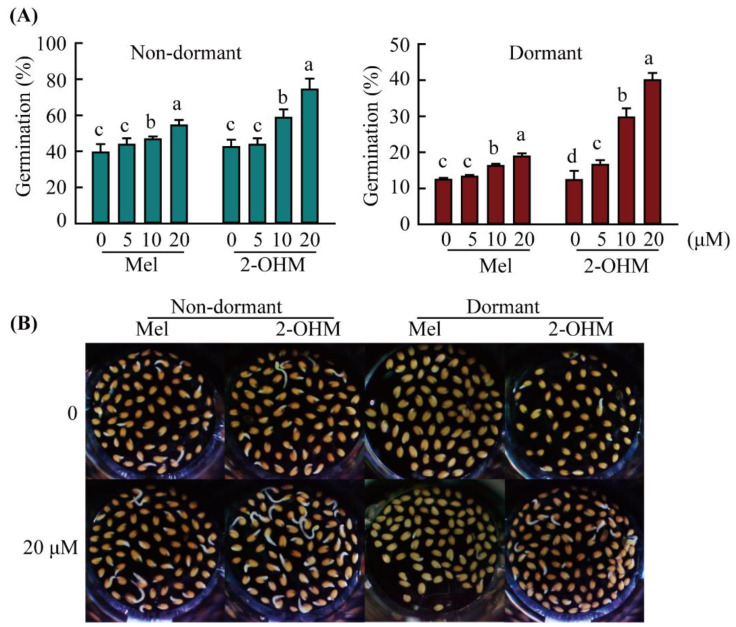
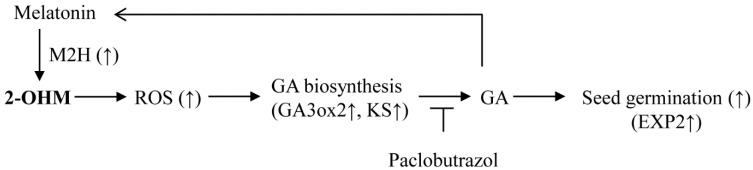
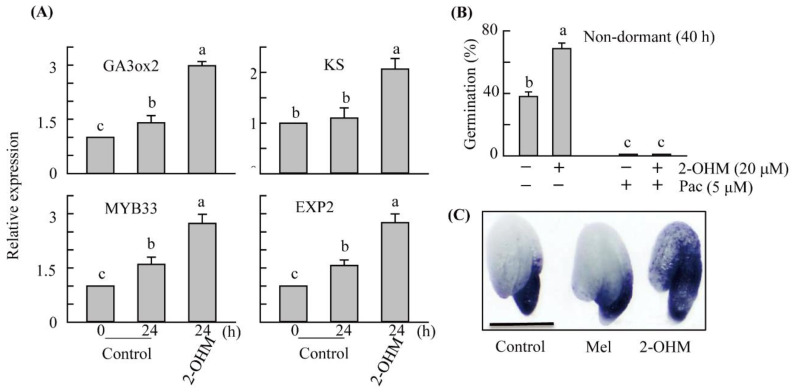
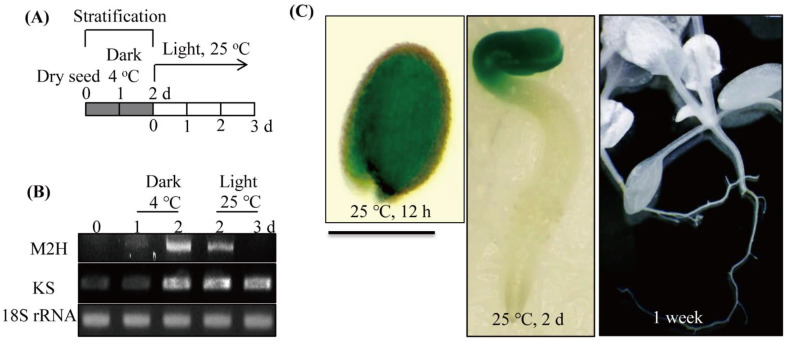
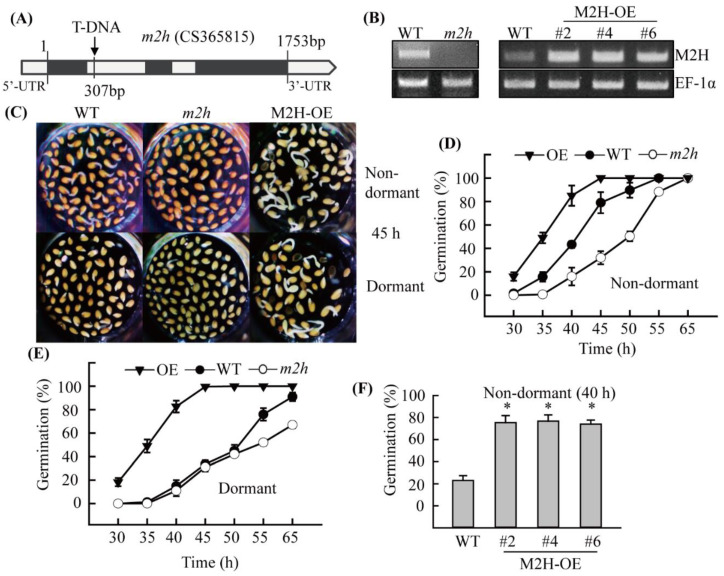
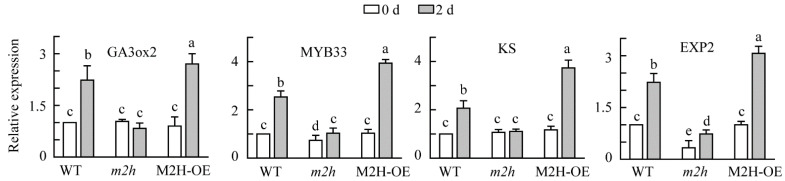
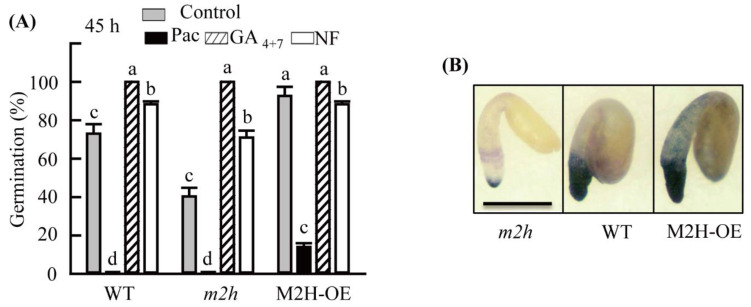
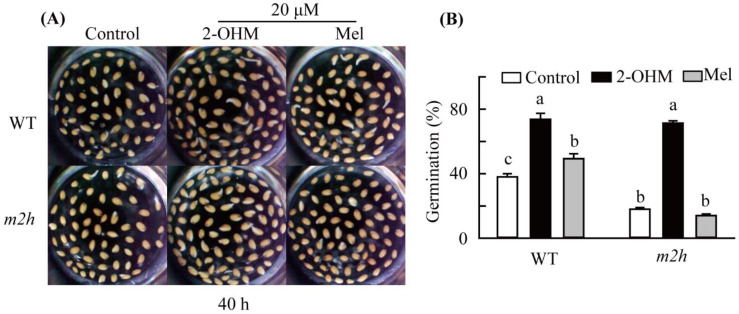
It was recently reported that 2-hydroxymelatonin (2-OHM) is responsible for inducing reactive oxygen species (ROS) in plants. ROS are crucial molecules that promote germination through interaction with hormones such as gibberellic acid (GA). In this study, to confirm the pro-oxidant role of 2-OHM, we investigated its effect on seed germination in (L.) Heynh. Columbia-0. We found that 2-OHM treatment stimulated seed germination by 90% and 330% in non-dormant and dormant seeds, respectively, whereas melatonin marginally increased germination (~13%) in both seed types compared to untreated control seeds. The germination promotion effects of exogenous 2-OHM treatment were due to increased ROS production followed by the induction of GA synthesis and expression of responsive genes. Accordingly, melatonin 2-hydroxylase (), the gene responsible for 2-OHM synthesis, was strictly expressed only during the germination process. Further molecular genetic analyses using knockout mutant and overexpression clearly supported an increase in ROS triggered by 2-OHM, followed by increased expression of GA-related genes, which shortened the time to germination. Notably, 2-OHM application to knockout mutant seeds fully recovered germination to levels comparable to that of the wild type, whereas melatonin treatment failed to increase germination. Together, these results indicate that 2-OHM is a pivotal molecule that triggers increased ROS production during seed germination, thereby enhancing germination via the GA pathway in .
最近有报道称,2-羟基褪黑素(2-OHM)在植物中可诱导活性氧(ROS)的产生。ROS是关键分子,通过与赤霉素(GA)等激素相互作用促进种子萌发。在本研究中,为证实2-OHM的促氧化作用,我们研究了其对哥伦比亚生态型拟南芥(Arabidopsis thaliana (L.) Heynh. Columbia-0)种子萌发的影响。我们发现,2-OHM处理分别使非休眠种子和休眠种子的萌发率提高了90%和330%,而与未处理的对照种子相比,褪黑素仅使两种种子类型的萌发率略有增加(约13%)。外源2-OHM处理促进种子萌发的作用是由于ROS产生增加,随后诱导了GA合成和响应基因的表达。因此,负责2-OHM合成的基因褪黑素2-羟化酶(CYP76B1)仅在萌发过程中严格表达。使用CYP76B1敲除突变体和过表达进行的进一步分子遗传学分析清楚地支持了2-OHM引发的ROS增加,随后GA相关基因的表达增加,从而缩短了萌发时间。值得注意的是,将2-OHM应用于CYP76B1敲除突变体种子可使萌发完全恢复到与野生型相当的水平,而褪黑素处理未能提高萌发率。总之,这些结果表明,2-OHM是一种关键分子,在种子萌发过程中触发ROS产生增加,从而通过GA途径增强拟南芥的种子萌发。