Goebel Heike, Koeditz Barbara, Huerta Manuel, Kameri Ersen, Nestler Tim, Kamphausen Thomas, Friemann Johannes, Hamdorf Matthias, Ohrmann Timo, Koehler Philipp, Cornely Oliver A, Montesinos-Rongen Manuel, Nicol David, Schorle Hubert, Boor Peter, Quaas Alexander, Pallasch Christian, Heidenreich Axel, von Brandenstein Melanie
Institute of Pathology, Faculty of Medicine and University Hospital Cologne, University of Cologne, Kerpener Str. 62, 50937 Cologne, Germany.
Clinic and Polyclinic for Urology, Faculty of Medicine and University Hospital Cologne, University of Cologne, Kerpener Str. 62, 50937 Cologne, Germany.
Biomedicines. 2022 Apr 6;10(4):858. doi: 10.3390/biomedicines10040858.
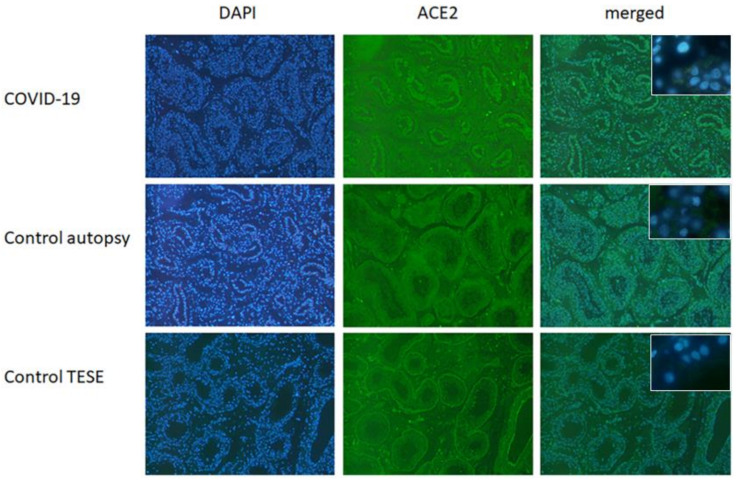
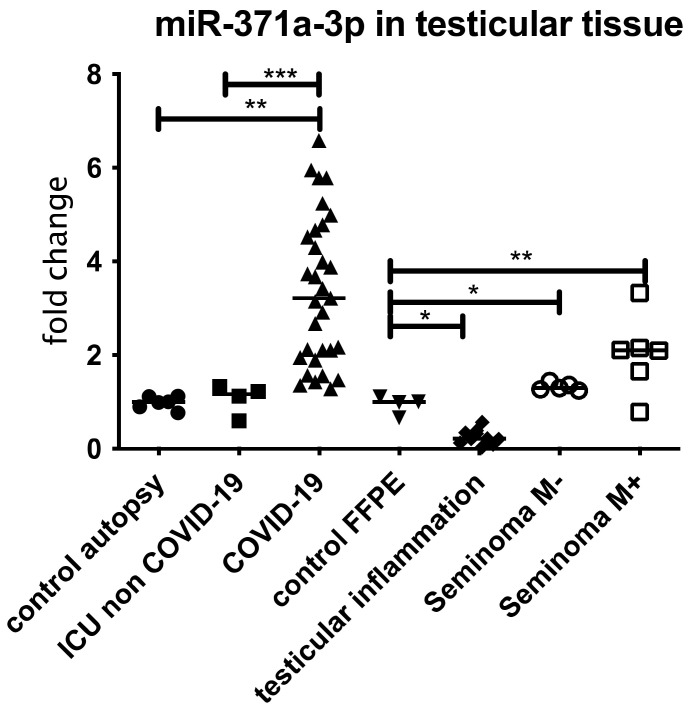
In December 2019, the first case of COVID-19 was reported and since then several groups have already published that the virus can be present in the testis. To study the influence of SARS-CoV-2 which cause a dysregulation of the androgen receptor (AR) level, thereby leading to fertility problems and inducing germ cell testicular changes in patients after the infection. Formalin-Fixed-Paraffin-Embedded (FFPE) testicular samples from patients who died with or as a result of COVID-19 ( = 32) with controls ( = 6), inflammatory changes ( = 9), seminoma with/without metastasis ( = 11) compared with healthy biopsy samples ( = 3) were analyzed and compared via qRT-PCR for the expression of miR-371a-3p. An immunohistochemical analysis (IHC) and ELISA were performed in order to highlight the miR-371a-3p targeting the AR. Serum samples of patients with mild or severe COVID-19 symptoms ( = 34) were analyzed for miR-371a-3p expression. In 70% of the analyzed postmortem testicular tissue samples, a significant upregulation of the miR-371a-3p was detected, and 75% of the samples showed a reduced spermatogenesis. In serum samples, the upregulation of the miR-371a-3p was also detectable. The upregulation of the miR-371a-3p is responsible for the downregulation of the AR in SARS-CoV-2-positive patients, resulting in decreased spermatogenesis. Since the dysregulation of the AR is associated with infertility, further studies have to confirm if the identified dysregulation is regressive after a declining infection.
2019年12月,首例新冠肺炎病例被报告,自那时起已有多个研究团队发表报告称该病毒可存在于睾丸中。为研究导致雄激素受体(AR)水平失调的严重急性呼吸综合征冠状病毒2(SARS-CoV-2)的影响,从而导致感染后患者出现生育问题并引发睾丸生殖细胞变化。对因新冠肺炎死亡或死于新冠肺炎的患者(n = 32)、对照组(n = 6)、炎症性改变患者(n = 9)、有/无转移的精原细胞瘤患者(n = 11)的福尔马林固定石蜡包埋(FFPE)睾丸样本与健康活检样本(n = 3)进行分析,并通过定量逆转录聚合酶链反应(qRT-PCR)比较miR-371a-3p的表达。进行免疫组织化学分析(IHC)和酶联免疫吸附测定(ELISA)以突出miR-371a-3p对AR的靶向作用。对有轻度或重度新冠肺炎症状的患者(n = 34)的血清样本进行miR-371a-3p表达分析。在70%的分析尸检睾丸组织样本中,检测到miR-371a-3p显著上调,75%的样本显示精子发生减少。在血清样本中,也可检测到miR-371a-3p上调。miR-371a-3p上调导致SARS-CoV-2阳性患者的AR下调,从而导致精子发生减少。由于AR失调与不孕有关,进一步研究必须确认所确定的失调在感染消退后是否会恢复。