U-Krit Warittha, Wadsungnoen Surasak, Yama Punnawut, Jitjumnong Jakree, Sangkate Molarat, Promsao Nalinthip, Montha Napatsorn, Sudwan Paiwan, Mektrirat Raktham, Panatuk Julakorn, Inyawilert Wilasinee, Intawicha Payungsuk, Tang Pin-Chi, Moonmanee Tossapol
Department of Animal and Aquatic Sciences, Faculty of Agriculture, Chiang Mai University, Chiang Mai 50200, Thailand.
Chiang Mai College of Agriculture and Technology, Sanpatong 50120, Thailand.
Biology (Basel). 2022 Mar 29;11(4):523. doi: 10.3390/biology11040523.
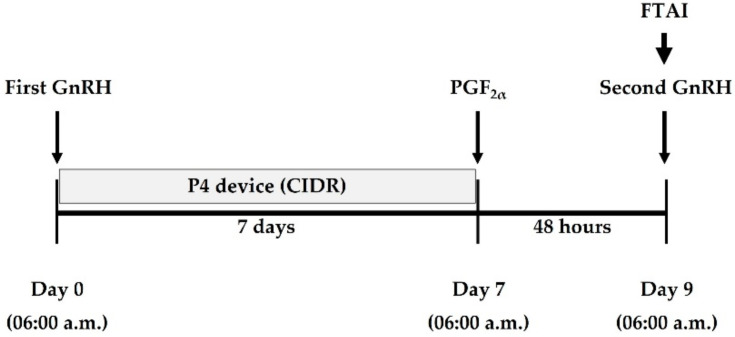
The antral follicle count (AFC) is a test in which the number of oocyte-containing follicles that are developing in both ovaries are visually counted. The count of these follicles strongly relates to the population of the growing follicle reserve on the ovaries. However, the importance of the main number of antral follicle populations (mAFC) in mono-ovulatory animal species has yet to be completely elucidated. Moreover, the investigation of the ovarian interrelationship with unilateral mAFC (main number of antral follicle populations appearing on only one side of the ovary) and bilateral mAFC (main number of antral follicle populations appearing in equivalent numbers on both sides of the ovary) and how understanding this interrelationship can offer possible indicators of ovarian response to hormonal induction have not yet been investigated in mono-ovulatory Bos indicus beef cows. The aim of this study is to investigate the different ovarian interrelationships of mAFC (unilateral and bilateral mAFC) at the time of exogenous hormonal stimulation on the total number of AFC (left and right ovaries) at the beginning of the hormonal protocol for ovarian stimulation and ovarian response at the completion of exogenous hormonal stimulation as well as their usefulness as possible biomarkers of successful hormonal stimulation in Bos indicus beef cattle. Beef cows (n = 104) with low total numbers of AFC (4.7 ± 2.4 follicles) were stimulated with a gonadotropin-releasing hormone-progesterone-prostaglandin F2α-based protocol. At the beginning of the hormonal protocol, ovarian ultrasound scans were performed to evaluate AFC from both ovaries of cows. Beef cows were divided into two groups, unilateral (n = 74) and bilateral mAFC (n = 30), according to the ovarian interrelationship. At the completion of the hormonal stimulation, ovarian ultrasound scans were performed to evaluate the dominant follicle (DF) and cows with DF > 8.5 mm in diameter emerging on their ovaries were defined as having experienced a response to hormonal stimuli. There was a difference of 19.1% between Bos indicus cows bearing unilateral mAFC that produced an increase in ovarian response (odds ratio = 2.717, p < 0.05) compared to the responsive rate of cows displaying bilateral mAFC (82.4% vs. 63.3%). In unilateral mAFC, cows bearing mAFC ipsilateral to the ovary of dominant follicle (DF) had a higher responsive rate than cows bearing mAFC contralateral to the DF ovary (50.0% vs. 32.4%, p < 0.05). In mAFC ipsilateral to the DF ovary, pregnancy rates were greatest in cows bearing mAFC and DF on the right ovary compared with cows bearing mAFC and DF on the left ovary (25.0% vs. 9.1%, p < 0.05). In primiparous and multiparous cows, unilateral mAFC occurs with a greater (p < 0.05) frequency than bilateral mAFC (69.0% and 72.0% vs. 31.0% and 28.0%, respectively). In unilateral mAFC, primiparous cows bearing mAFC ipsilateral to the DF ovary had a greater responsive rate than primiparous cows bearing mAFC contralateral to the DF ovary (55.0% vs. 20.0%, p < 0.05). In mAFC ipsilateral to the DF ovary, responsive and pregnancy rates were greatest (p < 0.05) in multiparous cows bearing mAFC and DF on the right ovary compared with multiparous cows bearing mAFC and DF on the left ovary (58.1% and 22.6% vs. 25.8% and 3.2%, respectively). Furthermore, there was a positive correlation between the mean diameter of AFC at the time of the exogenous hormonal trigger and the mean diameter of DF at the completion of hormonal synchronisation (p < 0.05). Our findings emphasise that the ovarian interrelationship with unilateral mAFC at the time of the hormonal trigger might be a promising biomarker for predicting success in ovarian response to hormonal stimulation of mono-ovulatory Bos indicus beef cows with low AFCs.
窦卵泡计数(AFC)是一项通过视觉计数双侧卵巢中正在发育的含卵母细胞卵泡数量的检测。这些卵泡的数量与卵巢中生长卵泡储备的数量密切相关。然而,单排卵动物物种中主要窦卵泡群体数量(mAFC)的重要性尚未完全阐明。此外,关于单排卵的印度瘤牛母牛中,卵巢与单侧mAFC(仅出现在一侧卵巢上的主要窦卵泡群体数量)和双侧mAFC(两侧卵巢上数量相等的主要窦卵泡群体数量)之间的相互关系,以及了解这种相互关系如何能提供卵巢对激素诱导反应的可能指标,尚未进行研究。本研究的目的是调查在外源性激素刺激时,mAFC(单侧和双侧mAFC)与激素刺激方案开始时AFC(左右卵巢)总数以及外源性激素刺激完成时卵巢反应之间的不同卵巢相互关系,以及它们作为印度瘤牛成功激素刺激可能生物标志物的有用性。对AFC总数较低(4.7±2.4个卵泡)的肉牛母牛(n = 104)采用基于促性腺激素释放激素 - 孕酮 - 前列腺素F2α的方案进行刺激。在激素方案开始时,对母牛的双侧卵巢进行超声扫描以评估AFC。根据卵巢相互关系,将肉牛母牛分为两组,单侧(n = 74)和双侧mAFC(n = 30)。在激素刺激完成时,进行卵巢超声扫描以评估优势卵泡(DF),卵巢上出现直径> 8.5 mm的DF的母牛被定义为对激素刺激有反应。与显示双侧mAFC的母牛的反应率(82.4%对63.3%)相比,具有单侧mAFC且卵巢反应增加的印度瘤牛母牛之间存在19.1%的差异(优势比 = 2.717,p < 0.05)。在单侧mAFC中,优势卵泡(DF)同侧具有mAFC的母牛的反应率高于DF对侧具有mAFC的母牛(50.0%对32.4%,p < 0.05)。在DF同侧的mAFC中,右侧卵巢同时具有mAFC和DF的母牛的妊娠率高于左侧卵巢同时具有mAFC和DF的母牛(25.0%对9.1%,p < 0.05)。在初产和经产母牛中,单侧mAFC出现的频率高于双侧mAFC(分别为69.0%和72.0%对31.0%和28.0%,p < 0.05)。在单侧mAFC中,DF同侧具有mAFC的初产母牛的反应率高于DF对侧具有mAFC的初产母牛(55.0%对20.0%,p < 0.05)。在DF同侧的mAFC中,右侧卵巢同时具有mAFC和DF的经产母牛的反应率和妊娠率高于左侧卵巢同时具有mAFC和DF的经产母牛(分别为58.1%和22.6%对25.8%和3.2%,p < 0.05)。此外,外源性激素触发时AFC的平均直径与激素同步完成时DF的平均直径之间存在正相关(p < 0.05)。我们的研究结果强调,激素触发时卵巢与单侧mAFC的相互关系可能是预测低AFC的单排卵印度瘤牛母牛对激素刺激卵巢反应成功的一个有前景的生物标志物。