Ciciriello Fabiana, Bijvelds Marcel J C, Alghisi Federico, Meijsen Kelly F, Cristiani Luca, Sorio Claudio, Melotti Paola, Fiocchi Alessandro G, Lucidi Vincenzina, De Jonge Hugo R
Cystic Fibrosis Unit, Department of Pediatric Subspecialties, Bambino Gesù Children's Hospital, IRCCS, 00165 Rome, Italy.
Department of Gastroenterology & Hepatology, Erasmus MC University Medical Center, P.O. Box 2040, 3000 CA Rotterdam, The Netherlands.
J Pers Med. 2022 Apr 14;12(4):632. doi: 10.3390/jpm12040632.
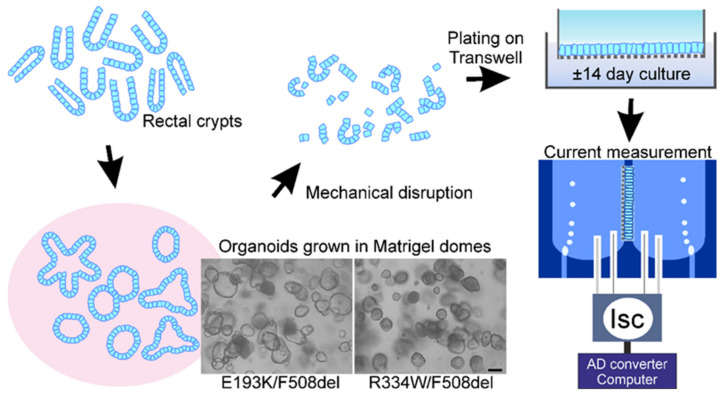
The effect of presently available CFTR modulator combinations, such as elexacaftor (ELX), tezacaftor (TEZ), and ivacaftor (IVA), on rare CFTR alleles is often unknown. Several assays have been developed, such as forskolin-induced swelling (FIS), to evaluate the rescue of such uncommon CFTR alleles both by established and novel modulators in patient-derived primary cell cultures (organoids). Presently, we assessed the CFTR-mediated electrical current across rectal organoid-derived epithelial monolayers. This technique, which allows separate measurement of CFTR-dependent chloride or bicarbonate transport, was used to assess the effect of ELX/TEZ/IVA on two rare CFTR variants.
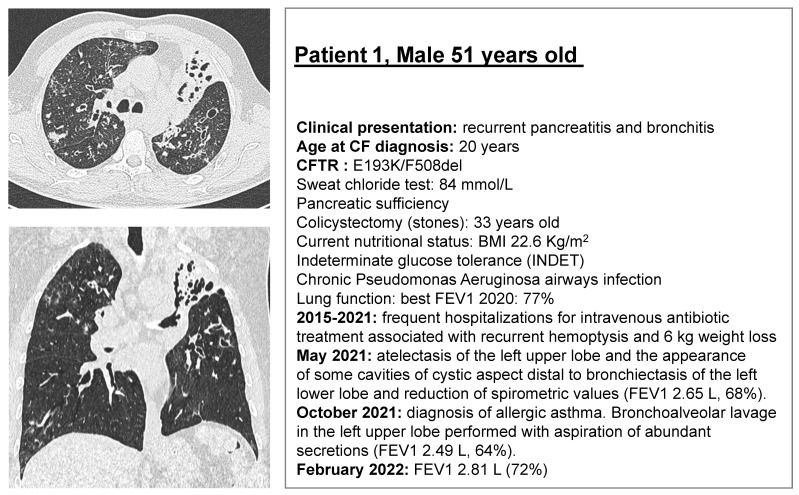
Intestinal organoid cultures were established from rectal biopsies of CF patients carrying the rare missense mutations E193K or R334W paired with F508del. The effect of the CFTR modulator combination ELX/TEZ/IVA on CFTR-mediated Cl and HCO secretion was assessed in organoid-derived intestinal epithelial monolayers. Non-CF organoids were used for comparison. Clinical biomarkers (sweat chloride, FEV1) were monitored in patients receiving modulator therapy.
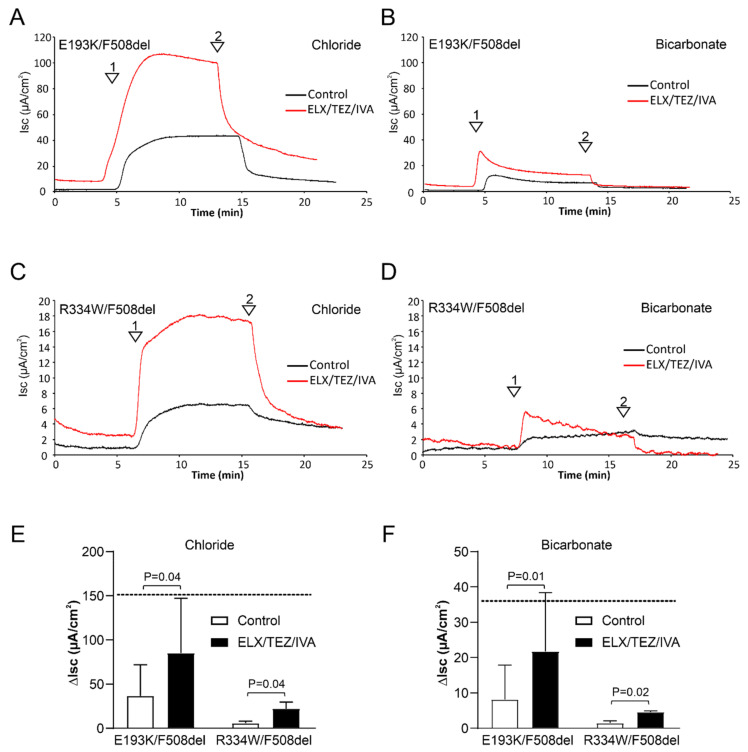
ELX/TEZ/IVA markedly enhanced CFTR-mediated bicarbonate and chloride transport across intestinal epithelium of both patients. Consistent with the rescue of CFTR function in cultured intestinal cells, ELX/TEZ/IVA therapy improved biomarkers of CFTR function in the R334W/F508del patient.
Current measurements in organoid-derived intestinal monolayers can readily be used to monitor CFTR-dependent epithelial Cl and HCO transport. This technique can be explored to assess the functional consequences of rare CFTR mutations and the efficacy of CFTR modulators. We propose that this functional CFTR assay may guide personalized medicine in patients with CF-like clinical manifestations as well as in those carrying rare CFTR mutations.
目前可用的CFTR调节剂组合,如依列卡福托(ELX)、替扎卡福托(TEZ)和依伐卡托(IVA),对罕见CFTR等位基因的影响通常未知。已经开发了几种检测方法,如福司可林诱导肿胀(FIS),以评估已确立的和新型调节剂在患者来源的原代细胞培养物(类器官)中对这类不常见CFTR等位基因的挽救作用。目前,我们评估了跨直肠类器官来源的上皮单层的CFTR介导的电流。该技术允许分别测量CFTR依赖性氯离子或碳酸氢根转运,用于评估ELX/TEZ/IVA对两种罕见CFTR变体的影响。
从携带罕见错义突变E193K或R334W并伴有F508del的CF患者的直肠活检组织中建立肠道类器官培养物。在类器官来源的肠上皮单层中评估CFTR调节剂组合ELX/TEZ/IVA对CFTR介导的Cl和HCO分泌的影响。使用非CF类器官作为对照。在接受调节剂治疗的患者中监测临床生物标志物(汗液氯化物、FEV1)。
ELX/TEZ/IVA显著增强了两名患者肠上皮中CFTR介导的碳酸氢根和氯离子转运。与培养的肠细胞中CFTR功能的挽救一致,ELX/TEZ/IVA治疗改善了R334W/F508del患者中CFTR功能的生物标志物。
目前在类器官来源的肠单层中的测量方法可轻易用于监测CFTR依赖性上皮Cl和HCO转运。该技术可用于评估罕见CFTR突变的功能后果以及CFTR调节剂的疗效。我们建议这种功能性CFTR检测方法可指导具有CF样临床表现的患者以及携带罕见CFTR突变的患者的个性化医疗。