Muñoz-Alcaraz María Nieves, Jiménez-Vílchez Antonio José, Santamaría-Peláez Mirian, Pérula-de Torres Luis A, Olmo-Carmona María Victoria, Muñoz-García María Teresa, Jorge-Gutiérrez Presentación, Serrano-Merino Jesús, Romero-Rodríguez Esperanza, Rodríguez-Elena Lorena, Refusta-Ainaga Raquel, Lahoz-Sánchez María Pilar, Miró-Palacios Belén, Medrano-Cid Mayra, Magallón-Botaya Rosa, Mínguez-Mínguez Luis A, González-Santos Josefa, González-Bernal Jerónimo J
Inter-Level Clinical Management Unit of Physical Medicine and Rehabilitation, Córdoba and Guadalquivir Health District, Reina Sofía University Hospital, Andalusia Health Service, 14011 Cordoba, Spain.
Maimonides Institute for Biomedical Research of Córdoba, Reina Sofía University Hospital, University of Córdoba, 14011 Cordoba, Spain.
J Clin Med. 2022 Apr 16;11(8):2234. doi: 10.3390/jcm11082234.
Lymphedema, secondary to breast cancer (BCRL), is the abnormal accumulation of protein-rich fluid in the interstitium caused by a malfunction of the lymphatic system. It causes swelling, deficiencies in upper limb functions and structures, sensory pain and emotional alterations, which have a chronic course and affect the upper limb's functionality. This study aims to verify the efficacy and efficiency in the upper limb´s functionality of a protocolized experimental approach based on occupational therapy, TAPA (activity-oriented proprioceptive antiedema therapy), in the rehabilitation of BCRL in stages I and II, comparing it with the conservative treatment considered as the standard, complex decongestive therapy (CDT), through a multicenter randomized clinical trial.
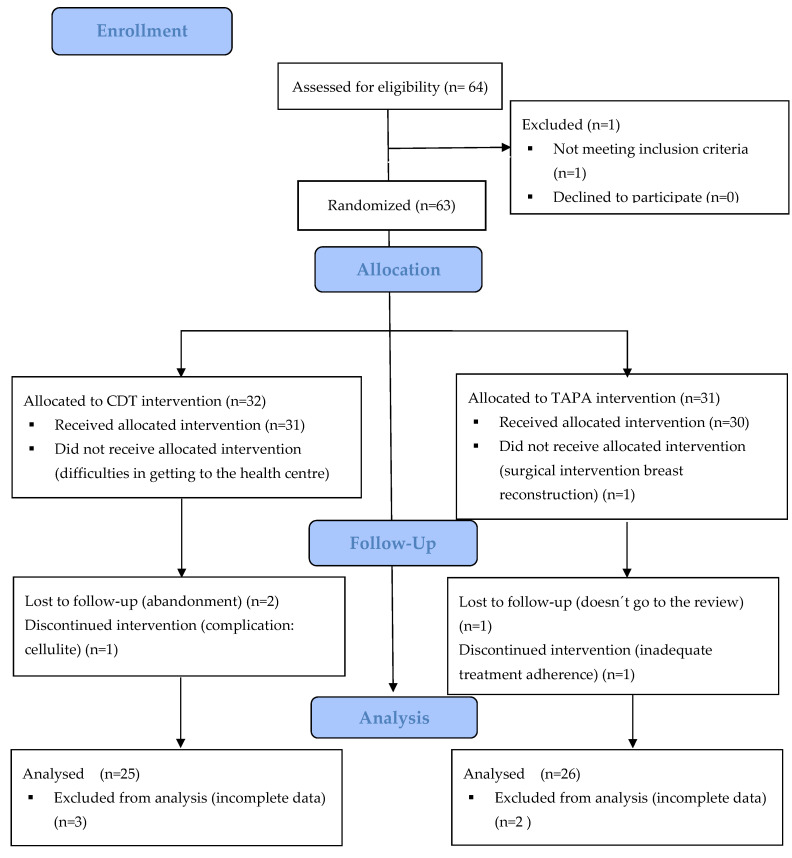
a randomized and prospective clinical trial was conducted with experimental and control groups. Women diagnosed with BCRL belonging to institutions in Córdoba and Aragon (Spain) participated. Sociodemographic variables and those related to the functionality of the affected upper limb were evaluated before and after the intervention.
The results showed statistically significant differences in the analysis of covariance performed for the variable joint balance of the shoulder´s external rotation ( = 0.045) that could be attributed to the intervention performed; however, the effect size was minimal (η ≤ 0.080). In the rest of the variables, no significant differences were found.
TAPA may be an alternative to the conservative treatment of women with BCRL. It was shown to be just as effective for volume reduction and activity performance as CDT but more effective in improving external rotation in shoulder joint balance.
继发于乳腺癌的淋巴水肿(BCRL)是由于淋巴系统功能障碍导致富含蛋白质的液体在间质中异常积聚。它会引起肿胀、上肢功能和结构缺陷、感觉疼痛以及情绪改变,病程呈慢性,影响上肢功能。本研究旨在通过多中心随机临床试验,验证基于职业疗法的程序化实验方法TAPA(以活动为导向的本体感觉抗水肿疗法)在I期和II期BCRL康复中对上肢功能的疗效和效率,并将其与被视为标准的保守治疗——综合消肿疗法(CDT)进行比较。
对实验组和对照组进行了一项随机前瞻性临床试验。来自科尔多瓦和阿拉贡(西班牙)机构的被诊断为BCRL的女性参与了研究。在干预前后评估了社会人口统计学变量以及与受影响上肢功能相关的变量。
在对肩部外旋关节平衡变量进行协方差分析时,结果显示出统计学上的显著差异(P = 0.045),这可归因于所进行的干预;然而,效应量极小(η≤0.080)。在其余变量中,未发现显著差异。
TAPA可能是BCRL女性保守治疗的一种替代方法。结果表明,它在减少肿胀和活动表现方面与CDT同样有效,但在改善肩关节平衡中的外旋方面更有效。