Department of Human Nutrition, Faculty of Health Sciences, Medical University of Warsaw, Erazma Ciołka 27, 01-445 Warsaw, Poland.
Department of General Surgery and Clinical Nutrition, Centre of Postgraduate Medical Education, Czerniakowska 231, 00-416 Warsaw, Poland.
Nutrients. 2022 Apr 14;14(8):1634. doi: 10.3390/nu14081634.
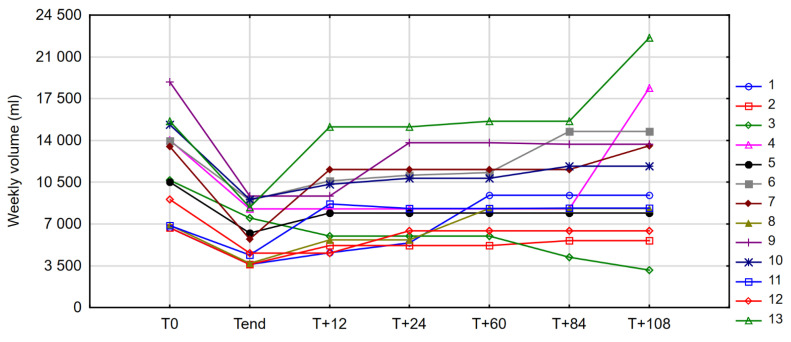
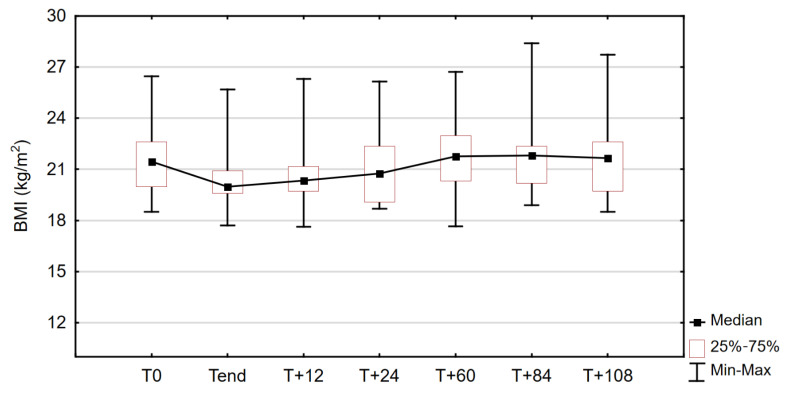
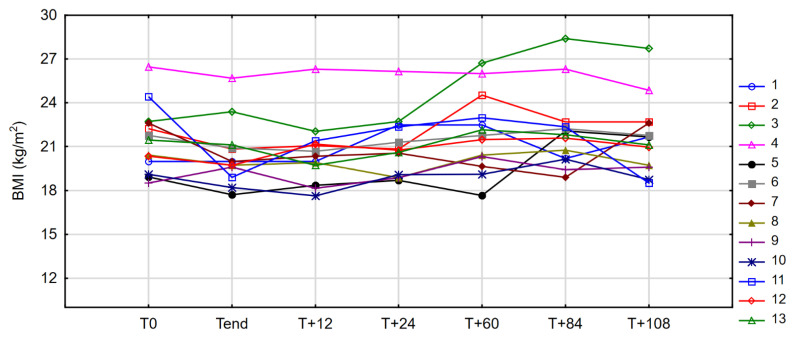
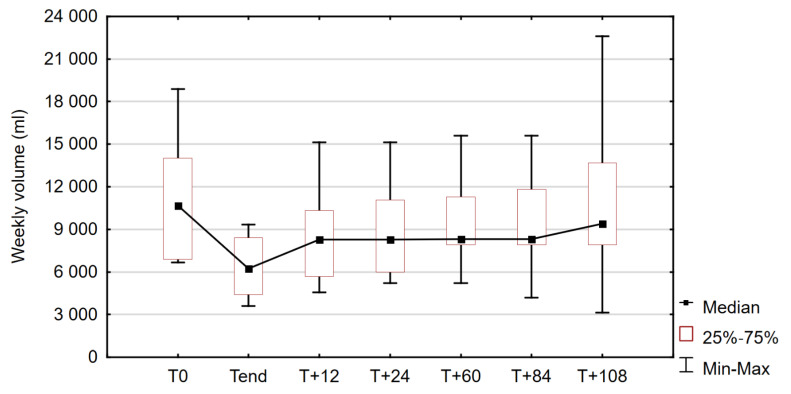
Teduglutide (TED) is widely used in patients with short-bowel-syndrome-associated intestinal failure (SBS-IF) to enhance intestinal adaptation and reduce the need for parenteral support (PS). There are limited data on the effects of discontinuing TED. In this study, we describe the changes in parenteral nutrition (PN) requirements and body mass index (BMI) in a 9-year follow-up of patients receiving home parenteral nutrition after discontinuation of the TED treatment. We performed a retrospective analysis of changes in weekly PN orders and BMI in all patients with PN-dependent SBS from two Polish home parenteral nutrition (HPN) centers who received teduglutide between 2009 and 2013 and still required HPN 9 years after discontinuation of the TED treatment. Data included in the analysis were collected prospectively at mandatory visits to the HPN centers at 12, 24, 60, 84, and 108 months after drug discontinuation and compared with values before and after TED treatment. Weekly PN volume values varied significantly between all of the above time points from baseline to 9 years after TED discontinuation (χ2 = 34.860, p < 0.001). After an initial increase within the first year after treatment discontinuation (not statistically significant), the PN volume requirements remained stable for 4 years and increased 5−9 years after treatment discontinuation. The rate of patients requiring an increase in PN volume was 84.62% at 60 and 84 months and 92.30% at 108 months. At 9 years after cessation of the TED treatment, 53.85% of the study group required a 21.21% increase in PN volume compared with values before treatment. The need for PN volume in patients with PN-dependent SBS who discontinued the TED treatment increased within the first year and 4−5 years after treatment cessation, and in some cases might even exceed pretreatment values after 9 years.
特度鲁肽(TED)广泛用于短肠综合征相关肠衰竭(SBS-IF)患者,以增强肠道适应能力并减少对肠外营养(PN)的需求。关于停止 TED 治疗的影响,数据有限。在这项研究中,我们描述了在 TED 治疗停止后进行为期 9 年的家庭肠外营养(HPN)随访中,接受 PN 治疗的患者 PN 需求和体重指数(BMI)的变化。我们对 2009 年至 2013 年间接受 TED 治疗且 TED 治疗停止 9 年后仍需 HPN 的来自波兰 2 个 HPN 中心的所有依赖 PN 的 SBS 患者的每周 PN 医嘱和 BMI 变化进行了回顾性分析。分析中包含的数据是在 TED 治疗停止后 12、24、60、84 和 108 个月时在 HPN 中心进行强制性访问时前瞻性收集的,并与治疗前后进行了比较。从基线到 TED 治疗停止后 9 年,所有上述时间点的每周 PN 量值均有显著差异(χ2=34.860,p<0.001)。在治疗停止后的第一年初始增加后(无统计学意义),PN 量需求在 4 年内保持稳定,并在治疗停止后 5-9 年内增加。在治疗停止后 60 和 84 个月时,需要增加 PN 量的患者比例分别为 84.62%和 92.30%,在治疗停止后 108 个月时达到 92.30%。在 TED 治疗停止后 9 年,研究组中有 53.85%的患者需要增加 21.21%的 PN 量,与治疗前相比。停止 TED 治疗的依赖 PN 的 SBS 患者的 PN 量需求在治疗停止后的第一年和 4-5 年内增加,在某些情况下,甚至可能在 9 年后超过治疗前的值。