Interdisciplinary Program in Precision Public Health, Graduate School, Korea University, Seoul 02841, Korea.
Department of Population Health, NYU Grossman School of Medicine, New York, NY 10016, USA.
Nutrients. 2022 Apr 14;14(8):1644. doi: 10.3390/nu14081644.
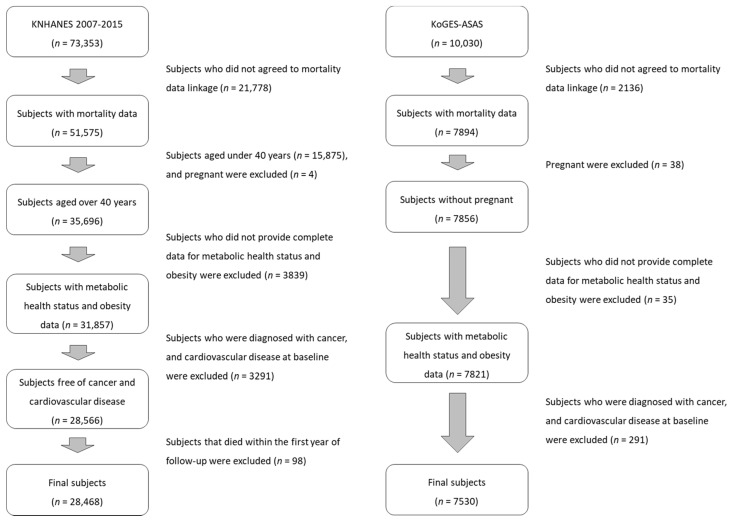
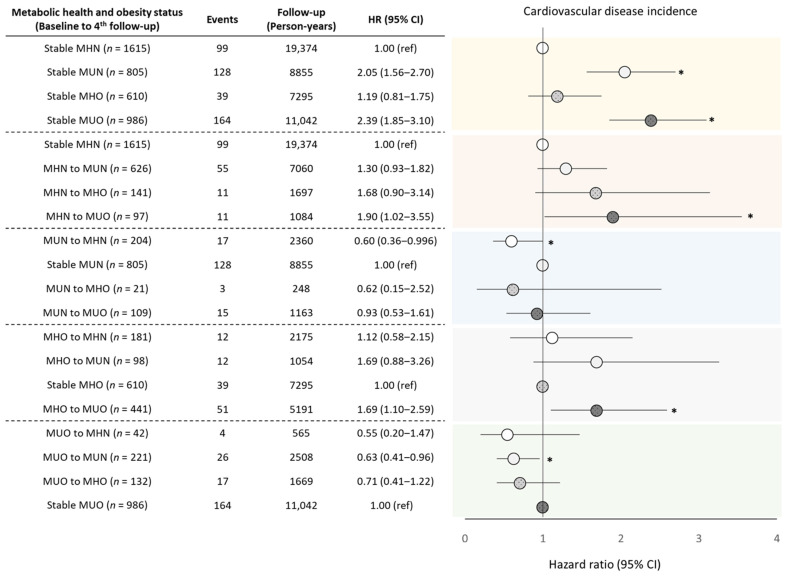
The risk of chronic disease and mortality may differ by metabolic health and obesity status and its transition. We investigated the risk of cardiovascular disease (CVD) and cancer incidence and mortality according to metabolic health and obesity status and their transition using the nationally representative Korea National Health and Nutrition Examination Survey (KNHANES) and the Ansan-Ansung (ASAS) cohort of the Korean Genome and Epidemiology Study. Participants that agreed to mortality linkage (n = 28,468 in KNHANES and n = 7530 adults in ASAS) were analyzed (mean follow-up: 8.2 and 17.4 years, respectively). Adults with no metabolic risk factors and BMI <25 or ≥25 kg/m2 were categorized as metabolically healthy non-obese (MHN) or metabolically healthy obese (MHO), respectively. Metabolically unhealthy non-obese (MUN) and metabolically unhealthy obese (MUO) adults had ≥1 metabolic risk factor and a BMI < or ≥25 kg/m2, respectively. In KNHANES participants, MUN, and MUO had higher risks for cardiovascular mortality, but not cancer mortality, compared with MHN adults. MHO had 47% and 35% lower risks of cancer mortality and all-cause mortality, respectively, compared to MHN. Similar results were observed in the ASAS participants. Compared to those persistently MHN, the risk of CVD was greater when continuously MUN or MUO. Transitioning from a metabolically healthy state to MUO also increased the risk of CVD. Few associations were found for cancer incidence. Using a nationally representative cohort and an 18-year follow-up cohort, we observed that the risk of CVD incidence and mortality and all-cause mortality, but not cancer incidence or mortality, increases with a continuous or a transition to an unhealthy metabolic status in Koreans.
慢性病和死亡率的风险可能因代谢健康和肥胖状况及其转变而异。我们使用具有代表性的全国性韩国国民健康与营养调查(KNHANES)和韩国基因组与流行病学研究的安山-安城(ASAS)队列,调查了根据代谢健康和肥胖状况及其转变,心血管疾病(CVD)和癌症发病率及死亡率的风险。同意进行死亡率关联分析的参与者(KNHANES 中 n = 28468,ASAS 中 n = 7530 名成年人)被纳入分析(平均随访时间分别为 8.2 年和 17.4 年)。无代谢危险因素且 BMI<25 或≥25kg/m2 的成年人分别被归类为代谢健康非肥胖(MHN)或代谢健康肥胖(MHO)。代谢不健康非肥胖(MUN)和代谢不健康肥胖(MUO)成年人则具有≥1 个代谢危险因素和 BMI<或≥25kg/m2。在 KNHANES 参与者中,与 MHN 成年人相比,MUN 和 MUO 患心血管疾病死亡率的风险更高,但癌症死亡率无差异。与 MHN 相比,MHO 癌症死亡率和全因死亡率分别降低了 47%和 35%。ASAS 参与者中也观察到了类似的结果。与持续 MHN 相比,持续 MUN 或 MUO 的 CVD 风险更大。从代谢健康状态向 MUO 转变也会增加 CVD 风险。癌症发病率的相关性较少。使用具有代表性的队列和 18 年的随访队列,我们观察到在韩国人群中,CVD 发病率和死亡率以及全因死亡率的风险随着代谢不健康状态的持续或转变而增加,但癌症发病率或死亡率没有变化。